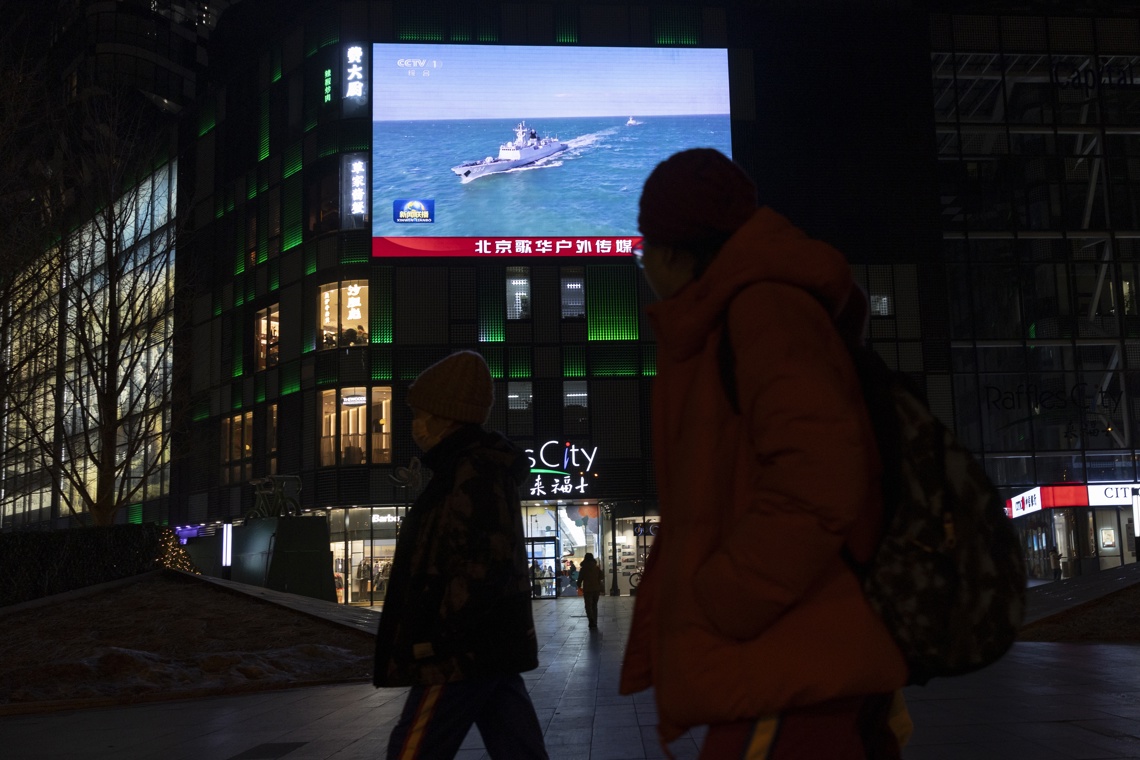
The People’s Liberation Army (PLA) of China is carrying out one of its largest military maneuvers around Taiwan this week, with live fire and massive deployment of troops, ships and combat aircraft.
The exercises, called Mission Justice-2025, were presented as a warning against “external forces” that support the independence of the so-called rebel island and come days after Washington announced an arms package worth more than $11 billion for Taipei.
The Eastern Theater Command reported that the operations include simulated attacks against land and sea targets, blockades of key ports and anti-submarine exercises.
According to Taiwan’s Ministry of Defense, 130 Chinese aircraft and 14 military vessels were detected around the island between Monday and Tuesday, the second highest number recorded in a single day.
Possible conflict scenarios disrupt civil flights
The drills take place in five maritime and air zones, some within Taiwan’s territorial waters. The PLA confirmed that long-range shots were fired in the north of the island and that “the desired effects” were achieved.
The maneuvers seek to test China’s ability to isolate Taiwan in the event of conflict, with coordinated sea and air operations. The plan includes port blockade tests, airspace control and attacks against strategic objectives, in a context of growing tension with the United States and Japan.
The maneuvers had an immediate impact on commercial aviation. The Civil Aviation Administration of Taiwan reported that more than 100,000 passengers were affected by the cancellation of 84 domestic flights and the rescheduling of 857 international flights.
Routes to the Kinmen and Matsu archipelagos were suspended, while international flights had to adopt alternative trajectories to avoid live fire zones.
Taiwanese authorities described the situation as “a serious disruption” and warned that air safety is under pressure due to the magnitude of the exercises.
The Ministry of National Defense described the actions as “irresponsible” and warned that its forces will follow the established rules of engagement. Military spokesman Sun Li-fang denounced that the exercises further raise regional tension and directly affect the civilian population.
“These drills are not only military intimidation, they also put the daily lives of thousands of people at risk,” he said.
Trump downplays the importance of the maneuvers
US President Donald Trump downplayed the importance of the Chinese exercises. In a joint press conference with Israeli Prime Minister Benjamin Netanyahu, he stated this Monday that Beijing “has been carrying out this type of maneuver for 20 or 25 years” and that some have been “of greater magnitude.”
“No, I’m not worried; nothing,” Trump responded when asked about the military deployment. The Republican president assured that he maintains “an excellent relationship” with his Chinese counterpart, Xi Jinping, and said that he does not believe that the Beijing leader will communicate details about the operations to him.
The statements contrast with the recent announcement of arms sales to Taiwan, including HIMARS rocket systems, anti-tank missiles, suicide drones and artillery pieces. The agreement, valued at $11.1 billion, is one of the largest in the history of relations between Washington and Taipei.
Moscow speaks
Meanwhile, China received explicit support from Russia on the Taiwanese issue. Russian Foreign Minister Sergei Lavrov reiterated that Moscow opposes any form of independence for the island and supports the principle of “one China.”
In response, Chinese Foreign Ministry spokesperson Lin Jian praised Russia’s “firm position” and stressed that international consensus supports Beijing’s sovereignty over Taiwan. “The United States’ attempt to use force to support Taiwanese independence will only be counterproductive,” he declared.
For his part, the spokesperson for the Chinese Ministry of Defense, Zhang Xiaogang, warned that foreign forces that support Taiwan’s independence “will bear the consequences” and urged the countries involved to “stop adding fuel to the fire,” recalling that the island’s independence is “incompatible with peace in the Strait.”
China has considered Taiwan an inalienable part of its territory since 1949, when the Kuomintang took refuge on the island after losing the civil war against the Communist Party. Beijing insists that any country wishing to maintain diplomatic relations must accept the “one China” principle.