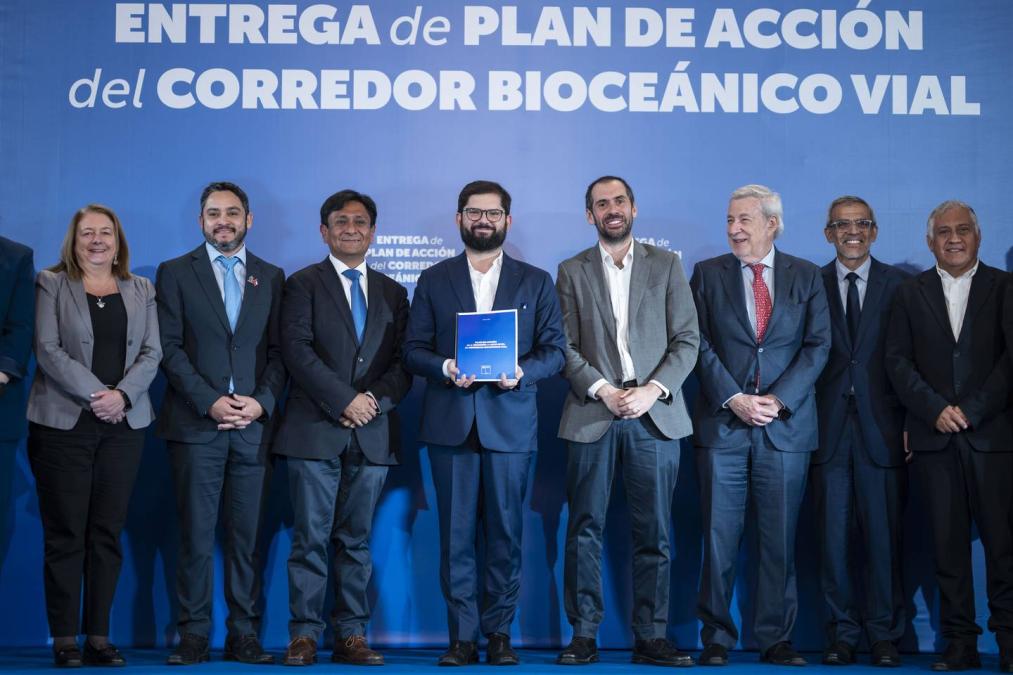
The president of Chile, Gabriel Boric, on Monday presented a complete action plan for the Road Bioceanic Corridor, a strategic initiative that seeks connect the Atlantic Ocean with the Pacific Through a land route, which will strengthen regional integration, border security and economic development of the north of its country.
The layout connects the Ports from southern Brazil with those in northern Chilecrossing Mato Grosso Do Sulthe Paraguayan Chaco, the Argentine provinces of Salta and Jujuyand not Consider Bolivia. The project has been in folder for a decade and is considered one of the Most important infrastructure works in Latin America, with an extension of 2,400 kilometers.
The Ministry of Economy, Development and Tourism of Chile reported in its official digital portal that the road map, contemplates concrete measures to advance in five strategic axes: Security, road infrastructure, port logistics, international integration and business opportunities.
During the presentation, Boric stressed that measures such as the bioceanic corridor allow us to positively and directly influence people.
“When the economy grows or when the economy stops growing, It has an impact on families And what we are doing here is betting on improving the quality of life of Chilean families, giving them greater security, greater economic security, Grant them greater security on our border, greater security in the future. ”
For his part, Foreign Minister Alberto Van Klaveren, stressed that “the bioceanic corridor is an important agenda for our country, so it was addressed in the State visit to Paraguay, And it will also be addressed during the Visit to Brazil on April 21. From a foreign policy perspective, it is a project that reinforces our position in the region and our alliances diversification strategy, precisely in a Complex geopolitical context ”.
The Action Plan includes measures that will begin to be implemented this year and They are projected until 2026, with an active participation of regional governments from Tarapacá and Antofagasta, together with various public institutions.
Why is Bolivia not considered?
The former president and current director of the East Transport Chamber (CTO), Erlan Melgar, He has participated and followed closely all the proposals that exist about bioceanic corridors – including the railway – in South America and considered that the announcement of the Chilean president does not consider Bolivia for being a “tranca country”, a term coined in Brazil, Due to the innumerable problems that Bolivia offers, from structural, to cultural.
Melgar recalled that the main driver of a bioceanic corridor for Bolivia was the former President Hugo Bánzer, at the end of the 90s, When he signed the Bolivia-Brasil-Chile tripartite agreement, which paid off with the construction of the Santa Cruz-Puerto Suárez road, with multilateral financing and a part of Brazil.
However, to consolidate the corridor, From Brazil a series of observations emerged on the national territory, according to Melgar, including the high number of Popular and Rompemuelles markets on the roads and insufficient suppliers for the Diesel provision, On the routes, for international transport.
The ‘automargination’ of Bolivia began when the former president Evo Morales decides to lift the subsidy of fuels to foreign vehicles, being that Bolivia is a signatory of the Terrestrial International Transportation Agreement (Atit), within the framework of the Latin American Integration Association (Aladi), which establishes that the country is obliged to provide fuel -at local price – to any foreigner who goes through their territory, Melgar summarized.
Then a series of Diplomatic impasses With Peru, Brazil and Chile -with the latter in the Court of The Hague for the maritime issue -which were crowned in 2014, when a delegation from Brazil toured, From Puerto Suárez, The probable bioceanic route through Bolivia. Upon their return by Chile and Paraguay, they found abysmal differences, especially in terms of Accelerate and respect agreements.
“There begins the famous baptism that The Brazilians of ‘Country Tranca’ make us, because they also added the famous blockages in Bolivia (…) Following that arrival in Paraguay (from the Brazilian delegation) is that this other corridor is born. They return to Brazil, do the management with their government and then Dilma Rousseff and Horacio Cartes agreements are signedand the works that They will be completed next year, 2026 ”, Melgar said.
The transport leader, however, considered that there is still the possibility that the Bioceanic rail corridor crosses Boliviagiven that the initial route from Brazil, crossing the Amazon, to reach Peruvian ports, has been considered economically economically by Chinese investors interested in the project.
“It’s a matter of activating it. It is said that to make the connection Bulo Bulo with Cochabamba would cost us like 3,000 million dollars (…) We have the second alternative yet, but for that to work political will is needed, A strong government is needed that really defines the destinations in our country, ”the director of the CTO deepened.