The link between Oshún and the Patroness of Cuba has been one of the most notable of the religious tradition of the island.
Santa Clara, Cuba. – At the gates of the Church of the Good Journey in Santa Clara, a newly started in the Santería buys a yellow candle to place before the altar of the Virgen de la Caridad and ask for its favor. As dictated by the rules of the Ocha rule for the Iyawósthe young man dresses completely white and is accompanied by his godmother, which indicates before entering the temple that puts the flowers in the form of a fan, as a symbol of opening and protection.
From a week before September 8, when Cuba commemorates his spiritual patron saint, many Santaclareños visited the diocesan sanctuary of the Virgen de la Caridad to ask, thank or renew promises. It is not only fervent believers of the Catholic faith; Practices of Afro -Cuban religions also come, especially from Santería, who recognize in the charity of Copper the syncretic manifestation of Oshún, for both religions a symbol of comfort and hope.
“Olofin’s blessing is coming to Church, because this is the house of God,” explains the godmother who accompanies his godson to crowned precisely with the Orisha de los Ríos and fertility. “In almost all the houses of Santeros this tradition is respected. The truth is that we have never denied entry here,” says the Santera.
Cuban religious history could not be understood without syncretism, a gesture of spiritual resistance that allowed African slaves to conserve their worldview under the veil tax of Catholicism. “Without black, Cuba would not be Cuba,” Fernando Ortiz said in one of his investigations; while other authors such as Natalia Bolívar argue that it was that “white religion” that allowed them to accommodate their beliefs with real fervor. For this anthropologist, it was “the same need of everyone to feel protected by God to depart from evil” because “Catholic saints were for blacks, the orishas of whites.”
According to the legend, the Virgen del Cobre was sighted in early 1600 in the Nepa Bay by three fishermen who ran into an intact figure on a table with a sign that said “I am the Virgin of Charity.” The image was taken to the nearby population of El Cobre where a temple was built in his honor, later rebuilt and then modernized, but since then became a place of pilgrimage, spiritual refuge and scenario of pleas and promises. Although in 1915 a group of veterans of the War of Independence asked the Pope to recognize the Virgin of Charity as “Patroness of Cuba”, it was not until January 24, 1998 that John Paul II officialized the title during the Holy Mass held in Santiago.
The link between Oshún and the Patroness of Cuba has been one of the most notable of the religious tradition of the island followed by others such as parallelism between San Lázaro and Babá Alú Ayé, Santa Barbara and Changó, the Virgin of Rule and Yemayá or Our Lady of the Mercedes and Obbatalá. However, the syncretic treatment of charity with the “Orisha of Sweet Waters” has not been exempt from controversy. In 2017, Cardinal Jaime Ortega considered the phenomenon as “unfortunate” and “often painful”, as well as “a historical absurd, a patriotic sin.”
His criticism was especially aimed at work Aphrodite, oh, mirror! of the choreographer Rosario Cárdenas, promoted by the official press and that, according to Ortega, distorted the religious sense of the Virgin when comparing it with the Orisha. In Ortega’s letterwhich was published in the Catholic magazine New wordit was read: “Neither for reasons of the Christian faith, nor for reasons of non -existent theological similarities, nor for historical reasons, the invocation of the Virgin of Charity, which makes the Virgin Mary present, model of pure love, of Virgin and Mother, can be compared to the Orisha Oshún, who is a goddess of sexual passions,” he questioned.

The protection of the same mother
Since last August 30, the Cuban Church began the ninth high school for the commemoration of Our Lady of Charity of Copper. “Our people need a lot. We are spending very difficult moments,” the Archbishop of Santiago de Cuba, Dionisio García Ibáñez told the faithful. “Wherever there is a Cuban, it will be remembered that September 8 is the day of the Virgin of Charity,” he added.
This week in Santa Clara, the requests to the Virgin, which many Cubans affectionately identify as “cachita”, there are several: women who light candles so that the deity gives them the gift of fertility, mothers who beg for the permanence in the United States of their newly emigrated children, relatives of patients who implore for their recovery. The image that presides over the temple belonged to Rosalía Abreu, the sister of Marta Abreu de Estévez, and went through several hands before being donated to the bishopric in 1997. A year later, in front of this same virgin, John Paul II prayed in her private sacristy during her visit to the city.
The sentence of that morning of September 2 is for people living in solitude or poverty. “I know the hope of Cuba, make your people be reborn,” proclaim the lines of the prayer. When the Mass concludes, many take advantage of these days prior to the procession of 8 to approach in silence and deliver their pleas in an environment of greater spiritual intimacy.
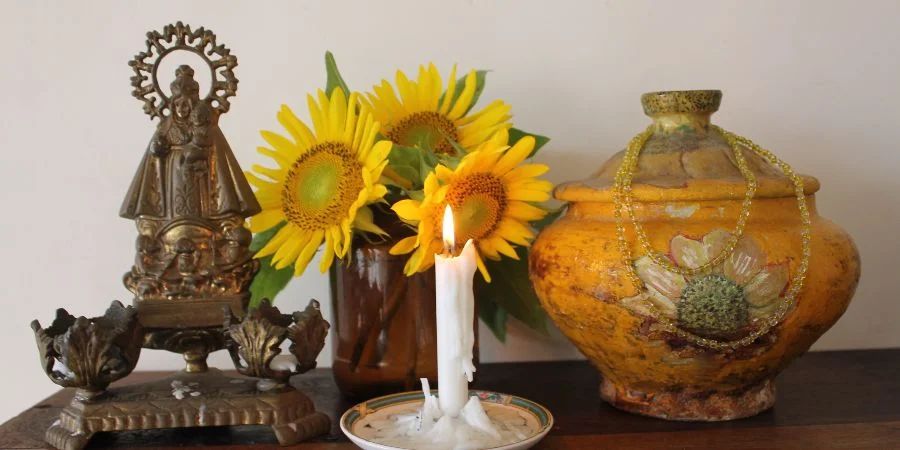
“I come to ask for my brother, who had a situation and is waiting for the trial,” specifies a young woman who carries a bunch of five sunflowers in the same left hand in which he uses a bracelet with green and yellow accounts that identify the cult of Ifá. This specific amount of flowers that even many believers often give to the Virgin is not accidental, since it keeps a direct relationship with the number with which Oshún is manifested in the divination system known as Dilogún. “For me they are the same: Oshún is charity, as Adalberto Álvarez’s song says. I don’t see contradiction, they are like mothers who, although you are wrong a thousand times, will always give you refuge,” says the woman.

If the Virgin is the Catholic referent of the mother of Jesus, for santeria practitioners, Oshún also represents protection on fertilized bellies and motherhood. Encarna, in turn, the art of healing with tenderness, intuitive wisdom and matriarchal power. In one of the Patakíes From the Yoruba religion it is said that Oshún had been relegated in decision making so he decided to make women become sterile. Both Oshún and Charity are asked for fertility or the happy term of gestations is entrusted.
Just in this sanctuary of good trip another woman with a child in his arms has come from the town of Mataguá, in Manicaragua, to thank him for the fruit of his belly. “Last year I walked off these stairs when I knew from pregnancy, today I come to thank you,” he says. “The promise was to go to copper, but the transport is very bad. Anyway, the Virgin is everywhere and always takes her hanging around her neck.”
In one of his alocutions in the Eastern province on the eve of September 8, 2022, Archbishop Dionisio García Ibáñez said that devotion to the Virgin is so widespread that people usually keep it “in the most incredible places” such as wallets, wallets, drawers with important memories or in school books. “It is almost an identity card of Cuban”, held.
This September 8, while the pilgrimage of the Virgin travels the streets of Santa Clara, in the center of the County, one of the peripheral neighborhoods of the city that still loads with the stigma of the marginal, a group of consecrated santeros has prepared a touch of drum, a festive ceremony in honor of the Patron Day. As every year, his devotion is directed to both Oshún and Charity, at a crossroads that, far from generating conflict, reveals the spiritual wealth that cohabit in Cuba: where the sacred is expressed in symbols that dialogue, the refuge of the Cubans against their multiple everyday vicissitudes and the protection of the same collective maternal figure.