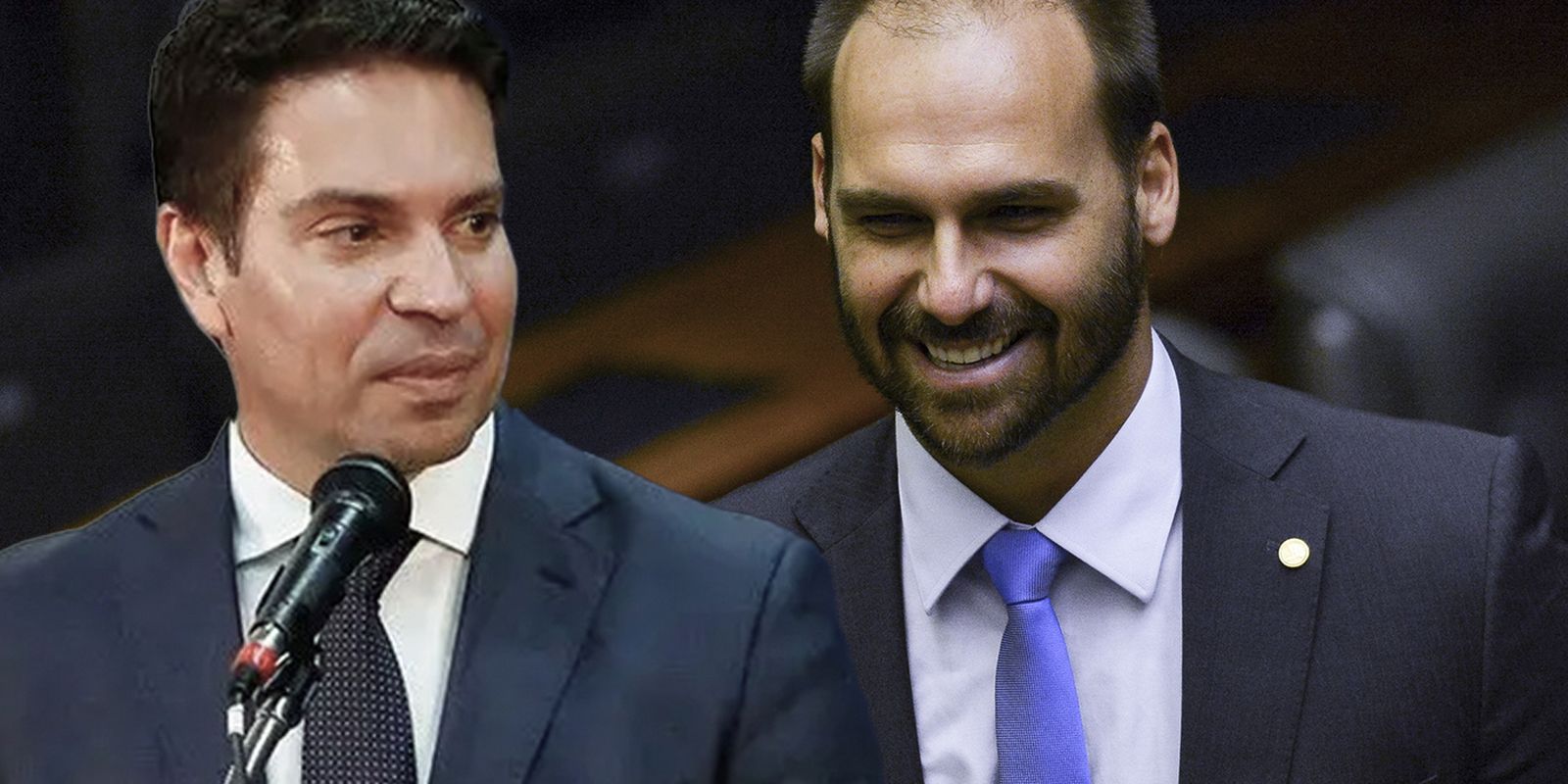
The Board of Directors of the Chamber of Deputies decided to revoke the mandates of federal deputies Eduardo Bolsonaro (PL-SP) and Alexandre Ramagem (PL-RJ). The acts determining the loss of mandates were published this Thursday (18) in extra edition of the Gazette of the Chamber of Deputies.
In addition to the president of the Chamber of Deputies, Hugo Motta (Republicanos-PB), the first and second vice-presidents, Altineu Côrtes (PL-RJ) and Elmar Nascimento (União-BA) signed the impeachments; and the first, second, third and fourth secretaries: Carlos Veras (PT-PE), Lula da Fonte (PP-PE), Delegate Katarina (PSD-SE) and Sergio Souza (MDB-PR).
Eduardo Bolsonaro
The Board revoked Eduardo Bolsonaro’s mandate due to absences, due to the fact that the deputy failed to attend a third of the deliberative sessions of the Chamber of Deputies, as provided for in the Constitution.
In March, Eduardo Bolsonaro fled to the United States and asked for a leave of absence from his parliamentary mandate. The leave ended on July 21, but the parliamentarian did not return to Brazil and had already accumulated a significant number of unexcused absences in plenary sessions.
In September, Motta rejected the deputy’s nomination to exercise minority leadership in the House, with the argument that there is no possibility of exercising a parliamentary mandate while absent from national territory.
Eduardo Bolsonaro is also a defendant in the STF case for promoting sanctions against Brazil to avoid the trial of his father, Jair Bolsonaro, for the coup plot.
Ramage
In the case of Ramagem, the revocation was applied after the Federal Supreme Court had defined the loss of mandate in the trial of the attempted coup d’état. He was sentenced to 16 years in prison.
Former director of the Brazilian Intelligence Agency (Abin) during the government of Jair Bolsonaro, Ramagem is on the run in Miami, in the United States. Since September, Ramagem had presented medical certificates to justify his absence from the Chamber.
After the discovery of the escape, the Chamber reported that the House was not communicated regarding the parliamentarian’s removal from national territory nor authorized any official Ramagem mission abroad.
Repercussion
The PL leader, deputy Sóstenes Cavalcante (PL-RJ), said he received a call from Hugo Motta reporting the impeachment. The deputy also said he considered the decision serious.
“This is a serious decision, which we deeply regret and which represents another step in the emptying of Parliament’s sovereignty. It is not a routine administrative act. It is a political decision that removes the plenary’s right to deliberate and transforms the Board into an instrument for automatically validating external pressure. When mandates are revoked without the vote of the deputies, Parliament ceases to be a Power and becomes a guardian”, he wrote on the social network X.
The leader of the PT, PCdoB and PV federation, Lindbergh Farias (PT-RJ), celebrated the decision stating that the revocation extinguishes the “outlaw bench”.
“Together, the two cases leave an unequivocal institutional message in the sense that either the mandate is exercised within the limits of the Constitution and the law, or it is lost, either through definitive criminal conviction, or through repeated absence and de facto renunciation of parliamentary functions,” he stated.
According to Lindbergh, the parliamentary mandate should not be a shield against justice or a safe conduct for the abandonment of public functions.
“The loss of the mandate, in both cases, constitutes an objective constitutional effect that is independent of discretionary or political judgment (article 55, paragraph 3, of the CF). As we have always defended, the Board was only responsible for declaring the vacancy, under penalty of usurpation of the Judiciary’s competence and a direct violation of the separation of Powers, as the parliamentary mandate is neither a shield against Justice nor safe conduct for the abandonment of public functions”, he concluded.