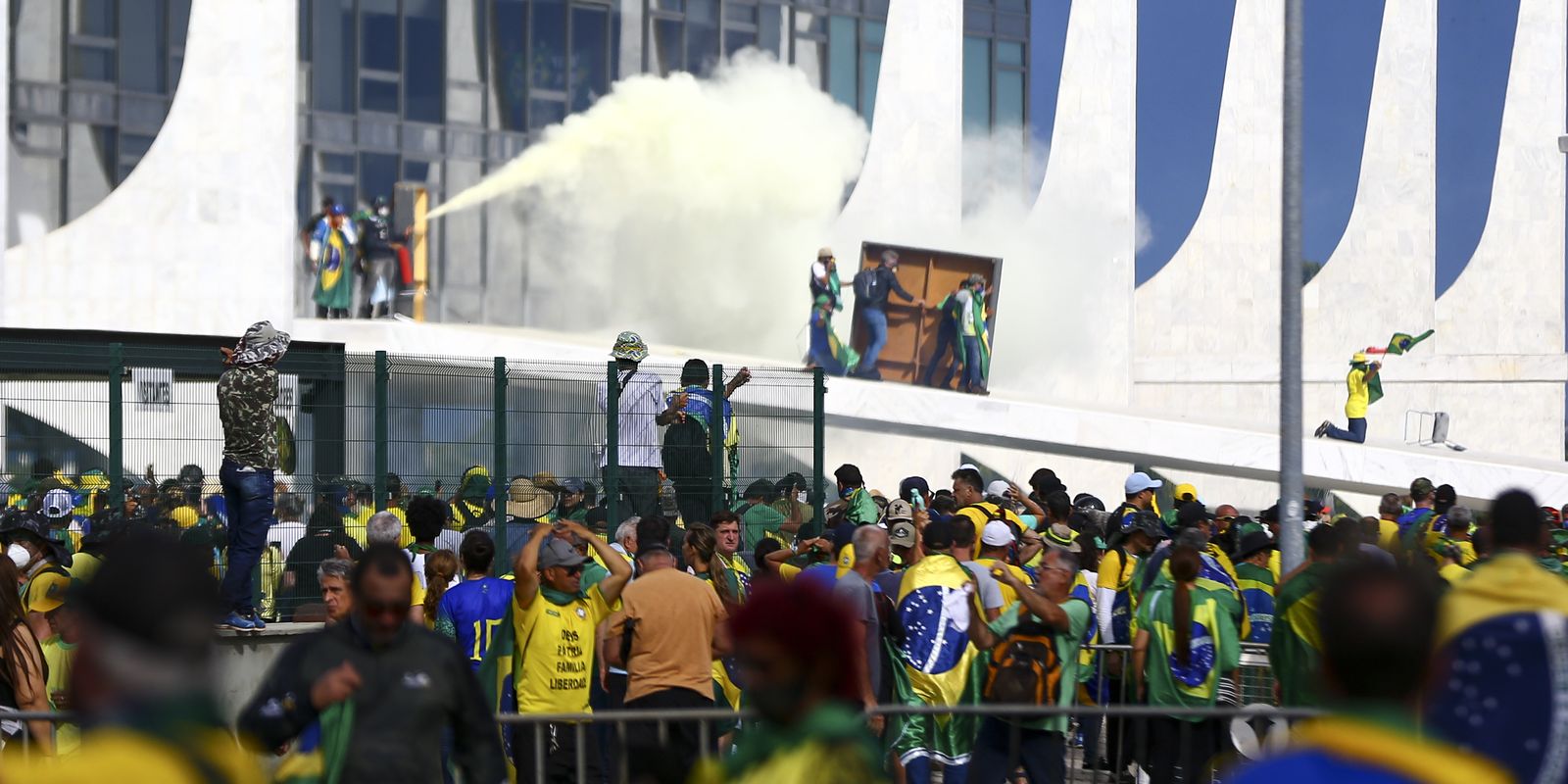
The Chamber of Deputies approved a bill that provides for the reduction of sentences for people convicted of the undemocratic acts of January 8, 2023 and the attempted coup d’état, such as former president Jair Bolsonaro. The proposal was approved in plenary by 291 votes to 148 and will be sent to the Senate.
The text approved in the early hours of this Wednesday (10) is a substitute by the rapporteur, deputy Paulinho da Força (Solidariedade-SP), to Bill 2162/23, by deputy Marcelo Crivella (Republicanos-RJ) and others.
The substitute determines that the crimes of attempting to end the Democratic Rule of Law and coup d’état, when committed in the same context, will imply the use of the most serious penalty instead of the sum of both penalties.
The original text provided for amnesty for all those involved in the acts of January 8 and those accused of the four groups related to the attempted coup d’état judged by the Federal Supreme Court (STF). But this article was removed from the project.
Main group
If it becomes law, the new form of sentencing should benefit all those convicted of the attempted coup d’état, such as those in the main group:
Jair Bolsonaro, former President of the Republic;
Almir Garnier, former Navy commander;
Paulo Sérgio Nogueira, former Minister of Defense;
Walter Braga Netto, former Minister of the Civil House;
Augusto Heleno, former head of the Institutional Security Office (GSI);
Anderson Torres, former Minister of Justice; and
Alexandre Ramagem, federal deputy.
This group was sentenced to sentences ranging from 16 to 24 years in a closed regime by the 1st Panel of the Federal Supreme Court (STF), definitively, on November 25th of this year. Other sentences of detention must be served after those of imprisonment.
As the law can be retroactive to benefit the defendant, the new rule would imply a review of the total for these two crimes, with the greater penalty (4 to 12 years) prevailing for attempted coup d’état. Aggravating and mitigating factors will still apply to the calculation.
Opposition parliamentarians predict, for former president Jair Bolsonaro, that the total reduction could lead to 2 years and 4 months in a closed regime instead of 7 years and 8 months according to the current calculation of the criminal execution court.
The final bill, however, is up to the Supreme Court to define and may depend on validating the use of work and study at home to reduce days in prison.
Progression
The difference is also influenced by the change in the rules for progression from closed to semi-open regime made by the rapporteur.
Currently, except for those convicted of heinous crimes, the first offender obtains sentence progression if he serves 16% of it in a closed regime, but the crime cannot have been committed with violence to the person or serious threat.
As the crimes of attempted coup and abolition of the Democratic State are classified as “violence or serious threat”, Paulinho da Força changes the text of the Criminal Execution Law (Law 7,210/84) to enforce the 16% closed regime for crimes with or without violence or serious threat.
Without the change, progression would only occur when the first offender completes 25% of the sentence. For repeat offenders, the compliance rate in the closed regime goes from 30% to 20%.
This 25% will only apply to first-time offenders convicted of crimes against life (title I of the Penal Code) and crimes against property (title II of the Penal Code) committed with violence or serious threat.
Recidivism, in the same situation as crimes against life or property, continues to imply serving 30% of the sentence for progression.
Other crimes
The reference, in the Penal Code, to crimes committed with “serious threat” involves several crimes not belonging to titles I and II, such as removal of a bidder (imprisonment of 3 to 5 years), contained in title XI.
Title VI typifies crimes against sexual freedom for which there are aggravating factors related to this serious threat, such as favoring prostitution (imprisonment of 4 to 10 years) and ruffianism (imprisonment of 2 to 8 years), the progression of which would also be affected by the proposed wording, since the reference to violence against the person or serious threat, for the purposes of regime progression, is replaced by reference only to titles I (crimes against life, such as homicide) and II (crimes against property, such as theft).
Thus, these crimes mentioned will have a shorter time for regime progression, as they are not classified as heinous, with greater requirements to reach the semi-open, nor are they included in titles I or II of the Penal Code.
House arrest
The rapporteur also proposes that carrying out study or work to reduce the sentence, as currently permitted in the closed regime, may be valid in the case of home imprisonment.
On this topic, mainly the Superior Court of Justice (STJ) produced jurisprudence allowing this practice, as long as it is proven and can be monitored.
Crowd
For the crimes of attempted abolition of the Democratic Rule of Law and attempted coup d’état, when committed in a crowd, as in the case of participants in the acts of January 8, 2023 at the headquarters of the three Powers, in Brasília, the text reduces the penalty from one third to two thirds, as long as the agent did not finance the act or exercise a leadership role.
Rejected Highlights
The plenary rejected all the highlights presented by the PSB and the federations PSOL-Rede and PT-PCdoB-PV in an attempt to change parts of the text.
Check out the voted and rejected highlights
PSB highlight intended to exclude all changes to the penalty progression system
Highlight from the Federation PSOL-Rede intended to maintain a minimum of 25% of the prison sentence for a first-time offender convicted of any crime involving violence or serious threat, such as those related to the attempted coup d’état
Highlight of the PT-PCdoB-PV Federation had the same objective, with another similar exclusion of part of the text
Highlight of the Federation PT-PCdoB-PV intended to exclude the possibility of reducing the sentence with study or work carried out under house arrest
Highlight of the Federation PT-PCdoB-PV intended to remove the section that determines the use of only the highest penalty for the crimes of attempted coup d’état and abolition of the Democratic Rule of Law;
Highlight from the PT-PCdoB-PV Federation intended to exclude the section that provides for a reduction of one third to two thirds of the sentence for these crimes if committed in the context of a crowd, such as the acts of January 8, 2023.
*With information from Agência Câmara de Notícias