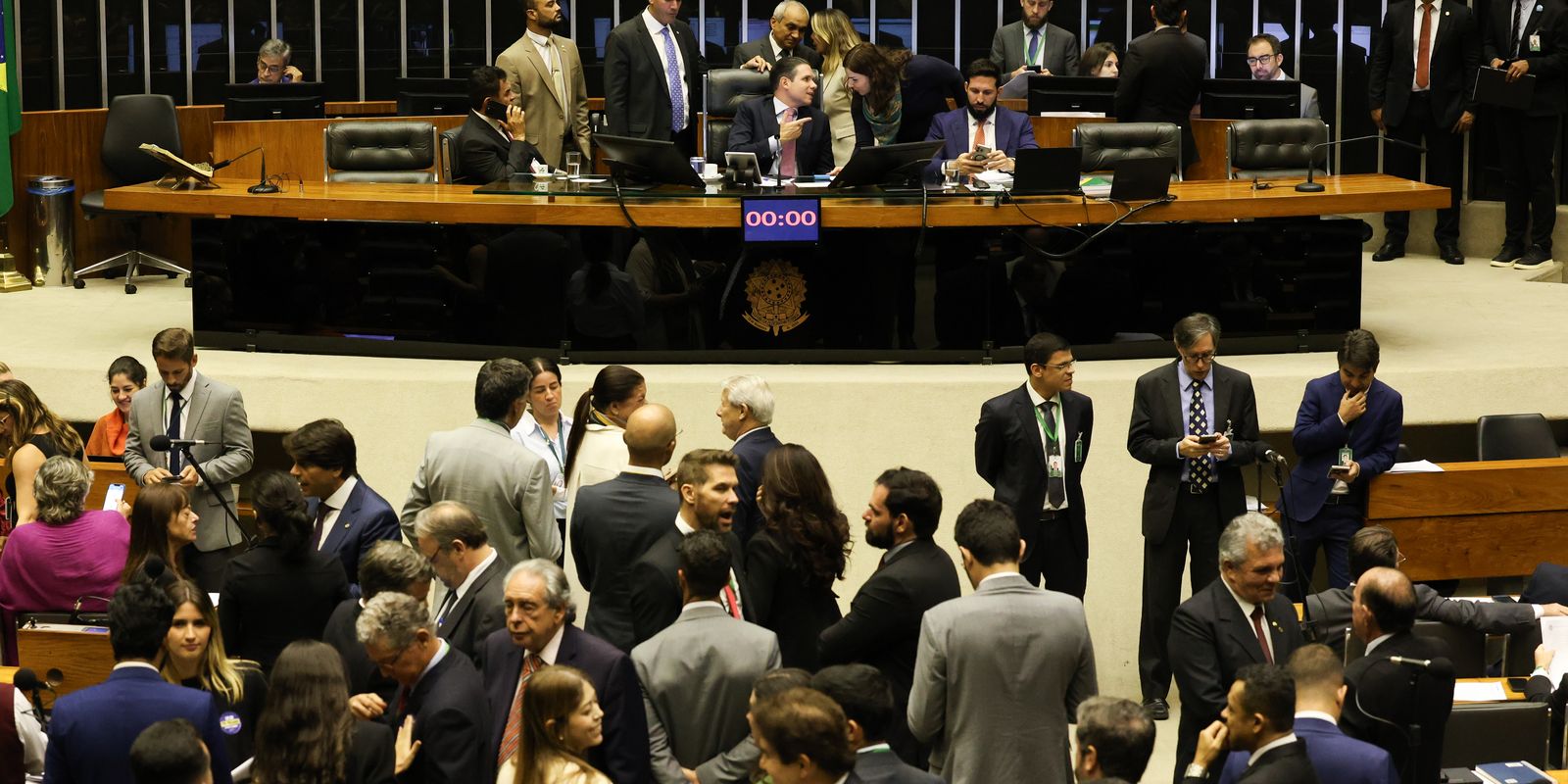
The Chamber of Deputies approved, this Tuesday (4), the bill (PL) 3935/2008 which gradually increases paternity leave up to 20 days.
The proposal, approved symbolically with Novo voting against, increases the license in a staggered manner from 10 days from the first to the second year of the law’s validity up to 20 days from the fourth year onwards. The leave may also be divided into two periods upon request by the employee. The text now returns for analysis in the Senate.
Initially, the project provided that the license would be for 10 days in the first year of application of the law, 15 days in the second year, with an increase of 5 days/year up to 30 days in the 5th year, maintained thereafter. However, the rapporteur, deputy Pedro Campos (PSB-PE), had to make adjustments to the text to obtain approval. Furthermore, the project determines that the 120-day leave will only be granted in the event of maternal death.
With the changes, the maximum period established for paternity leave will be 10 days, from the first to the second year; 15 days, from the second to the third year; and 20 days, starting from the fourth year. Furthermore, the proposal determines that the 20-day license will only be granted if the government manages to meet the fiscal targets set out in the Budget Guidelines Law (LDO) for the second year of application of the law.
If the target is not met, the 20-day license will only come into force from the second financial year following the one in which the target is achieved.
The text also says that paternity leave and paternity pay in cases of birth, adoption or judicial custody for the purpose of adopting a child or adolescent with a disability, will increase from 30 to 60 days, with validity staggered until the fifth year of validity of the law.
Paternity leave is granted to employees, with full remuneration, due to the birth of a child, adoption or legal custody for the purpose of adopting a child or teenager, without prejudice to employment and salary.
When arguing in favor of the proposal, the rapporteur stated that no right is more fundamental than that of being born surrounded by care. Campos also pointed out that the topic had been the subject of debate since the National Constituent Assembly, which drafted the 1988 Constitution, which recognizes the family as the basis of society and imposes on the State the duty to guarantee it special protection.
“For decades, Brazilian Labor Law recognized this need only from the maternal perspective. Maternity leave represented a civilizing advance, but paternity remained on the sidelines, as if care were an exclusive responsibility of women. This asymmetry has repercussions not only on mothers’ overload, but also on paternal absence in one of the most decisive periods of a child’s life”, he observed.
The resources for paying for the license will come from the General Social Security Regime (RGPS). If the text is approved, the estimate presented by the rapporteur says that the net fiscal impact (expenses and loss of revenue) will be around R$2.61 billion in 2026; of R$3.3 billion, in 2027; of R$4.35 billion, in 2028; of R$5.44 billion in 2029.
Pedro Campos pointed out that resources for the new policy can come from the Special Regime for Update and Regularization of Assets (Rearp), which provides for updating the value and regularization of vehicles, properties, values, titles and shares in Income Tax, if they are legal and have not been declared.
The revenue provided for in the Complementary Bill presented by the Government in the Chamber of Deputies, which aims to increase federal revenue by R$19.76 billion in 2026, may be considered as a source of additional funding.
The project promotes direct changes to the Consolidation of Labor Laws. Paternity leave now appears, alongside maternity leave, as a social right of the same hierarchy and scope. To this end, it creates a new benefit called paternity pay, with the same duration as maternity leave.
The text also says that the paternity salary will be allocated to the same categories of insured persons currently covered by the maternity salary, and, with the exception of employees in general, it will be paid directly by the National Social Security Institute (INSS), which will also be responsible for paying the employee of the individual micro-entrepreneur.
According to the text, tax incentives are expected to be granted for companies to adhere to the license. Furthermore, the project says that the license can be suspended by the Court when there are elements that indicate the practice, by the father, of domestic violence or material abandonment in relation to the child.
The project also says that the simultaneous maintenance of paternity salary and maternity salary will be permitted, in relation to birth or adoption, or judicial custody for adoption purposes, of the same child or adolescent. However, the first will be conditioned on the insured’s absence from work or activity performed, under penalty of suspension of the benefit.
“The measure thus harmonizes the constitutional duty of protection with economic rationality, as paternal involvement strengthens family ties, reduces inequalities and favors more balanced and productive work environments”, pointed out Campos.
Novo deputies took a stand against the matter. Leader Marcel van Hattem (Novo-RS) criticized the project with the argument that establishing expanded paternity leave will harm economic activity, especially micro and small companies.
According to the parliamentarian, the initiative brings “concern to the job market”.
“There will be an increase in mandatory licenses, reducing compensation margins, affecting small and micro-enterprises that are less able to afford this abrupt change in legislation. The new law has been contrary to the matter. We express the party’s opposite position”, he stated.
The argument was refuted by deputy Jandira Feghali (PCdoB-RJ), who recalled that the project was presented in 2008. The deputy clarified that the resources will come from Social Security.
“The problem is that the argument is always about who pays. But the person who pays for maternity and paternity leave is the social assistance worker”, he stated.
Representative Tabata Amaral (PSB-SP) celebrated the approval. “Today was a victory for the entire women’s group, but also for the Brazilian Parliament, which today is listening to fathers, listening to mothers and listening to families,” he said.