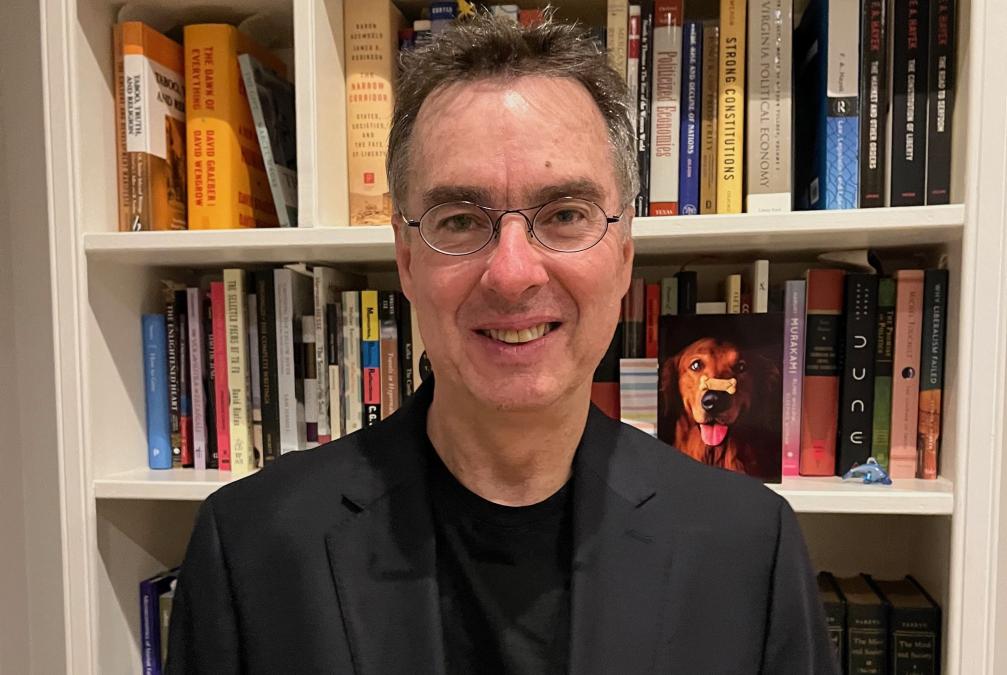
Peruvian economist César Martinelli explains why the Venezuelan crisis does not end in politics, how economics helps understand the persistence of authoritarianism and the implications for the oil market.
How has the news been received in the United States?
Many people are worried that there is an electoral motivation, because the mid-terms are coming, the mid-term elections, and Trump’s popularity has not been very high. Furthermore, part of Trump’s election was the idea that he was not a warmonger. Many conservatives, much of their intellectual conservative support, are against it, but voters like this. Sabers have never failed.
How was Maduro managing Venezuela’s economy under his administration?
It’s curious. When Chávez was a cadet, he visited Peru and was very impressed with General Velasco. Part of what has been Chávez’s socialist turn, which is the origin of the Maduro government, is inspired by the revolutionary government of the Armed Forces in Peru. It was a controlling state that absorbed a lot of functions, and it worked well for Chávez because the price of oil was high. But, when he dies and prices are no longer so high, difficulties with Maduro begin.
What was the economic cost of Maduro?
Chávez had been taking over politics. Maduro enters in 2013 and finds a window of opportunity. There is a wave of protests in 2014 and, basically, a civil war is generated where, on the one hand, you have the modern State with an army, etc., and, on the other hand, the middle classes. They lost and an immense migration was generated.
The economic cost of Maduro is, on the one hand, socialism. Socialism basically destroys market incentives, but those things can be rebuilt. The biggest cost is outbound migration. 8 million people have left Venezuela, which is 20% of the population. Basically, all the educated people and everyone who could have left have left. These are the ones who, hopefully, are taxi drivers in Peru and who were skilled workers, people who had gone to university, etc.
The worst thing that can happen to you is a civil war and that’s what it has. Civil war in the 21st century is not like before, because you are not going to have people throwing stones at the army. The civil war has meant enormous outbound migration.
What impact has this outbound migration had for Venezuela?
The percentage of a person’s wealth, which is human capital, is more than two-thirds. Maduro has destroyed the wealth of 20% to 25% of the population, but the wealth of the most educated people. It is the most important episode of out-migration in modern history. Never in modern history, since the great wars and revolutions of the 20th century, has there been a disaster of this nature.
One thing that is interesting, as Peruvians, is the reversal. And it is something that pushes you to have a certain compassion with the Venezuelans, it is that they were with their doors open to the Peruvians when we had our crisis of hyperinflation and violence. You have to remember it.
How did hyperinflation affect Venezuela?
We had hyperinflation and we had violence. They have had this, but many times. So, when they asked people why they were leaving, they talked about hyperinflation, the massive closure of the private sector and violence and insecurity.
That is a wake-up call for us too, because there is a tendency towards an increase in violence and crime in our countries. That explains a little the migration out of Peru as well, which is quite strong in educated sectors right now. Venezuela is like an exaggerated version of what happened to us.
Could there be other factors that explained this situation?
There is an economic cost to Maduro, but the economy also explains why Maduro. In a country where wealth is concentrated in a natural resource, the temptation to seize and control that natural resource is very high. So, the fact that the Army ends up dominating oil is no coincidence. When you see oil countries, they are typically dictatorships. You need to have a lot of institutional development. You need to be Norway to resist the existence of a very important natural resource or be Alaska, which is part of the United States, to be able to survive the incentives of a dictatorship.
What is going to happen after Maduro?
There will be another dictator. People believe that you end the dictator and democracy comes. However, there is ergodicity in political institutions.
We have recent work with David Levine and Nicole Stoelinga. It’s called Vote or Fight. We have a large database of more than 100 years of civil wars and transitions between dictatorships and democracy, and what we see is that what happens after a dictatorship is typically another dictatorship. The economic bases explain political phenomena. Just as politics has effects on the economy; On the other hand, economics explains why you have a dictator.
Is this a great tragedy for Venezuela?
It is an unprecedented tragedy. Venezuela was a rich country on paper, but the truth is that things on paper are very different in reality. I was comparing life expectancy at birth. For example, in Venezuela it was about 72 years old in 1995. Peru came from a very bad situation. In Peru, in 1995, it was below 68 years. Now it is 78 years, life expectancy at birth has increased by 10 years. In Venezuela it has not changed, it remains 72 years old. That is a tragedy, because all the rest of Latin America has improved.
The other indicator I saw was infant mortality, the number of deaths per 1,000 live births. Peru has gone from 45 to 15. In other words, Peru has really become civilized. While, in Venezuela, infant mortality reached 20 in 95, much better than Peru, and it rose again with the years of military government, especially since Maduro came in, and they have stopped counting. Now it is far above Peru. He’s in his twenties and there are no statistics anymore.
What will be the impact of what has happened in Venezuela on the global and Peruvian oil market?
Very small in the short term. Venezuela needs a lot of investment in infrastructure to raise production and I don’t think the American invasion will be smooth. Obviously, Trump thinks differently. The bet is to lower the price of oil, reduce dependence on Saudi Arabia and collaterally reduce Russia’s income. Something that will be very complex because, while prices were high, Chávez neglected the maintenance of the oil industry and fired qualified people.
So, it is not as easy as Trump and those who are talking in his ear believe. The bet, I think, is to reach a quick agreement with the vice president and start investing. There is an element of wishful thinking on the part of the American government, as often happens in closed administrations. Venezuela is a dangerous and destroyed place.
Data:
- César Martinelli has a degree in Economics from the PUCP. He has a master’s degree and a doctorate in economics from the University of California, Los Angeles.
- He is currently a professor of economics at George Mason University and a member of the Interdisciplinary Center for Economic Sciences (ICES).
- His research focuses on economic theory, game theory, political economy, public economics and experimental economics.
- He is a consulting editor of Games and Economic Behavior and an associate editor of the European Economic Review. He also writes the blog Foco Economico and co-organizes online seminars on behavioral and experimental economics.
- In addition, he has taught in the university extension course of the Central Reserve Bank of Peru (BCR).
Receive your Perú21 by email or WhatsApp. Subscribe to our enriched digital newspaper. Take advantage of the discounts here.
RECOMMENDED VIDEO