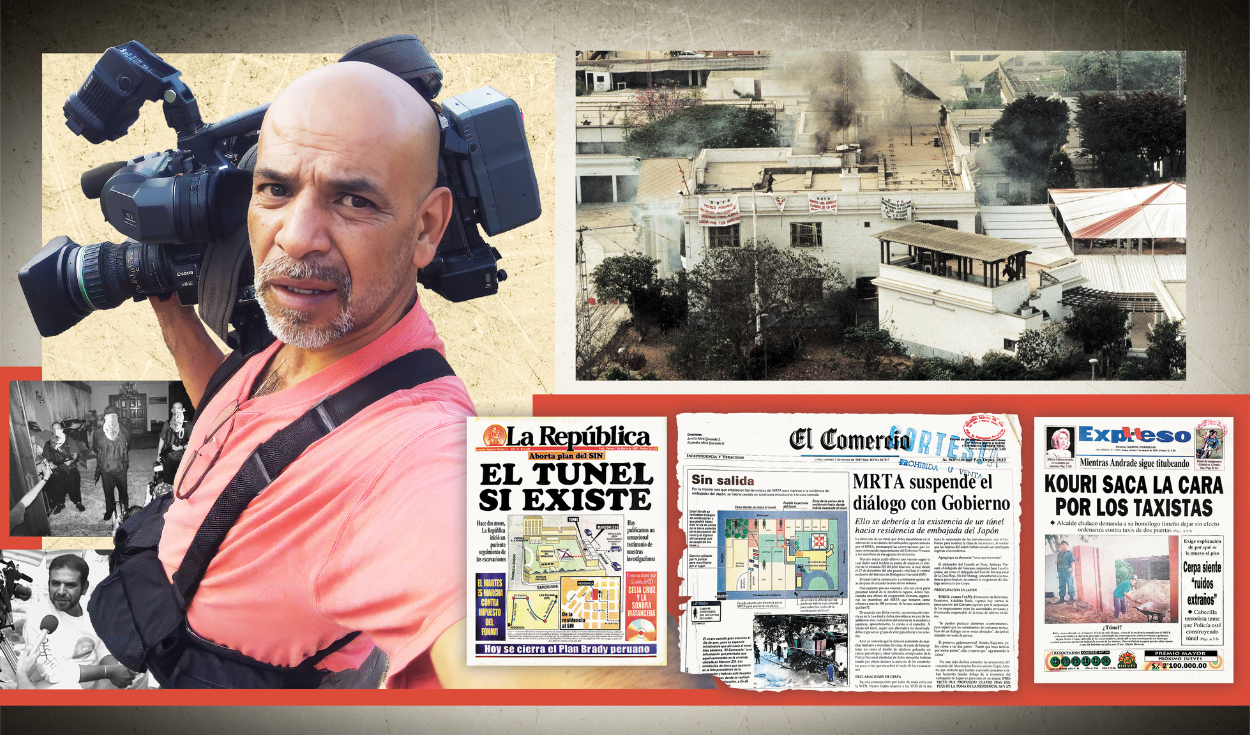
From the first minute of the terrorist attack on the residence of the Japanese ambassador Morihisa Aoki, the Mexican journalist from the British network WTN, Miguel Real Fierros, covered the evolution of the events for the whole world. Real had a great advantage over the thousands of reporters who arrived in Lima to report on the action of the Túpac Amaru Revolutionary Movement (MRTA), which had put the regime of Alberto Fujimori, his advisor Vladimiro Montesinos and General Nicolás Hermoza in check. Miguel Real had been a foreign correspondent in the capital since 1990, so he knew the city well, lived and had his office nearby, which allowed him to rent the roof of the building on Dos de Mayo Avenue N°1754. He strategically installed himself with his team just one street from the scene, from where he had a privileged view of the captured house. But not only that.
“I had daily communication with Néstor Cerpa Cartolini, the head of the emerretistas. It was Cerpa who on March 6, 1997 told me about the excavation of the tunnel because we were speaking on a shortwave radio. He told me that he would make a statement announcing the suspension of the dialogue because the tunnel was an indication that Fujimori had opted for the violent solution. We recorded his manifesto and broadcast it as news on March 6. WTN was the first media who disclosed Cerpa’s statement about the tunnel,” Miguel Real told La República.
On December 31, 14 days after the hostage crisis began, terrorist leader Néstor Cerpa, as a sign of his interest in sitting at a dialogue table, improvised a press conference inside the Japanese residence, with the participation of national and foreign journalists. The WTN journalists took the opportunity to leave a shortwave radio, with the idea that one of the assailants would notice the device and try to communicate.
“The purpose was to obtain information about the evolution of events inside the Japanese residence. As you will remember, the Fujimori government was very secretive and agents from the intelligence services frequently lurked. We had to obtain news beyond the official communications. Fortunately, Cerpa responded and thus a link could be established. A link that ended when the radio’s battery expired,” Miguel Real recalled.
To ensure communication, Cerpa identified himself as “Cero Cero” and Real as “Marlboro”, the journalist’s favorite cigarettes.
“We knew everything that was happening inside. Absolutely everything. That’s how we found out that a tunnel was being built. Cerpa and his people were sure that the government would attempt a rescue with weapons,” Real said.
Aware that La República was credited with having exposed the excavation of the tunnel, Mexican journalist Miguel Real Fierros was categorical: “No way. It’s a lie. Cerpa warned us about the tunnel. And it appears in the interview we did with him on August 6, 1997. To say that La República revealed the tunnel is a lie,” he said.
This newspaper obtained the WTN audio that Miguel Real recorded and shared with Frecuencia Latina, which was broadcast on March 6. In the record, Cerpa is heard saying:
“For three days now we have been hearing some noises under what could be the floor of the residence. And this, today at dawn, is happening with greater intensity. Everything indicates, let’s say, that there is without a doubt, or at least there is the intention, from our point of view, to prepare a military attack, using an external attack tactic. (…) We also want to announce that tomorrow (March 7) we will not attend the talks to the extent that we do not believe that it is correct that, on the one hand, talk about dialogue and conversations, and on the other hand, this type of maneuver is taking place, which is not our invention (…) In other words, there is either a negotiated political solution – which is what the government is talking about – or a military solution.
At that time, some media outlets had their own information about the excavation, but they only published it when the terrorist Cerpa spoke about the tunnel through the WTN network. It is false that La República anticipated and exposed the government’s secret plan with the intention of alerting the MRTA, as confirmed by Miguel Real, who was the one who recorded the Cerpa demonstration.
As the reporter Edmundo Cruz, author of the La República investigation, pointed out at the time: in the first week of February he confirmed that the construction of the tunnel had begun, but by editorial decision he waited for the opportunity to present the case:
“(An) ethical dilemma arose: on one side of the scale the truth weighed and on the other, life. They decided not to publish and embargo the investigation until the end of the crisis. This decision was reviewed by La República on the morning of March 6, 1997, after Néstor Cerpa launched his complaint. The secret had been revealed by the excavators themselves. For journalists the ethical dilemma disappeared and it was decided to publish the investigation to confirm what was already in the public domain. If anyone alerted the kidnappers, it was the diggers themselves and those responsible.”
The day after Miguel Real broadcast Néstor Cerpa’s recording, on March 7, 1997, La República headlined: “The tunnel does exist.” The newspapers “El Comercio” and “Expreso” did the same with material that their reporters obtained about the excavation under the Japanese residence.
The rest of the media reproduced the version of the government of Fujimori, Montesinos and Hermoza: the tunnel does not exist, it is an invention of the MRTA terrorists. Of course, the “chicha press”, financed by the regime, unleashed a campaign of lies put together by Fujimori and Montesinos from the National Intelligence Service (SIN). For example, the newspaper “Ajá” headlined: “Cerpa crazy sees ghost tunnel. He no longer wants to talk because ‘his floor is moving’.”
The Republic published the facts. He told the truth.
It is now known that the noises became more noticeable as part of the military’s tactics. In the Army’s official version of the internal armed conflict, In Honor of the Truth (2010), the story of General EP César Díaz Peche, who was part of Operation Chavín de Huántar, is recorded:
“Later, underground noises were deliberately heard with the aim of placing the hostages on the second floor of the residence: ‘That’s why one of those days noise was made in the tunnels and that forced the kidnappers to go up to the second floor. That’s what was wanted, actually (…)’. The objective was met. On March 6 (1997), Cerpa decided to suspend the talks.”
The reprisals of the regime of Fujimori, Montesinos and Hermoza were immediate. Military and intelligence sources alerted Miguel Real Fierros that the government was preparing an indictment for terrorism. Other sources warned him that he could be the victim of a violent attack. The Mexican journalist had to leave Peru with his entire family.
The Republic knew it, but refrained from spreading it
- In the book Montesinos and the Armed Forces (IEP, 2000), Fernando Rospigliosi maintains that La República published information about the tunnel after Néstor Cerpa did.
- “On March 6, the emerretista leader Néstor Cerpa revealed in a radio interview that he had discovered that the security forces were digging a tunnel under the residence and that it could not be negotiated under those conditions. Both La República and El Comercio knew of the existence of the tunnel, but had refrained from revealing it,” wrote the current president of Congress, from the Fuerza Popular party.
- However, Fujimoriism is part of this newspaper’s campaign of lies to the detriment of this newspaper. It is retaliation because he discovered the crimes and thefts of the Alberto Fujimori regime.