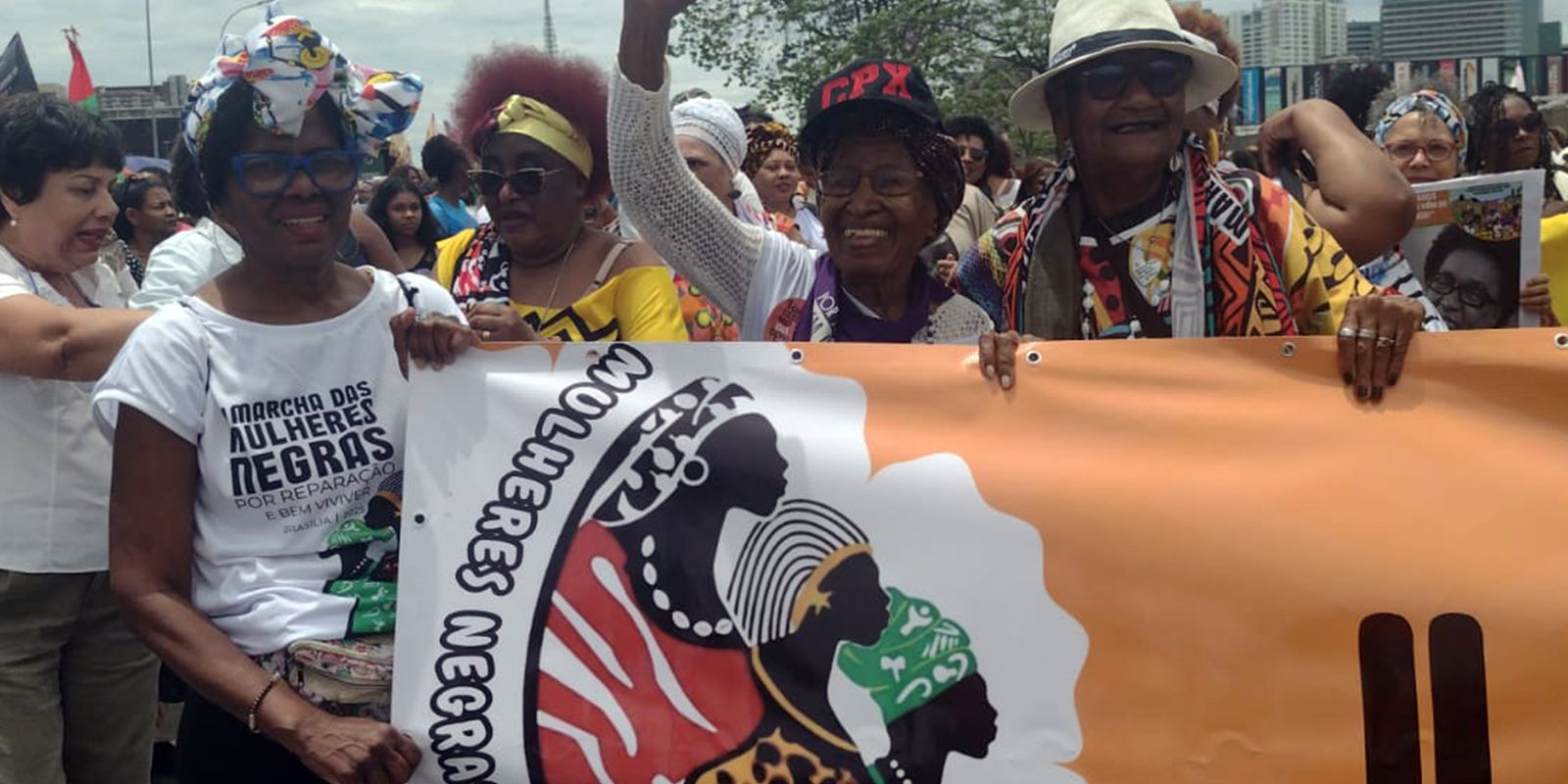
Maria Adelina, 77. Valmira dos Santos, 83. Maria de Lourdes, 88. Maria dos Santos Soares, 101. Together, these women have more than three hundred years of life.
More than three centuries of legacy and resistance. All of them were in Brasília this November 25th, marching for reparation and good living. Coming from the North, Northeast, Southeast, South and Central-West. An entire Brazil converging on the capital for the 2nd National March of Black Women.
“It was time for us to return. In these last 10 years, society has moved. In the first period, recognizing the presence of black women, who assumed prominent positions during this period; but the other side regrouped, the white supremacists, the racists, the conservatives also took to the streets to confront everything we proposed to confront the level of violence against us and worsen the social and political situation in Brazil and the world”, says Jurema Werneck, executive director of Amnesty International Brazil.
Jurema states that the fight for reparation is fair since black women built Brazil.
“Everything you look around has the hands of black women”, he says.
Hands like Dona Maria dos Santos Soares, Dona Santinha. A native of Minas Gerais living in Rio de Janeiro, youngest daughter in a family of 14 siblings, Ms. Maria has been fighting for many years, with her fists raised, marching against inequalities. No fear.

Brasília (DF), 11/24/2025 – At 101 years old, Dona Santinha, historical activist, marched with thousands of women. Photo: Joédson Alves/Agência Brasil
“I’m very bold and I’ve had a political spirit since I was little. I didn’t have the awareness I have today, this knowledge. But I’ve always been fearless. And now, more than ever. I don’t know how to be indifferent to the facts.”
Present at the first march, in 2015, Dona Maria insisted on marching again, at the age of 101, accompanied by her only daughter and her only granddaughter. And thousands of women who stop to hug her, take a photo, thank her and pay her respects.
“I see that our strength is expanding everywhere. We have achieved very little, but this movement gives me hope that we will be able to change this cruel reality that affects black people”, he believes.
A reality that she sees changing, even if little by little. She says that she spent years without watching television, because she didn’t see black people in productions.
Likewise, she has always questioned the lack of products suitable for her skin, as well as the lack of black dolls in stores for many years. But he believes that advances exist. Especially when you look at your own history.
“I was from the time when you arrived at the bar and they said they didn’t accept black people. That was in 1950, it wasn’t that long ago. Today it’s a crime. People may want to antagonize us, but they keep quiet. It’s already a big step forward”, he says.
Managers of the impossible
Advances that can be seen in individual stories, but also in the black women’s movement as a whole.
Valdecir Nascimento, from the National March Committee, said that he was quadrupled in excitement during this second march, especially when he saw the size of the event, estimated at almost 500,000 women.

Rio de Janeiro – Valdecir Nascimento, from the National March Committee. Photo: Archive/Tânia Rêgo/Agência Brasil
“It means that what we planted in 2015 has grown and is bearing fruit. It means seeing young women wanting to touch, pulling, without us having a conflict about it. So, 10 years later, we are more mature. We are more strategic. Those who were 15, 16, 20, are now 25, 30, 45. So, that’s it. The idea of continuity, the idea of collectivity, we need to reaffirm that we are collective, We don’t win alone. And that’s what this march reaffirms. It’s for us, it’s not for one or the other, it’s for us”, he celebrates.
Valdecir classifies the black women as managers of the impossible. She states that, in this racist and hostile country, black women will remain in struggle.
“If the key turns to the left, it doesn’t mean we win. If it turns to the right, it makes our losses worse. So, we are always in the fight. We are the third eye, you know? And, as a third eye, we need to continue visualizing a future that only managers of the impossible have the capacity to visualize”, he concludes.
Occupy the streets as long as necessary
In the march, with their art, performances, musical instruments, bodies, hair and voices, black women continue to dream of the impossible. Carrying their struggles, the pain of losing their children, their hands dirty with dirt.
Coming from the interior or large centers. At ten years of age. Or at 101, like Dona Santinha.
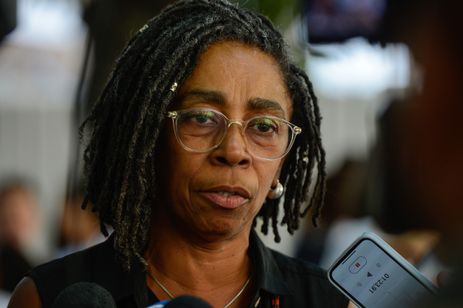
Rio de Janeiro (RJ), 03/05/2024 – The executive director of Amnesty International Brazil, Jurema Werneck. Photo: Archive/Tomaz Silva/Agência Brasil
For Jurema Werneck, the Her presence and that of so many other older women is a reminder that the fight doesn’t stop and that it is everyone’s commitment. A path for other ways of living, less violent, with more dignity, to be traced.
“As long as it is possible, we will all occupy the streets; as long as it is necessary, we will all occupy the struggles in all directions, because Brazil needs to be a different place, the world needs to be a different place. We know what good living is and we want to share this proposal beyond capitalism, beyond neoliberalism, beyond racism, there is another way of inhabiting the planet and we are once again presenting this proposal.”
Dona Santinha, who marched bravely, made this commitment. And he doesn’t want to give up.
“I feel like a swallow, with your little drop. It helps, right?”, he asks, smiling and already knowing the answer.