The internationalist Luis Daniel Álvarez points out that the Santa Marta declaration sought “consensus around the big issues.” He points out that Venezuela, by not signing the document, shows its “inconsistency” after having made a call to “join forces as countries” to denounce, among others, the United States attacks in the Caribbean.
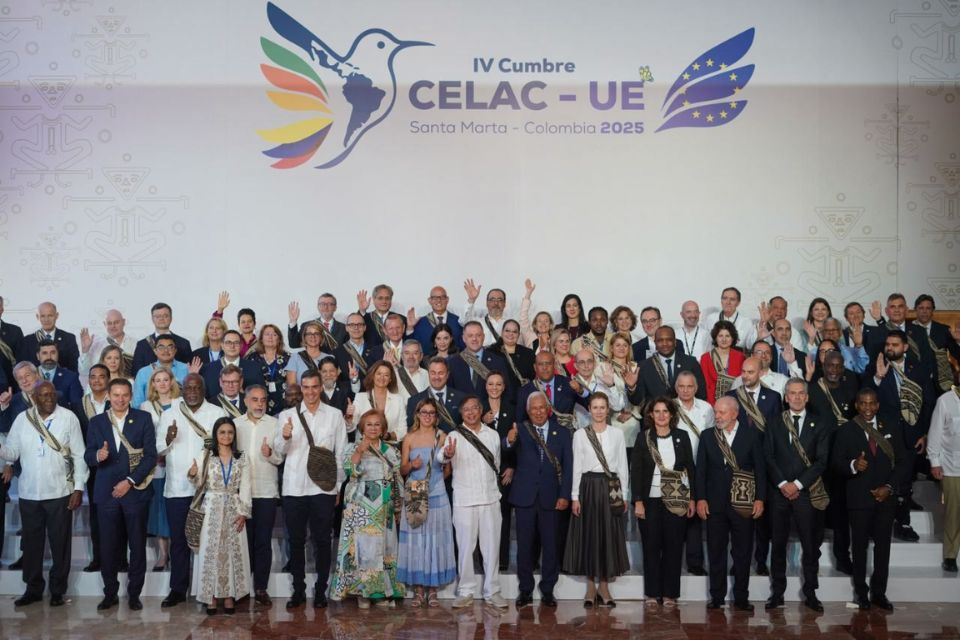
A declaration of great consensus on great issues. This is how he summarized the international press the final declaration of the Celac-EU Summit in the city of Santa Marta, Colombia, where calls were made to defend multilateralism, the request to reduce global “trade tensions” or give priority to the peaceful settlement of disputes.
The discordant point, in addition to the little assistance from heads of state, was provided by Venezuela and Nicaragua by not signing the 52 point statement. An “inconsistency,” points out internationalist Luis Daniel Álvarez, from the Nicolás Maduro administration, who had already called for “joining our forces as countries” to reject the United States attacks in the Caribbean Sea in the framework of anti-drug operations.
He points out that Venezuela’s “inconsistency” comes from the very content of what was expressed by Maduro in his letter and the final declaration of Santa Marta, which makes continuous calls for regional integration and the contribution that the European Union can provide in trade, security, climate, technological developments and strengthening of democracy, among other points.
*Read also: Maduro asks Celac to join forces to reject the US “attacks”
“Venezuela looks bad by wasting the opportunity to make a statement. They have been able to portray themselves, but today the news is that neither Venezuela nor Nicaragua signed; if they had signed, they would go unnoticed. Being a summit of visions, of great exhortations, of good wishes, not having signed does not imply great isolation but it does imply a reflection for the countries,” says the doctor in Social Sciences.
In Álvarez’s opinion, both Nicaragua and Venezuela “should have strategically signed because it would have been an adhesion to those great principles, great ideas. Not doing so generates noise.”
Venezuela and the US attacks
In the letter that Nicolás Maduro sent to the members of the Community of Latin American and Caribbean States, and that Foreign Minister Yván Gil read last Sunday in Santa Marta, there was talk of a “war threat” represented by the actions of the United States in the Caribbean and the “obligation” of each of the countries in the region to ask that they stop “to preserve the peace of the region.”
Since September, Donald Trump’s administration has maintained a military deployment in international waters to combat drug trafficking cartels. To date, they have reported 18 attacks and 72 dead men who, they claim, were “narcoterrorists.”
These actions have been rejected by the United Nations, which considers that these attacks not only violate international law, but could be extrajudicial executions. “These attacks, and their increasing human cost, are unacceptable,” has said the UN High Commissioner for Human Rights, Volker Türk.
Foreign Minister Yván Gil met with the Minister of Foreign Affairs of Colombia, Rosa Villavicencio, within the framework of the Celac-EU Summit
While Celac, in its document, points out that they addressed “the importance of maritime security and regional stability in the Caribbean”, without mentioning the actions of the United States, as well as the relevance “of international cooperation, mutual respect and full compliance with international law, including in the fight against transnational organized crime and illicit drug trafficking” (point 10).
Celac recognized that several member states “highlighted their national positions regarding the situation in the Caribbean and the Pacific,” which is why the “commitment to strengthening dialogue, coordination and technical assistance mechanisms to jointly address these challenges” was reiterated.
“Urgent crisis” to address
For the internationalist Luis Daniel Álvarez, the Santa Marta declaration sought “consensus around the big issues, that is why some ideas are addressed, certain positions are assumed, but it is not pointed out to try to prevent it from being personalized or assuming that it is an attack on someone.”
“Some may say that it lacked forcefulness, but I believe that the idea was a voice of consensus around great realities, issues that worry, and that is what the final declaration bet on. You have to read between the lines and one knows very well what was there and to whom the messages were directed,” he asserts.
Among those messages between the lines, Celac also added its “unwavering commitment to democracy, including free, inclusive, transparent and credible elections, as well as to freedom of expression, human rights, the rule of law and international law.”
Several members of the Community have rejected the results of the Venezuelan presidential elections that gave Nicolás Maduro the winner, following complaints from the opposition of “fraud” and the lack of publication of the minutes that certified the announcements of the Electoral Power, managed by officials related to Chavismo.
Even Colombian President Gustavo Petro, who has supported Maduro’s complaints regarding US attacks, has reiterated on several occasions his proposal for repeat the elections. “The path I propose may be more real. Unleash political dialogue in Venezuela and call elections with real guarantees for all contenders. Maduro and Corina would do well to allow this peaceful and sovereign solution for the Venezuelan people,” he wrote on his account on the social network X on November 6.
The internationalist Álvarez recalls that Venezuela “continues to be an urgent crisis to address” by the international community.
“Of course there is still concern about Venezuela, there are still calls to resolve the crisis, to solve the situation that is being experienced and that does not mean ceasing to see with concern what the United States has been doing in the region not only with those policies of what is happening in the Caribbean and the Pacific, but with respect to tariff policy,” he highlights.
It also mentions the statements made by the president of Brazil, Luiz Inácio Lula da Silva, regarding a dialogue about Venezuela in his last meeting with President Donald Trump in Malaysia. “This indicates that there is concern for Venezuela, to seek ways to understand. We must continue to bet on that, on that reality of seeking a solution that is as least traumatic as possible in every sense.”
Likewise, he indicates that in the Santa Marta declaration there are “between the lines” some premises “that could be used to measure what is happening in Venezuela. There are some indications that lead the international community to see what the reality of the countries should be and what is happening.”
“The Venezuelan situation has not been forgotten, but we are committed to a path of understanding to try to solve it,” he insists.
*Journalism in Venezuela is carried out in a hostile environment for the press with dozens of legal instruments in place to punish the word, especially the laws “against hate”, “against fascism” and “against the blockade.” This content was written taking into consideration the threats and limits that, consequently, have been imposed on the dissemination of information from within the country.
Post Views: 170