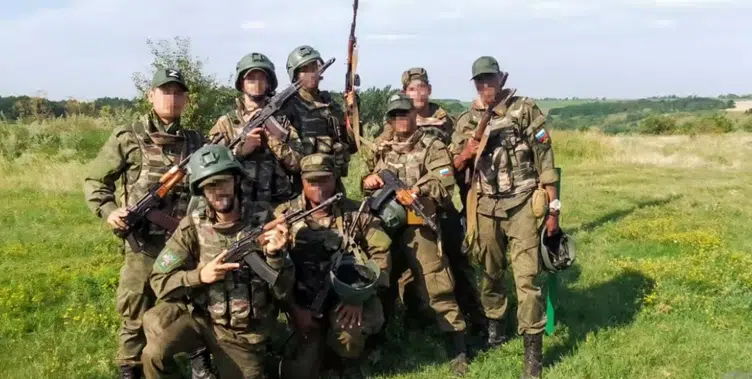
In an official statement, the Ministry of Foreign Affairs in Cuba denied its participation in the armed conflict between Russia and Ukraine.
LIMA, Peru – The Cuban regime assured this Saturday in a statement issued by its Ministry of Foreign Affairs (MINREX) which has no participation in the armed conflict between Russia and Ukraine.
“Our authorities do not have precise information about Cuban nationals who, on their own, have participated or participate in the military forces of both parties in the war,” the official note states.
According to the Castro government, it is “irrefutable” that none of the Cubans identified in Ukraine “has the encouragement, commitment or consent of the Cuban State for their actions.”
The reaction of the dictatorship in Havana comes a week after it became known about a cable from the State Department in the US in which it mobilizes its diplomats worldwide.
In the notice shared by the Reuters agency, Washington encourages pressure against the UN resolution that asks the White House to lift the embargo sanctions imposed on the Cuban regime for decades and shares details about Castroism’s support for Russia’s war in Ukraine.
Last September, the Cuban Resistance Assembly (ARC) reported that the Ukrainian Armed Forces captured a third Cuban citizen who was fighting on the Russian side. The organization has been vital in uncovering Havana’s role alongside Moscow during the offensive on Ukrainian soil.
According to a statement from the organization sent to CubaNet On September 19, this is Ernesto Michel Pérez Alvelaes, born on August 15, 1999 in Trinidad, Cuba, who was a member of the 7th. Motorized Rifle Brigade.
“We categorically reject the mendacious accusations of the US government regarding Cuba’s alleged participation in the conflict in Ukraine. They have not and will not be able to provide any evidence to support these unfounded accusations to support their new campaign against Cuba,” he wrote this weekend. on X (formerly Twitter) the dictator Miguel Díaz-Canel.
According to the current MINREX statement, since 2023 actions have been taken on the Island to neutralize recruitment within the national territory and criminal proceedings have been initiated in this regard.
“In the period from 2023 to 2025, 9 criminal proceedings have been presented to the Cuban courts for the crime of mercenarism, against 40 defendants. In 8 cases, trials have been held, of which in 5 a conviction was handed down against 26 defendants, with sentences between 5 and 14 years of deprivation of liberty. Three trials are pending the Court’s ruling, and one case is pending trial,” he justifies. the note.
Cuban mercenaries at the service of Russia
Congressman Mario Díaz-Balart (FL-26) led a virtual briefing on national security on September 18 in which advisors to the Ukrainian Government and legislators from kyiv explained that some 20,000 Cuban citizens had been recruited by Russia to fight in the war against Ukraine.
The session was announced by the congressman’s office Mario Diaz-Balart “to expose the alarming presence of thousands of Cuban nationals fighting alongside Russia.” In that sense, he highlighted the risks to the security of the United States and the region derived from the alliance between Moscow and Havana.
Vladyslav Vlasyuk, advisor to the president Volodymyr Zelensky Regarding sanctions, he stated: “Currently we are talking about at least 20,000 Cuban mercenaries fighting against Ukraine.” And he added: “We have been able to physically identify more than 1,000 of these mercenaries.”
He also specified that at least 250 contracts would have expired without those recruited being released by Russian forces. “The average monthly salary for Cuban mercenaries in Russia is $2,000 a month,” he said. In addition, he indicated that his average age is 35 years. “On average they die between 140 and 150 days after signing the contract. The shortest known period between signing the contract and death is seven days,” he said.
According to the materials presented during the meeting, the Ukrainian authorities maintain that the recruitment includes operations by Russian recruiters in Cuba and that there are formal complaints from Cuban relatives to Russian authorities for disappearances, non-payments and forced retention after the expiration of contracts. In the examples shown, the case of a Cuban woman with a contract dated January 13, 2025 for 195,000 rubles per month was cited, as well as a criminal case in Russia against the recruiter Yelena Smirnova, who had admitted embezzling salaries of between 300 and 400 Cubans. Letters from detained Cubans who denounced non-payments and the impossibility of leaving units deployed in Crimea were also exposed.
Oleksandr Merezhko, president of the Foreign Relations Commission of the Ukrainian Parliament and member of the Free Cuba Caucus, framed the phenomenon in an authoritarian constellation: “We are dealing with the axis of evil, which includes different countries and different regimes. The Castro regime in Cuba plays a special role in Latin America,” he stated, maintaining that those who help Russia “must be considered complicit in war crimes and other crimes committed by Russia.” The deputy announced that he will advocate before European bodies to recognize the Cuban regime “as a terrorist regime.”