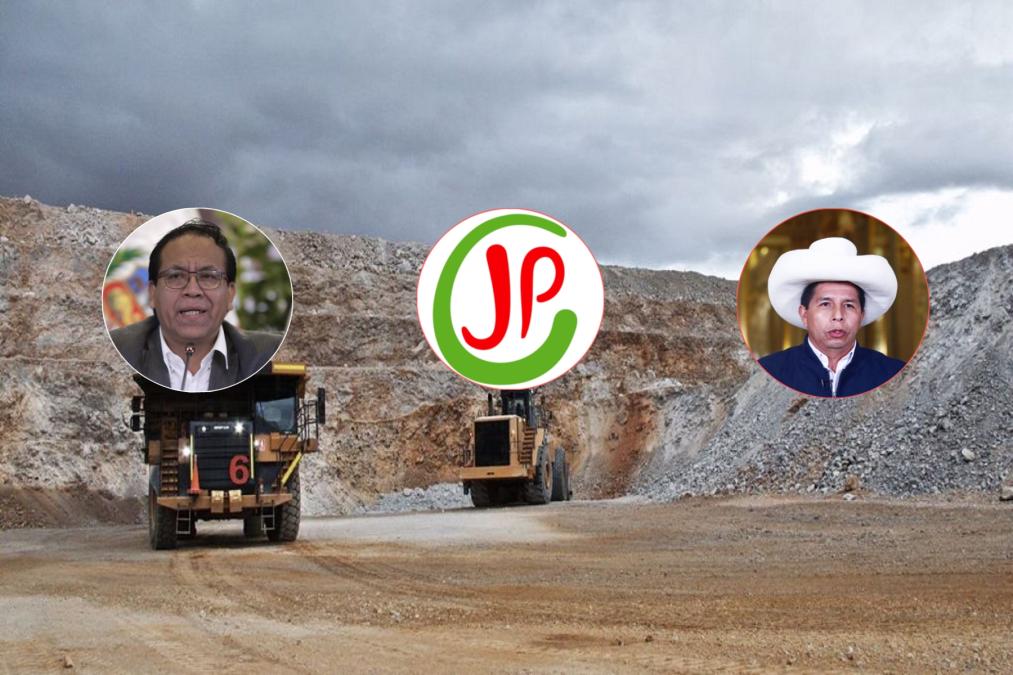
He announced it and fulfilled it. The spokesman of the bench together for Peru (JP), Roberto Sánchez —What party is an ally of the former president Pedro Castillo-, he presented this afternoon at the Energy Commission and Mines Two bills of his authorship.
The first proposes to reduce from 30 to 15 years the expiration of unproductive mining concessions, while the second proposes to expand the integral registration of mining formalization (reinfo) until December 2026.
The next step will be that the aforementioned commission – chaired by the JP legislator, Víctor Cutipa – prepares the respective opinions so that they then pass to the plenary and submitted to vote.
“Ham is always for great mining, and the people have the right to democratization and access to production (mining),” said Sanchez during his presentation.
The congressman also defended his proposal to reverse concessions without productivity, ensuring – without giving names – that many of them, despite not producing, refuse to sign contracts with informal miners, a necessary requirement to advance in their formalization.
In parallel, he insisted on expanding the reinfillment until December 2026, although he admitted that it should be extended until a new law for small mining and artisanal mining (MAPE) is approved.
Danger to legal stability
As reported Peru21JP is not the only group that seeks to shorten the deadlines of mining concessions. Congressmen Paul Gutiérrez (Somos Peru) and Passion Dávila (all with the people), both close to Castillo, also presented projects that propose to reduce the validity of unproductive concessions from 30 to only five years.
Simultaneously, the popular renovation bench – a position to JP and Castillism – presented another initiative to shorten the deadlines of 30 to 20 years.
The context favors these proposals: the Energy and Mines Commission is headed by Cutipa, of JP, a group that accompanied the former president Pedro Castillo in its frustrated 2022 coup d’etat.
https://www.youtube.com/watch?v=ihmvoqpbqyg
Roberto Sánchez exhibition this afternoon before the Energy Commission (Minute 40).
Roberto Sánchez’s bill:
Favored: legal and informal
For Carlos Gálvez, former president of the National Society of Mining, Petroleum and Energy (SNMPE), the background is evident: these initiatives seek to open space to informal and illegal mining.
“The five bills would seek to give them the current concessions, in the 18 million hectares, to illegal and informal miners … they do not want Peru21.
Along the same lines, Víctor Fuentes, public policy manager of the Peruvian Institute of Economics (IPE), questioned the viability of reduced deadlines: “The average mining projects is 40 years. It makes no sense to lower the validity. In the case of copper, it can take 62 years; in gold projects, about 30 years.”
He added: “If you lower that period of concession, the big investors will not arrive because it is not profitable. With 20 years, in front of a project that takes 40 to leave, it simply does not reach. We have already lost competitiveness for social conflict and, in recent years, for illegal mining. That discouraging insecurity to any serious investor.”
Interestingly, political forces that were previously attacked today coincide on the same path. Coyuntural convenience or voting for the next elections?
I knew that
-“The processes take long periods. Antamina took 50 years; Bayóvar, 80 years; and Cerro Verde, 61 years,” recalled Carlos Gálvez.
-The fifth bill on concession expiration was presented on March 24 by Edwin Martínez (Popular Action). It proposes to reduce the deadline to only five years.
Receive your Peru21 by email or by WhatsApp. Subscribe to our enriched digital newspaper. Take advantage of discounts here.