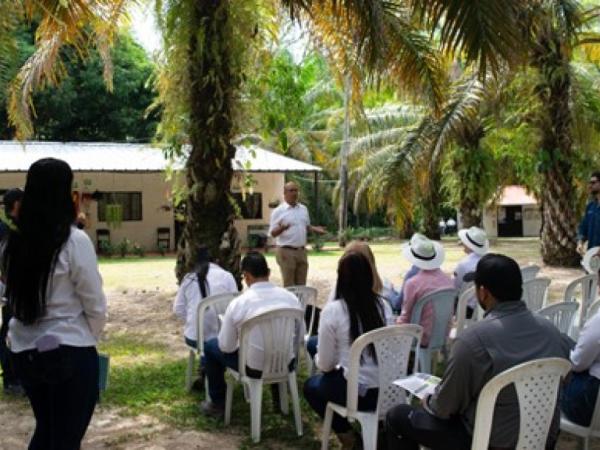
Cargill and Solidaridad complete two years of joint work with oil palm producers in Colombia, within the framework of a global alliance valid until June 2026 that aims to strengthen sustainable practices in the palm oil value chain.
This effort focuses on training farmers, measuring emissions and implementing technical tools to advance environmental criteria within the sector.
(See: Jorge Mario Velásquez joins the Trinity Group Advisory Board)
Since the beginning of the collaboration, 768 palm growers have received sustainability training and 310 actively participate in processes to close gaps in their plantations. The alliance set a goal to train 880 producers and directly link 520 associates to Cargill’s supply chain. With the support of 100 of them, the plantation’s carbon footprint baseline will be built, a key input to guide mitigation actions.
One of the central tools in this strategy is the Ecopalma App, developed by Cenipalma. This platform, designed specifically for the Colombian context, allows measuring the carbon footprint of palm crops and structuring two-year reduction plans. Cargill incorporated the use of this application in its supply chain as part of its corporate climate commitments.
The development of Ecopalma has been gradual. In 2019, it migrated its calculation engine to a web platform to facilitate data capture and estimate greenhouse gas emissions. In 2023 the first mobile version was launched and in 2024 a training cycle began in different regions of the country promoted by Solidaridad and Cargill. Following this evolution, the second version of the App is now available for growers, plantation owners and technical and environmental teams in the sector.
(Read more: Microbusinesses: more than half lack formal financial records)
Carbon footprint of the Colombian palm: 182 kg of CO₂ equivalent per ton of crude oil.
Courtesy
The first results show significant progress. Colombian palm oil has a carbon footprint of 182 kilograms of CO₂ equivalent per ton of crude oila figure that, according to initial analyses, is below that recorded in other producing countries.
The use of the tool also allowed us to identify that the agricultural phase generates a smaller footprint than the industrial phase, due to the ability of crops to capture carbon during their life cycle, estimated to be about 20 years.
José Alejandro Moreno Peralta, Cargill’s sustainability coordinator in Colombia, pointed out that the company maintains a long-term vision on this front. “Our purpose is to feed the world in a sustainable way. We have an ambitious goal: to reduce greenhouse gas emissions by 30% throughout our chain.”, he stated.
(See also: Presence of Spanish companies in Colombia grows almost six times in a decade)

Cargill’s goal: reduce greenhouse gas emissions in its chain by 30%.
iStock
For Solidaridad, progress in measurement is a starting point to strengthen environmental standards. Maria Goretti Esquivel, manager of the organization’s oil palm program in Colombia, highlighted the role of the tool in technical decision-making. “The Ecopalma App is a key starting point to guide sustainability improvement plans”, he indicated.
This initiative is articulated with the sectoral agenda led by Fedepalma, which includes issues such as human rights, labor rights, water management and adaptation to climate change. The joint work seeks to consolidate productive practices aligned with the global challenges of decarbonization and at the same time strengthen the competitiveness of Colombian palm in international markets. The company projects that these efforts will contribute to increasing efficiency in the field and generating benefits for communities linked to the palm value chain in Colombia..
(Read: The Czech footwear brand that has been in Colombia for 57 years and many believe it is national)
DIANA K. RODRÍGUEZ T.
Portfolio Journalist