The National Water and Basic Sanitation Agency (ANA) and the São Paulo State Water Agency (SP-Águas) inform, this Wednesday (31) that the Cantareira System, the main source of water in the metropolitan region of São Paulo, will continue to operate in Band 4 – Restriction, starting this Thursday (January 1).
This occurs when the useful volume of Cantareira is between 20% and 30%. On the last day of the year, the Cantareira System recorded 20.18% of its useful volume, showing a decrease in relation to the 20.99% observed on November 30th.
The system operates in bands based on the amount of water stored.
As the volume still remains above the 20% limit, the operation of the Cantareira system in January 2026 will continue in Band 4 – Restriction. However, if the Cantareira level falls below 20%, the system would enter Band 5 – Special, with even more severe restrictions.
In an official statement, ANA and SP Águas ask that the Basic Sanitation Company of the State of São Paulo (Sabesp) control demand and that the population saves money to prevent the level from reaching the dead volume or the emergency range and, in this way, compromising the water supply in the region.
“The agencies reinforce the importance of adopting operational demand management measures by Sabesp within the scope of water supply services. They also recommend the adoption of measures by other users to preserve the volume of water in the system’s reservoirs”, says the public note.
Withdrawals
With the Cantareira System remaining in band 4, Sabesp will continue to be able to withdraw up to 23 cubic meters per second (m³/s) in January 2026, as provided for in Joint Resolution, No. 925/2017, of the regulatory agency [https://www.gov.br/ana/pt-br/legislacao/resolucoes/resolucoes-regulatorias/2017/925 ] and the Department of Water and Electric Energy (DAEE), of the state of São Paulo.
To supply the capital and metropolitan region, in addition to this volume (23 m³/s authorized from the Cantareira System), Sabesp will be able to use water from the Paraíba do Sul River basin, dammed by the Jaguari Hydroelectric Plant (UHE), in the São José dos Campos region, to “help” the Cantareira. In practice, it is as if it were a transfusion of water from a fuller reservoir to one that needs supply.
Cause
Even in the so-called wet period — the rainy season that runs from October 2025 to May 2026 — the system did not recover sufficiently in December. On the contrary, the drop in useful volume (from 20.99% to 20.18%) keeps the alert on for the consumption of water resources.
The Cantareira
The Cantareira System supplies approximately half of the population of the Metropolitan Region of São Paulo and contributes to meeting the multiple uses of water, with emphasis on supplying Campinas, in the Piracicaba, Capivari and Jundiaí river basins.
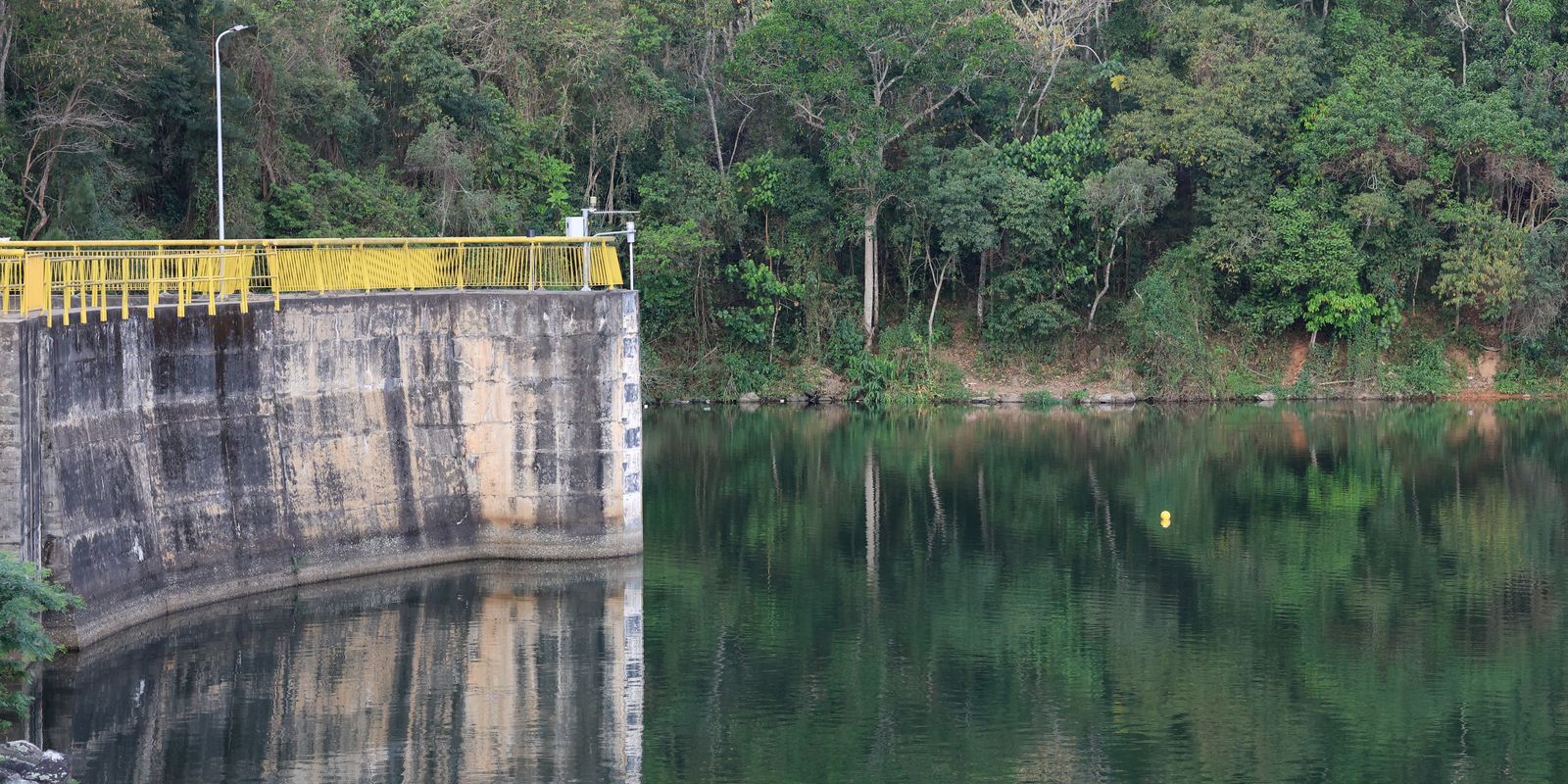
Cantareira is made up of five interconnected reservoirs: Jaguari, Jacareí, Cachoeira, Atibainha and Paiva Castro, with a total useful volume of 981.56 billion liters.
Since 2018, it has also had interconnection between the Jaguari dam (on the Paraíba do Sul river) and the Atibainha dam, which increases water security for Greater São Paulo.
Although its reservoirs are located entirely in the territory of São Paulo, part of the water comes from rivers controlled by the Union, as they have sources and stretches in the state of Minas Gerais, making up the basin of the Piracicaba, Capivari and Jundiaí rivers.
For this reason, ANA and SP Águas monitor data on water levels, flow and stored volume on a daily basis and assess whether the current operating rules are adequate for managing the System’s water resources.