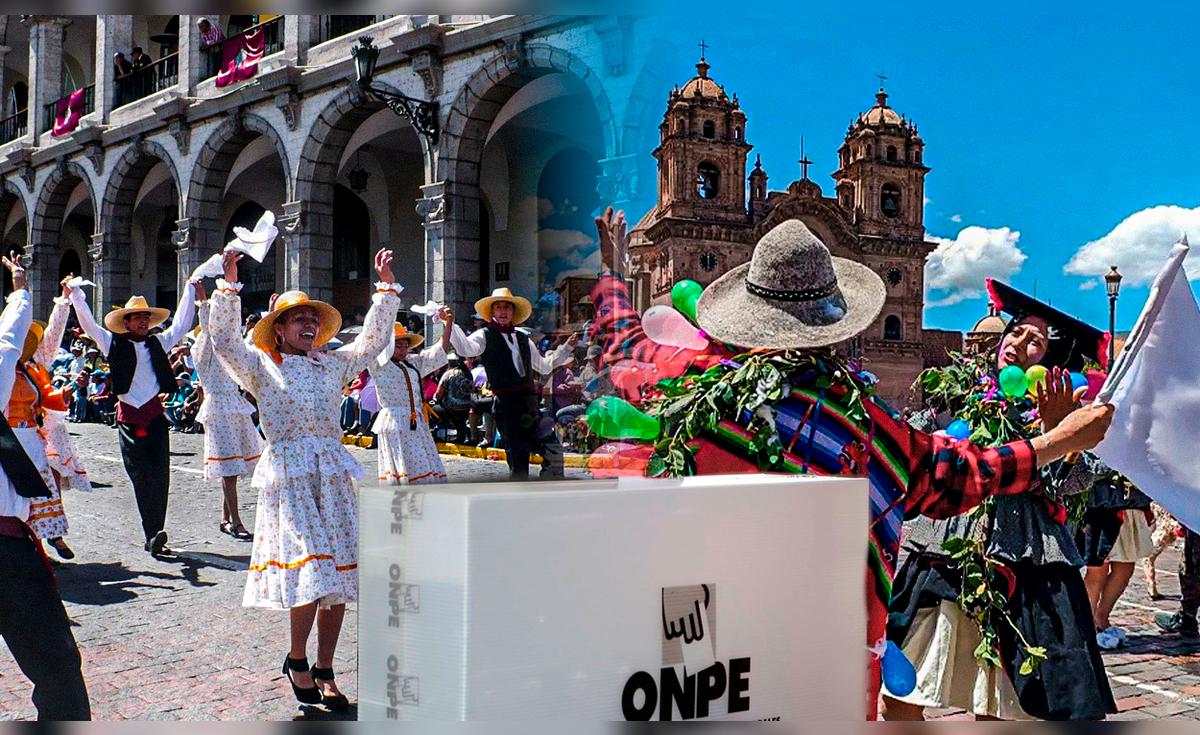
Arequipa, Moquegua, Tacna, Puno, Cusco, Apurimac and Madre de Dios. The southern macro-region of Peru is one of the most important electoral strongholds in each presidential election. Various political analysts maintain that if a candidate manages to obtain solid support from this area, it could facilitate their passage to a second round.
listen to the newsText converted to audio
Artificial intelligence
It is no coincidence: in 2021, in the seven departments mentioned, Pedro Castillo was the candidate with the most votes in all of them. In Puno, for example, it reached 38.69% of the total votes cast, obtaining almost 20 points more than second place. According to historical data from the ONPE, in the entire southern macro-region it obtained 991,583 votes, a figure sufficient to make a decisive difference in a scenario of dispersion among its competitors.
WE RECOMMEND YOU
PNP IS STILL UNDER THE SIGHT: THEY HAVE FACILITATED THE ESCAPE OF ÓSCAR ACUÑA | THE TRUTH IN DEPTH WITH PEDRO SALINAS
By 2026, the electoral weight of the south could be even greater. An initial approximation from Reniec indicates that, among the seven departments, up to 4,305,192 qualified votes could be registered. A figure that would greatly exceed the 3,048,044 in 2021. In percentage, this would represent almost 16.5% of the national total.
But what details make a candidate classified as attractive to the southern regions of Peru? In recent years, the most immediate response delves into a commonplace: “anti-system” candidates, those who break with the neoliberal and pro-establishment corner, are more attractive to this space of the electorate. Is this really so?
An attractive profile for the southern voter
“I’m looking for an honest person, who has not been a congressman because the people who have been there are always linked to corruption,” says Jordan Huacan, a 23-year-old young man from Arequipa, when describing his preferences for the 2026 elections. Five years ago, Huacan annulled his vote in the first round when he did not find any candidate with those characteristics.
In the south, values such as integrity and a sense of community are often fundamental when choosing a presidential option. The vote is cast with distrust of the institutions, but also with a certain degree of hope in renewal. For Katherin Mamani, a political scientist at the Micaela Bastidas National University of Apurímac (Unamba), this part of the country is oriented towards proposals that can articulate policies capable of correcting structural inequality, in dialogue with community idiosyncrasy.
“Historically, the south has experienced coercive state interventions, from political repression to the imposition of extractive projects without prior consultation. This memory of conflict conditions the interpretation of political speeches and the evaluation of candidates. (…) Territorial inequality, experiences of conflict with the State and community dynamics of political organization operate constantly in daily life and reflect the socio-territorial dynamics of the south. Unlike Lima or the north, where logics associated with modernization predominate economic, in the south the vote is intertwined with collective memories of marginality, centralism, political violence and impacts of extractivism,” explains the specialist.
This helps to understand the distrust towards candidates who prioritize values associated with individuality or who are perceived as alien to the region. There are recent examples. The visit of Phillip Butters (Avanza País) to Puno generated an immediate reaction: dozens of citizens disowned him for his statements about the protests, which forced him to be escorted by the Police. Similarly, Keiko Fujimori has been rejected in places like Cusco, where in 2021 she was booed during proselytizing activities.
“The rejection of these figures is explained by historical trajectories of confrontation between the Andean south and political projects associated with centralism, repression and cultural homogenization. In the case of Fujimorism, the memory of forced sterilizations, the militarization of the 90s and the expansion of the extractive model without consultation reaffirm an image of state violence. While in the case of right-wing communicators like Phillip Butters, their public narrative reproduces discourses that anthropology identifies as structural racism. In territories where historical racialization has been a central element of exclusion, these figures represent the continuity of a Lima perspective that devalues what is Andean,” Mamani maintains.
The political scientist questions the view that labels the southern vote as “anti-system.” For her, the electorate rather seeks a political relationship that does not reproduce the historical distance between the State and its communities. “It is not an emotional response, but rather a structural rejection, built from the experience of a State that historically extracts, controls and sanctions the Andean territories,” he says.
Mimetization from Lima
With the start of the electoral campaign, some candidates have tried to position themselves in the southern imagination through actions that draw the attention of an electorate to which they do not belong. Rafael López Aliaga, former mayor of Lima and candidate for Renovación Popular, broadcast an advertising video in which he uses a song by Mercedes Sosa while appearing wearing a chullo and accompanied by his candidate for vice presidency, Jhon Ramos, a native of Huanta (Ayacucho).
The strategy seems obvious: in politics, mimicry seeks to ensure that certain candidates adopt cultural, symbolic or discursive traits of a foreign social group to generate closeness and obtain legitimacy. This can be expressed through changes in speech, aesthetics, cultural references, or even the appropriation of historical claims. The intention is to project belonging and reduce the distance with the target electorate.
Did this first attempt work? For Williams Simaita, a 21-year-old student at the National University of San Agustín in Arequipa, no: “Apparently he identifies with the chullo,” he comments ironically. The images remind him of episodes seen in his history classes: “It reminds me a lot of when Fujimori dressed like that. I see a lot of similarity in his actions. That strategy doesn’t seem valid to me.”
As expected, mimicry is a more frequent practice among certain sectors of Lima and Creoles. Fujimorism has resorted to this resource several times. Before formally launching her candidacy, Keiko Fujimori (Fuerza Popular) appeared dressed in a typical peasant costume on a visit to Combayo, Cajamarca, a region that was also adverse to her in 2021.
Mamani analyzes this practice: “Mimetization reveals a central tension: superficial cultural imitation—use of Andean clothing, routine phrases in Quechua, ritualized visits to fairs or markets—contrasts with the absence of structural commitment to socio-territorial agendas, particularly with the reduction of historical inequalities and the regulation of extractivism. It is a symbolic staging designed to fill a void of legitimacy, but the population perceives it as an instrumental act. In contexts of distrust between the State and communities, the performative does not replace political consistency or the ability to respond to concrete demands.”
Who could take the southern vote?
If several political figures do not connect with the predominant values in the region, the question arises: which candidate could win the trust of the south? For Mamani, the answer points to leadership that comes directly from the territories.
“The profiles that emerge from the territories themselves—communal, regional or union leaders—are usually perceived as authentic actors, in contrast to ‘radically Lima’ figures whose relationship with the south is limited to the electoral cycle. These candidates fit into the category of descriptive representation and shared experience, key in contexts where a strong sociocultural distance persists,” he states.
Looking back, this description helps explain Pedro Castillo’s victory in 2021. Looking at the present, the electoral offer allows for some comparisons. In the left alliance ‘Venceremos’, the figure of Vicente Alanoca, a native of Puno and with a university education and leadership experience in his region, seems to fit this profile better than that of Ronald Atencio, a lawyer trained in Lima. Likewise, Alfonso López-Chau ( Ahora Nación ), a self-declared democratic socialist, would not seem to fit these characteristics either; but, on the other hand, his second vice president, Ruth Buendía – Asháninka leader and environmental leader – could fill that role.
Pedro Castillo could still retain significant political weight. His recent support for the candidacy of Roberto Sánchez, from Together for Peru (JPP), publicly expressed during the hearing for the coup d’état case, could give that candidate some electoral momentum.
“The southern electorate usually values candidates who articulate redistribution agendas, adopt critical stances against centralism, recognize the legitimacy of communal organizational forms, have a territorial trajectory that transcends the electoral situation and build narratives that make historical inequality visible from a perspective of justice. The southern vote not only seeks representation, but also political visibility and recognition of its territorial demands,” Mamani concludes.