The judicial reform establishes that they will reach the charges – of magistrate judges or ministers – who obtain more votes in the election. However, in the case of the Supreme Court of Justice of the Nation (SCJN) the number of suffrages charges greater relevance.
The highest court will consist of nine members (five women and four men) and their presidency will be renewed every two years in a rotary manner depending on the number of votes obtained by each candidacy in the election.
“The Presidency (of the SCJN) corresponding to those who reach greater vote,” stipulates the reform.
For the professor of the Ibero -American University, Ana Laura Magaloni, who achieve the support of groups such as the Mexican Electrician Union (SME), the National Union of Education Workers (SNTE), as well as the clientele vote of Morena, will be the most chances of reaching the Judiciary.
No (they will have the possibility of arriving) those who make their occurrences in the videos. They will arrive (those who have unions support) because it is the only way that can be placed as viable candidates. ”
Ana Laura Magaloni, professor at the Ibero -American University.
They meet with unions
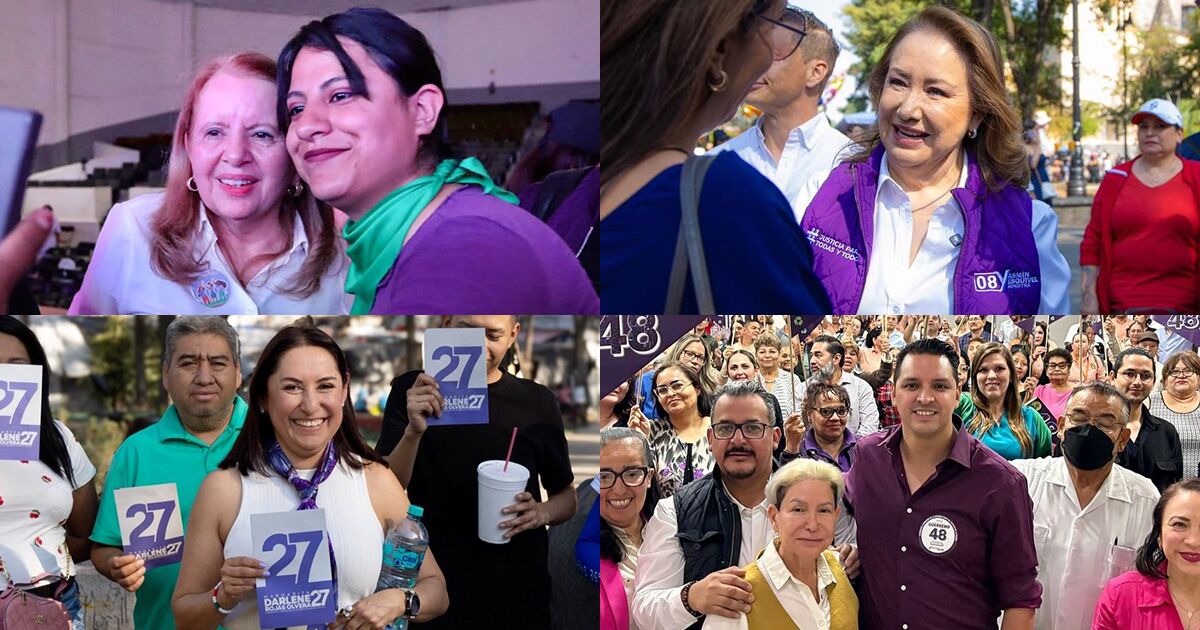
One of the court candidates who has met with unions is Loretta Ortiz. In almost 15 days of campaign, add meetings with four groups. The first was with the SME, headed by Martín Esparza. During that meeting, the contender assured them that, if you arrive at the SCJN, it will seek “justice” for them.
In the same event, the SME leader called it “our candidate” and asked the formerlectricists to go to the boxes on June 1 and vote for the minister, who will be at number 22 on the tickets.
Ortiz also met with the Railroad Workers Union of the Mexican Republic, headed by Víctor Flores and who thanked for “organizing such a significant event.”
Similarly, the minister attended an event of the Labor Congress, which presides over Reyes Soberanis Moreno, in which the National Association of Actors (ANDA) also participated.
Another example is Yasmín Esquivel. The minister and aspiring SCJN started her campaign – March 30 – with the National Union Education Workers (SNTE).
In that meeting, the professors shouted “President, President”, in allusion to the aspiration of Esquivel to head the Court. With the SNTE he had already held a meeting in January, before the formal start of judicial campaigns.
In that meeting at the beginning of the year, the SNTE even released a statement in which he justified his meeting with Esquivel with the argument that the union sought to disseminate the judicial reform among its members.

In the same situation is Darlene Rojas Olverawho has met with several guilds during the campaign, such as the Independent Volkswagen (Sitiavw) Puebla union, who thanked him for listening to it, and with the Mexican alliance Organization of National Ac transporters, where I speak of judicial reform.
Rojas also had a meeting with union leaders from the National Workers ‘Confederation (CTM), the Confederation of Workers and Peasants (CTC) and the Mexican Regional Workers’ Confederation.
Zulema Mosrimagistrate of the second section of the Superior Chamber of the Federal Court of Administrative Justice, also met with the Labor Congress on April 8.
“Listening to the labor sector is also a way of strengthening justice: from commitment, empathy and responsibility. Dialogue with workers is key to justice that responds to the reality of the country,” the candidate posted on said event.
Mosri also met this week with the Caribbean Business Coordinating Council to “listen and share ideas” about the judicial system.

Also figure Aristides Rodrigo Guerrerowho met with Section 48 of the National Union of Workers of the Ministry of Health in Tabasco, where he defended that the contestants have these types of meetings with guilds and groups.
“It would not have to prohibit yourself, the vote is definitely universal, secret and non -transferable. The only thing we did today was to talk with the workers,” the candidate argued.
The magistrate Estela Fuentes JiménezPresident of the Administrative Court of Justice, said on April 8 an meeting with members of the National Vanguard of Workers of the National Institute of Fine Arts (Inbal).
During his participation, Fuentes highlighted the importance of administrative justice against “abusive authoritarianism”, as well as judicial democratization through the appointment of judges by popular vote.
Fuentes also met on April 5 with the Popular Revolutionary Union Emiliano Zapata (UPREZ) in Nezahualcóyotl, State of Mexico, and with the Union of Workers of the Radiodifusion, Television and Telecommunications Industry, on March 31.
The minister Lenia Batres He has prioritized meetings in universities, although one of his appearances at the campaign start was in the historic center of the CDMX, surrounded by Tepito merchants and brunette’s supporters.
“People do know how to choose, people do know justice. I am the only one who is starting with people, in the street, in open space,” he said in one of his events.

Ricardo Ortega, director of the Law Department of the Ibero -American University, considers that the judicial reform created a “perverse system” in which the candidates are in need of assuming electoral commitments to achieve sufficient support.
The academic agrees that, given the “huge” disinterest of citizenship, the lack of incentives to vote and the difficulty involved in the ballots, who will have the opportunity to win will be those who have the support of unions and political parties.