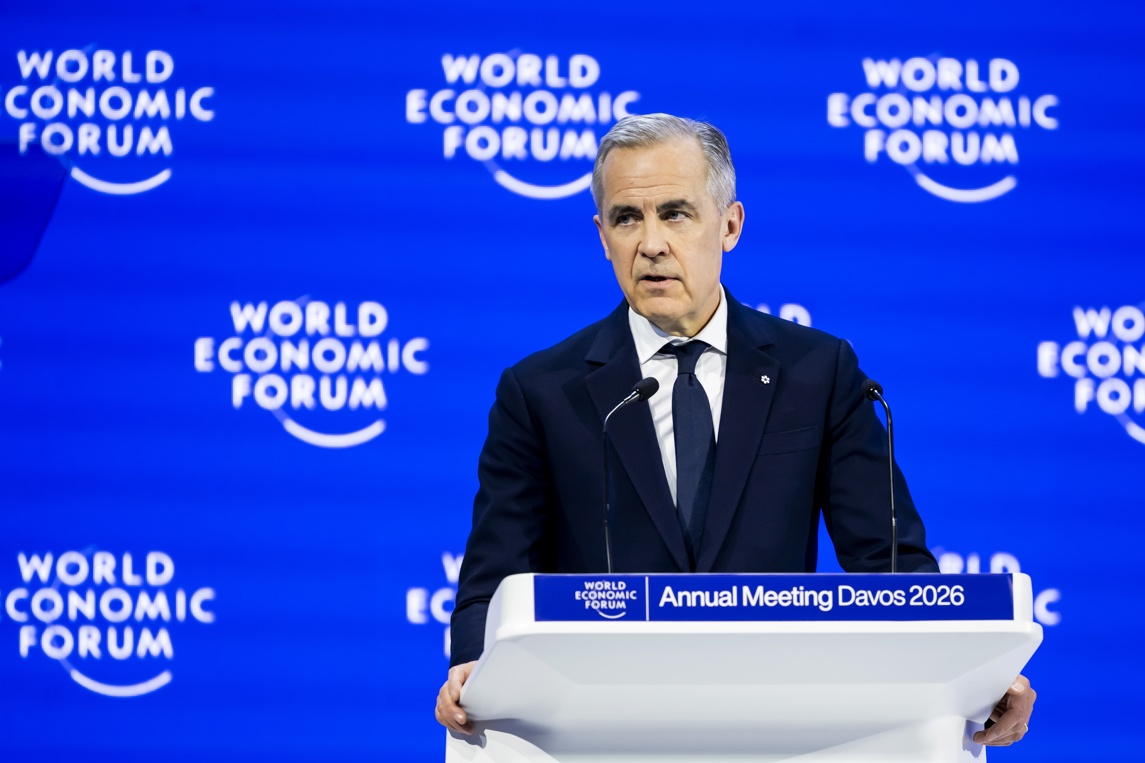
Canadian Prime Minister Mark Carney gave a powerful speech and politically risky this Tuesday at the World Economic Forum in Davos, in which he declared that the international order led by the United States has come to an end and that middle powers like Canada must adapt to avoid falling victims to the “coercion” of more powerful actors.
“Let’s be direct. We are in the middle of a breakup, not a transition,” he said. Carney before world leaders gathered at the Swiss ski resort, in a speech that, without mentioning US President Donald Trump by name, clearly pointed towards Washington. The reference to “economic coercion” and the rejection of tariffs on Greenland are unequivocal.
The message is a call not to be submissive waiting for protection from Washington. Its recent statements and actions regarding China constitute a “third way,” something that Canada historically avoided and that could prove inspiring to other countries and regional blocs.
The end of a “pleasant fiction”
The Canadian president used a reference to the book The power of the powerless, by Czech writer and politician Václav Havel, to illustrate his argument about how middle powers have sustained the illusion that the international rules-based order continues to function as advertised.
In it, Havel posed a simple question: how was the communist system sustained?
His answer began with a greengrocer. Every morning, this merchant puts a sign in his window: “Workers of the world, unite!” He doesn’t believe it. Nobody believes it. But put up the sign anyway—to avoid trouble, to signal compliance, to get along with the system. And since all the merchants on all the streets do the same, the system persists.
Not just through violence, but through the participation of ordinary people in rituals that they privately know are false.
Havel called this “living inside a lie.” The power of the system comes not from its truth, but from everyone’s willingness to act as if it were true. And its fragility comes from the same source: when even a single person stops acting—when the greengrocer takes down his sign—the illusion begins to crack.
It’s time for companies and countries to take down their signs.
“For decades, countries like Canada prospered under what we called the rules-based international order,” Carney explained. “We knew that the story was partially false, that the strongest would exempt themselves when convenient, that trade rules were applied asymmetrically. This fiction was useful. But this agreement no longer works.”
The prime minister warned that in the last two decades, great powers have begun to use economic integration as a weapon: “Tariffs as leverage, financial infrastructure as coercion, supply chains as vulnerabilities to exploit.”
A call for unity of the middle powers
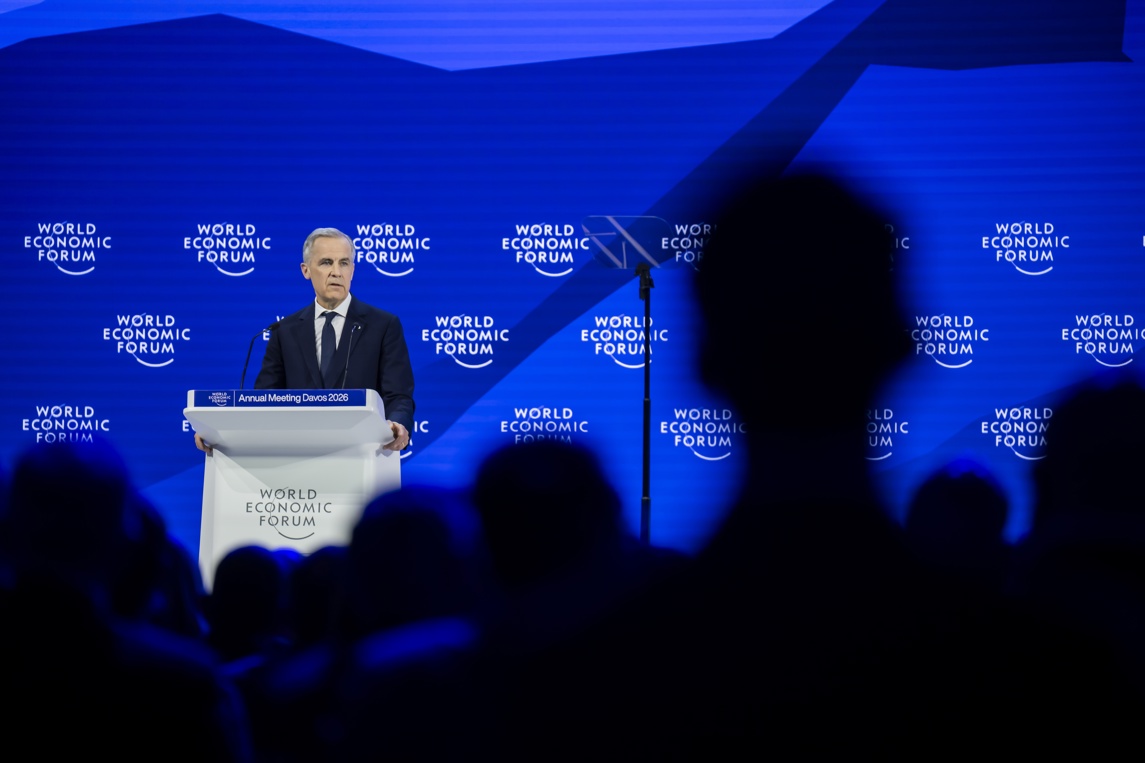
In his speech before the forum, Carney emphasized that the middle powers must act together to survive in this new context: “The middle powers must act together because if you are not at the table, you are on the menu.”
“The great powers can afford to go alone. They have the market size, the military capacity and the leverage to dictate terms. The middle powers do not,” he said. “When we only negotiate bilaterally with a hegemon, we negotiate from weakness. We accept what is offered. We compete with each other to be the most accommodating. This is not sovereignty. It is the representation of sovereignty while accepting subordination.”
About Greenland
Carney’s speech takes on special relevance amid President Trump’s threats to impose tariffs on European countries that oppose his efforts to acquire control of Greenland, the autonomous Danish territory.
“On Arctic sovereignty, we stand firmly with Greenland and Denmark, and fully support their unique right to determine the future of Greenland,” declared the Canadian prime minister. “Our commitment to NATO Article 5 is unwavering.”
Carney added that Canada “strongly opposes” tariffs related to Greenland and calls for “focused conversations to achieve our shared goals of security and prosperity in the Arctic.”
A new approach for Canada
The prime minister outlined Canada’s new strategy, which he called “values-based realism” — a term he borrowed from Finnish President Alexander Stubb — that combines commitments to sovereignty and human rights with pragmatism in a fragmented world.
Since taking office, the Carney government has implemented significant changes: doubling defense spending by the end of the decade, rapidly diversifying trade by signing 12 trade and security agreements on four continents in six months, and moving even closer to the European Union.
We are committed to broad and strategic engagement, with our eyes wide open. We actively confront the world as it is, we do not expect the world as we would like it to be. Canada is calibrating its relationships so that their depth reflects our values. We are prioritizing broad engagement to maximize our influence, given the fluidity of the world, the risks involved and what is at stake for what comes next. We no longer depend solely on the strength of our values, but also on the value of our strength.
We are building that strength at home. Since my government came to power, we have reduced taxes on income, capital gains, and business investment, removed all federal barriers to interprovincial trade, and are accelerating $1 trillion in investments in energy, artificial intelligence, critical minerals, new trade corridors, and beyond. We are doubling our defense spending by 2030, and we are doing it in ways that strengthen our domestic industries.
We are rapidly diversifying abroad. We have agreed a comprehensive strategic partnership with the European Union, which includes our accession to SAFE, the European Defense Acquisition Facilities. We have signed twelve other trade and security agreements on four continents in the last six months. In recent days, we have concluded new strategic partnerships with China and Qatar. We are negotiating free trade pacts with India, ASEAN, Thailand, the Philippines and Mercosur.
“Canadians know that our old, comfortable assumption that our geography and alliance memberships automatically conferred prosperity and security is no longer valid,” he said.
Canada as an investment power
In his speech, Carney also presented Canada as an attractive destination for global investment: “Canada has what the world wants. We are an energy superpower. We have vast reserves of critical minerals. We have the most educated population in the world,” he noted, adding that the country has sophisticated pension funds and “a government with immense fiscal capacity to act decisively.”
The prime minister concluded with a message about the need to face reality: “The old order is not going to return. We should not regret it. Nostalgia is not a strategy. But we believe that from the fracture, we can build something bigger, better, stronger, fairer.”
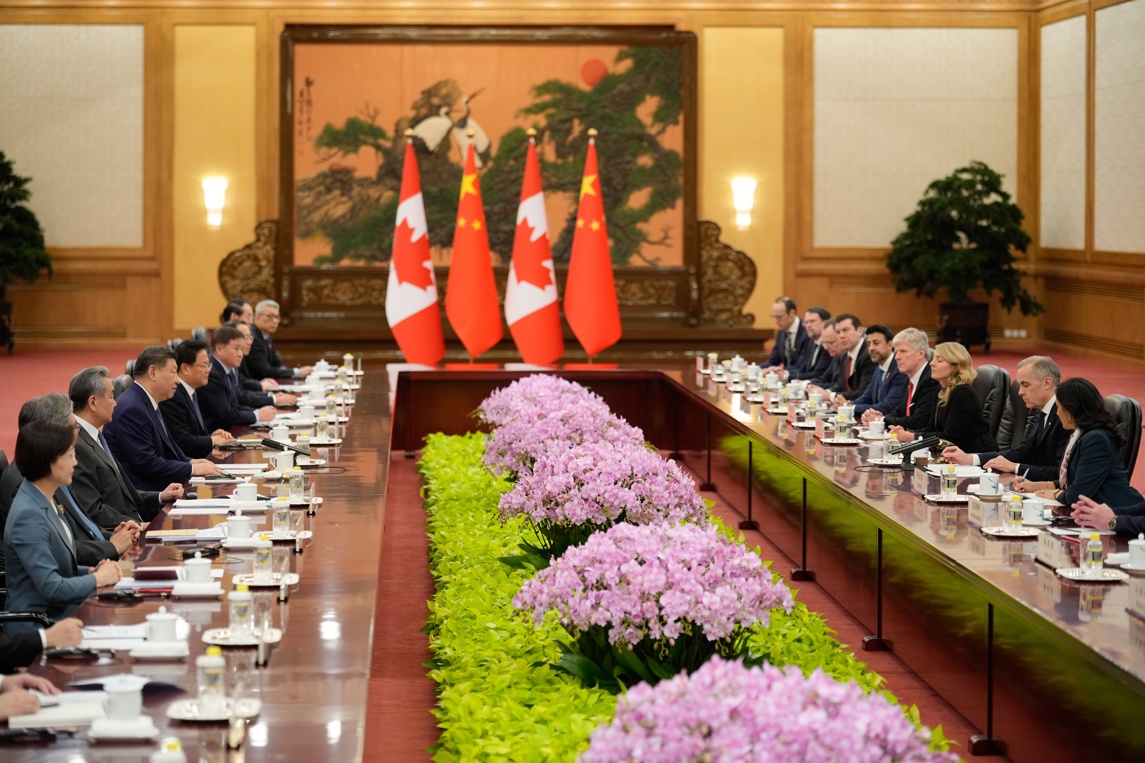
Canada-China: a way out of the confrontation
Carney’s participation in Davos caps a global trip that included a high-level meeting with Chinese President Xi Jinping — the first visit by a Canadian prime minister to China in eight years — and meetings in Qatar.
Carney, who took office in March 2025 after Justin Trudeau, announced on January 16 an agreement that ends months of trade war between Ottawa and Beijing.
The pact, result of the first visit by a Canadian prime minister to China since 2017contemplates significant tariff reductions in strategic sectors for both economies.
Under the terms of the agreement, Canada will allow the entry of up to 49 thousand Chinese electric vehicles with a 6.1% tariffwell below the 100% that had been imposed in 2024.
In exchange, China will reduce tariffs on canola canadian to approximately 15% for Marchfrom the current combined level of 84%, and will eliminate tariffs on products such as lobster, crab and peas.
The conflict had begun when the Trudeau government, following in Washington’s footsteps, imposed a 100% tariff on Chinese electric vehicles and 25% on steel and aluminum in September 2024.
China responded in March 2025 with tariffs on more than $2.6 billion in Canadian agricultural and seafood products, including canola oil, pork and seafood, leading to a 10.4% drop in Chinese imports of Canadian products during 2025.
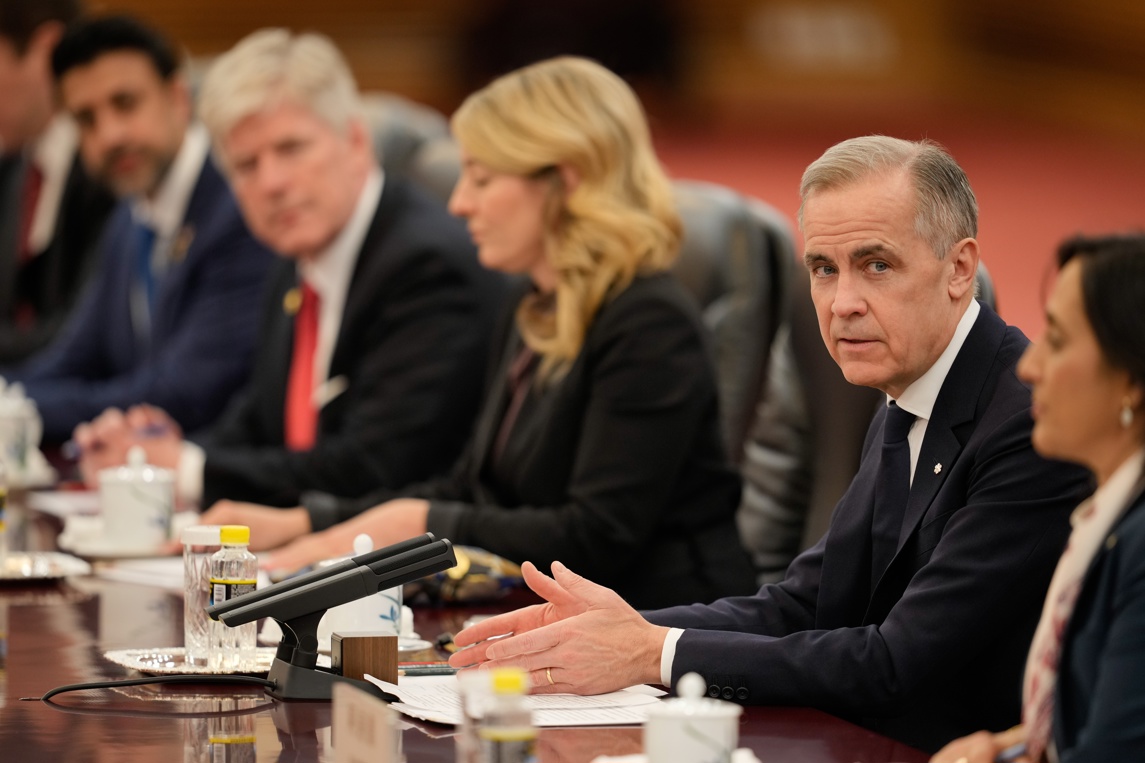
Canada’s response: strategic diversification
For Canada, whose largest trading partner is the United States, Trump’s erratic policies have created an urgent need to diversify its markets. Prime Minister Carney has been explicit about this.
During his visit to Beijing, he declared that the agreement with China provides “an example to the world of cooperation in the midst of a global time of division and disorder.”
The numbers support this strategy. Canadian crude oil exports to China reached a record 7.3 million barrels in March 2025driven by the expansion of the Trans Mountain pipeline.
China has become the largest buyer of the pipeline’s additional production, especially after reduce its imports of US oil due to Trump’s tariffs.
In the first half of 2025, Canadian exports to China reached 16 billion Canadian dollarsan increase of 12% compared to the same period in 2024, despite trade tensions. China remains Canada’s third most important trading partner, after the United States and the European Union.
The Carney government has adopted what it describes as a “tiered engagement approach” with China: deeper cooperation in certain sectors while maintaining restrictions in sensitive areas. This strategy seeks to balance economic interests with national security concerns, particularly in the face of US pressure to limit ties with Beijing.
China, for its part, sees this opening as an opportunity to weaken the cohesion of the alliances led by Washington. He Chinese ambassador to Canada, Wang Diemphasized in October 2025 that “relations between China and Canada should not be hijacked by ideological prejudices or dominated by differences,” pointing out the economic complementarity between both countries.