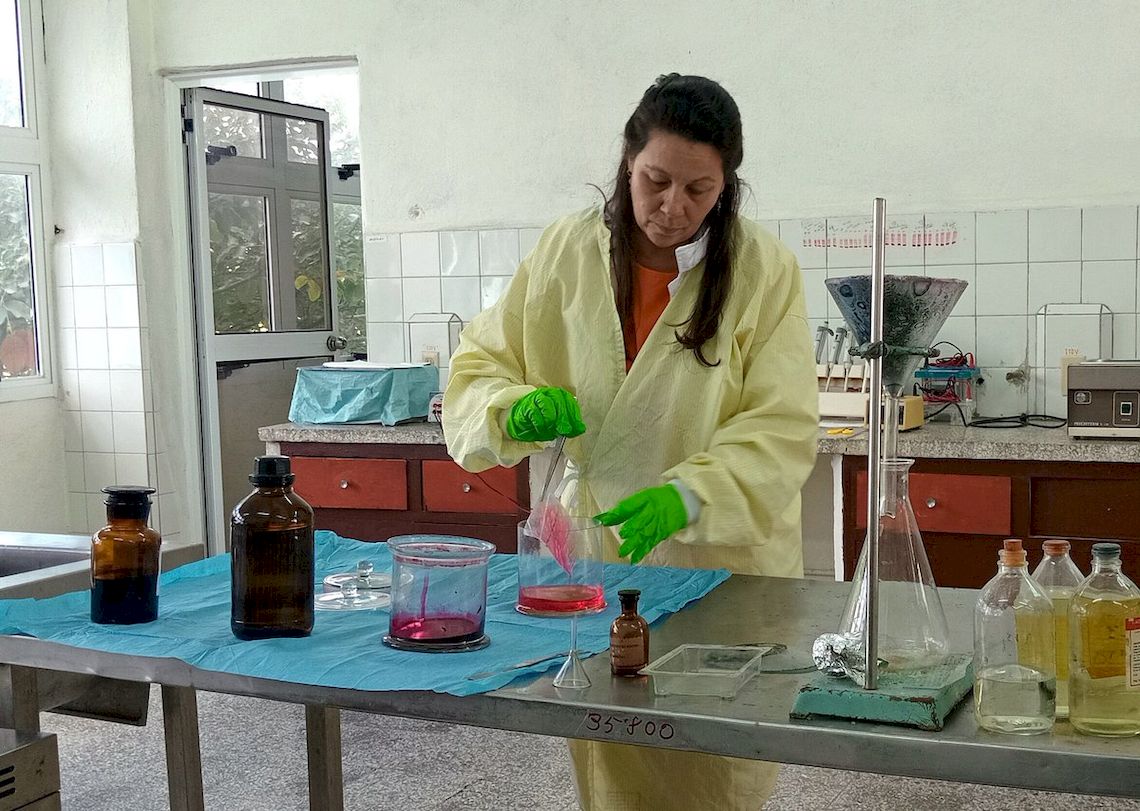
The Center for Immunology and Biological Products of Camagüey (CENIPBI) deepens international studies on Santa Caña, in collaboration with Italian laboratories to validate their therapeutic potential, revealed a dispatch of the agency Latin press.
Researchers sent samples to Italy for advanced physical-chemical analysis of this plant with antihypertensive properties, said the source.
International collaboration to validate the Santa Caña
The project on the Santa Caña is part of a strategic cooperation with Avoca, a leading Italian company in natural health accessories.
Founded in 1978, it emphasizes the research, production and marketing of natural health and well -being products. It specializes in phytotherapy, that is, the use of medicinal plants to treat diseases and maintain health.
This alliance allows Cuba to carry out meticulous studies on the metabolites present in the Santa Caña in order to grant medicinal added value to the plant and guarantee its effectiveness and safety.
Gerardo Brunet, director of the Cuban Center, stressed the importance of this collaboration to raise the scientific standard of the study and strengthen the national production of medicines based on medicinal plants.
Clinical research and practical application in Cuba
The investigation does not remain in the laboratory, because in 2016 a controlled clinical trial was carried out in the Venezuela municipality, Ciego de Ávila province, which demonstrated the efficacy of a 20 % Santa Caña dye to control blood pressure in older adults.
The study evidenced significant improvement in patients treated with this tincture regarding the control group that received conventional treatment, highlighting the value of natural medicine in a country where hypertension is a health problem.
According to the results of the National Health Survey, carried out between 2018 and 2019, the prevalence of arterial hypertension in Cuba was 37.3 %, superior in women with 40.2 %, both globally and in the urban and rural geographical areas, with differences between sexes that were all significant.
The hypertensive of the two sexes in urban areas predominated and hypertension increased as the age did. In turn, people with black skin color prevailed with 44.9 % and that difference was significant, according to scientific valuations of the demographic exercise.
Building academic and scientific networks
The CENIPBI has integrated this research in the mastery in natural and traditional medicine, strengthening a scientific network that promotes the reasoned and effective use of natural health resources. The center also develops specialized genetic and diagnostic tests.
The collaboration with ABOCA has led to the donation of high quality natural medicines for the Cuban population, especially for the treatment of digestive conditions and problems in pediatric ages.
Founded in 1994 at the University of Medical Sciences of Camagüey, the CENIPBI has established itself as a regional reference in biomedical research, combining cutting -edge research with a social vision that prioritizes the needs of the community.
Santa Caña, Properties
According to Cuban pharmacological authorities and various scientific studies, Santa Caña (Cymbopogon citratus) has multiple recognized medicinal uses that make it a valuable resource within Cuban natural and traditional medicine.
Among its therapeutic properties, antihypertensive and hypotensive, antispasmodic and antiasmatic stand out, in addition to providing antifungal and antibacterial functions.
The Santa Caña is also attributed carminative properties (gase relief), digestive, diaphoretic (promo promotion to lower fever), anxiolytics (anxiety reduction), expectorant, anticatarral, antitusive (cough relief), and feverish (fever reduction).
Commonly used pharmaceutical preparations include infusions, tinctures and fluid extracts of their leaves, administered both orally and topically.