He Lima Bar Association (CAL) rejected lhe recent decision of the Constitutional Court (TC) that declared Law 32107 constitutional, norm that specifies the scope of crimes against humanity. The union’s Board of Directors maintained that this ruling opens a risk of impunity by limiting investigations into events committed before 2002.
listen to the newsText converted to audio
Artificial intelligence
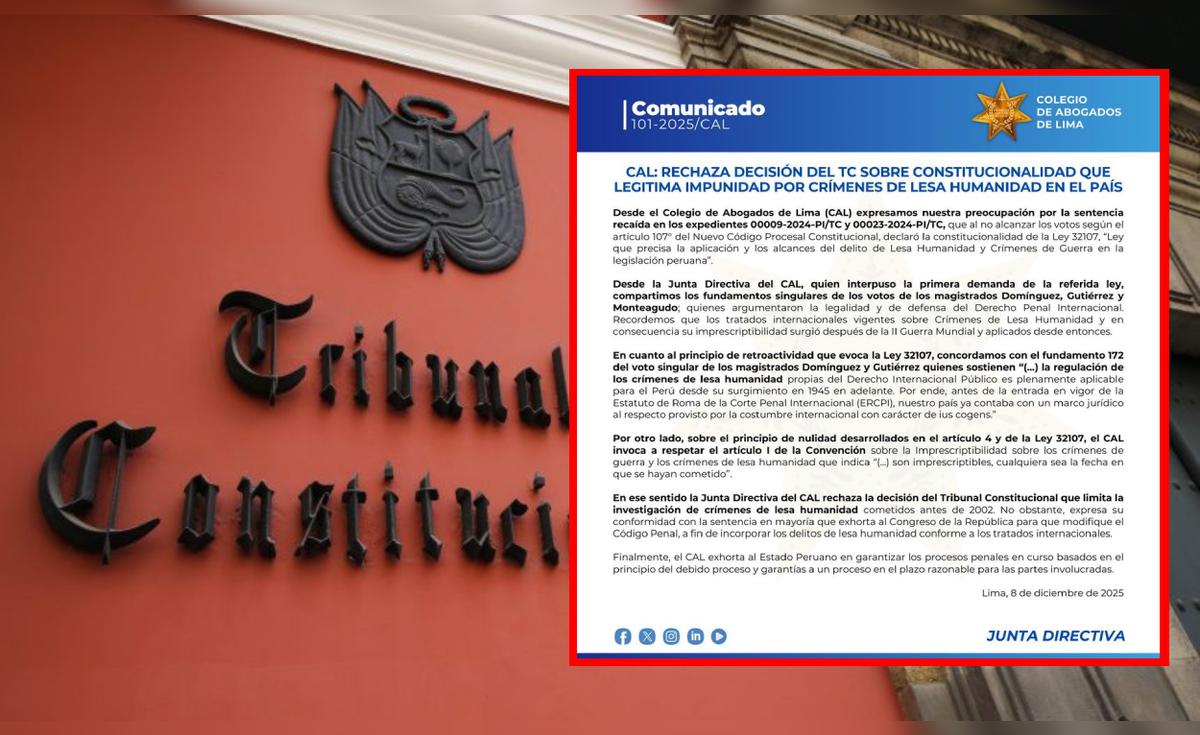
“From the Lima Bar Association (CAL) we express our concern about the sentence handed down in files 00009-2024-PI/TC and 00023-2024-PI/TC, which, by not reaching the votes according to article 107 of the New Constitutional Procedural Code, declared the constitutionality of Law 32107, “Law that specifies the application and scope of the crime Against Humanity and War Crimes in Peruvian legislation,” the statement reads.
WE RECOMMEND YOU
DELIA ESPINOZA FIGHTS BACK AND CRITICAL ELECTIONS | WITHOUT SCRIPT WITH ROSA MARÍA PALACIOS
CAL statement. Photo: X
The CAL recalled that international treaties on crimes against humanity, in particular the rule of imprescriptibility, have been applicable since the end of the Second World War and are part of customary international law. The union welcomed that the singular votes of the magistrates Domínguez, Gutiérrez and Monteagudo have recognized this legal framework and the validity of ius cogens in the country.
“In that sense, the CAL Board of Directors rejects the decision of the Constitutional Court that limits the investigation of crimes against humanity committed before 2002. However, it expresses its agreement with the majority ruling that urges the Congress of the Republic to modify the Penal Code, in order to incorporate crimes against humanity in accordance with international treaties,” they maintained.
Finally, the Lima Bar Association urged the Peruvian State to guarantee that ongoing criminal proceedings are carried out respecting due process and within a reasonable period of time, in accordance with the international obligations assumed by the country.
TC declares unfounded lawsuits against the Law that prescribes crimes against humanity
The Constitutional Courtl (TC) decided to keep Law 32107 in force – which allows the prescription of crimes against humanity committed before 2002 – by declaring unfounded the claims of unconstitutionality presented by the Lima Bar Association and the Public Ministry.
The rule was not annulled because it only obtained four votes to be declared unconstitutional, when five were required. The magistrates Pacheco Zerga, Morales Saravia, Ochoa Cardich and Hernández Chávez supported the validity of the law, while Domínguez Haro, Gutiérrez Ticse and Monteagudo Valdez They voted against through a singular vote.