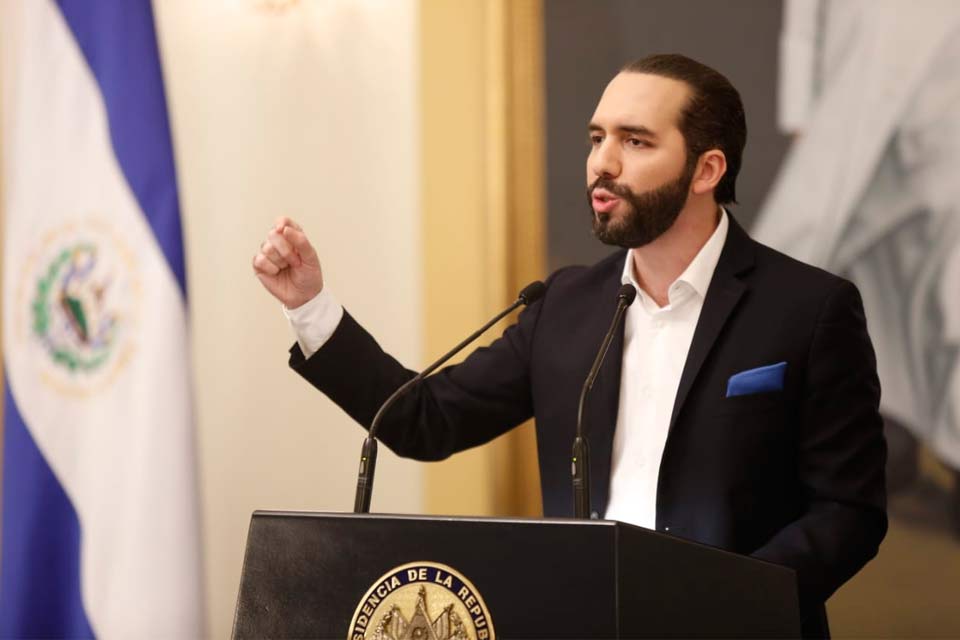
The president of El Salvador, Nayib Bukele, obtained this Thursday via free for his indefinite re -election, after Congress, under his control, approved a deep constitutional reform that also extended the government mandate from five to six years
Bukele, 44, governs since 2019 and was re -elected in 2024 with 85% of the votes, which gave him an almost absolute domain over all powers and institutions of the State, in which the opposition of “dictatorship.”
In an express procedure, the 57 official deputies, of a Legislative Assembly of 60 seats, decided to allow “re -unreserved re -election”, expand the government mandate, synchronize the presidential, legislative and municipal elections, and eliminate the second electoral round.
Pyrotechnic fires broke out in the main square of the Historic Center of San Salvador, while the legislators ratified the constitutional reform in a second plenary session convened at night, in an expedited entry into force.
The Congress also shortened the current presidential mandate – which concluded in 2029 – to hold general elections in March 2027, in which Bukele will participate after the indefinite presidential re -election can be enabled.
Bukele enjoys enormous popularity for his “war” against gangs that reduced violence in the country to historical minimums. But its security policy is based on an exception regime criticized by human rights groups because it allows mass arrests without court order.
The constitutional reform was presented by the officials after a wave of arrests against human rights and critical defenders, which has forced dozens of journalists and humanitarian activists into exile.
*Also read: Venezuelans sent to the CECOT: “We had the bad luck of falling into that blacklist”
“Democracy has died”
In a bus stop in northern San Salvador, Master Mauricio Acevedo, 41, said he was not soping. «Although many works have been good, the tendency to bad will increase. In the end we will only have witnesses of what happens, ”he told AFP.
The official deputy Ana Figueroa, who presented the reform, celebrated that Salvadorans now “will be able to decide how long support their president.”
«This day democracy has died in El Salvador. The masks were removed, ”said the opponent Marcela Villatoro, who criticized the reform when the country enters a week of vacation:” They are cynical. “
For Juanita Goebertus, director of Human Rights Watch (HRW), with the indefinite re -election El Salvador travels “the same path as Venezuela.” “It begins with a leader who uses his popularity to concentrate power, and ends in dictatorship,” he wrote on the social network X.
“The reforms lead to a total imbalance in democracy that no longer exists,” the Coordinator of the Non -Governmental Human Rights Commission, Miguel Montenegro, told the AFP.
In his speech for the first year of his second term, Bukele said he is “without care” to call him “dictator”, before the wave of criticism against him for the arrests of humanitarian activists.
“Repressive climbing”
Loyal to his “friend” Donald Trump, his international image was fogged for having maintained for four months incommunicado in the megacárcel that he built for gang members 252 Venezuelans, who when released denounced torture and abuse.
Embroeded by its relationship with Trump, Bukele’s government arrested Human Rights defenders last June and June, including the outstanding lawyer Ruth López, who denounced alleged cases of government corruption.
The organization where López worked, Chrysal, recently departed into exile after denouncing a “repressive escalation.”
Human rights groups say that Bukele uses against their critics, to silence them, the exception regime that has been maintained in the country for three years, and that it limits freedoms and allows arrests without court order.
Under the state of exception, some 88,000 people accused of being gang members or accomplices have been arrested. According to Oenegés as Chrysal and Legal Socorro, thousands have been arbitrarily detained and about 430 have died in prison.
Already in 2024, Bukele’s re -election had been questioned because, despite being constitutionally prohibited, it was allowed by a ruling of related judges.
*Journalism in Venezuela is exercised in a hostile environment for the press with dozens of legal instruments arranged for the punishment of the word, especially the laws “against hatred”, “against fascism” and “against blockade.” This content was written taking into consideration the threats and limits that, consequently, have been imposed on the dissemination of information from within the country.
Post views: 518