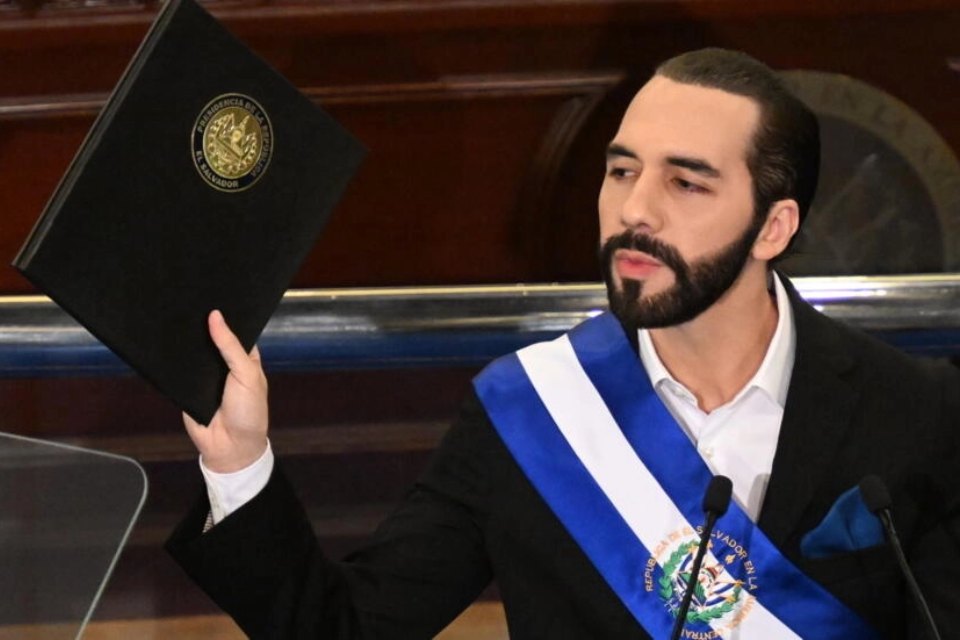
The Salvadoran president, Nayib Bukele, rejected this Sunday that the approval in El Salvador of the indefinite presidential re -election is the “end of democracy”, ensuring that criticism of that decision is due to the fact that a “small and poor” country took it
In his first reaction to the wave of criticism from international human rights organizations, Nayib Bukele said in the Social network x that “90% of developed countries allow the indefinite re -election of their head of government, and no one is flimered.”
“But when a small and poor country as El Salvador tries to do the same, it is suddenly the end of democracy,” the 44 -year -old president ironized, who came to power in 2019 and was re -elected in 2024 with 85% of votes that allowed him to have almost absolute control of all the powers of the State.
“Of course, they will rush to point out that ‘a parliamentary system is not the same as a presidential one’, as if that technicalism justified the double standard. But let’s be sincere, that’s nothing more than a pretext, ”he added in the message, written in English.
According to Bukele, if El Salvador declared a parliamentary monarchy “exactly the same rules as the United Kingdom, Spain or Denmark,” the criticisms would continue.
«Because the problem is not the system, but the fact that a poor country dares to act like a sovereign country. You should not do what they do. You should do what they tell you. And you are expected to stay in your lane, ”he added.
Organizations such as Amnesty International, Human Rights Watch (HRW), the Washington Office for Latin American Affairs (WOLA) considered the decision as a “deadly blow” to democracy and a “manipulation” to the Constitution to favor Bukele’s ambitions of power.
The Salvadoran president, who assures that he is unattended to be called “dictator,” enjoys great popularity for his “war” against gangs, which he began in 2022 and reduced to historical minimums violence in the Central American country.
But human rights groups criticize their security policy because it is based on an exception regime that allows massive arrests without court order and restricts freedoms.
The constitutional reform was approved after a wave of arrests against human rights and critical defenders, which has forced exile to dozens of journalists and humanitarian activists.
*Journalism in Venezuela is exercised in a hostile environment for the press with dozens of legal instruments arranged for the punishment of the word, especially the laws “against hatred”, “against fascism” and “against blockade.” This content was written taking into consideration the threats and limits that, consequently, have been imposed on the dissemination of information from within the country.
Post views: 303