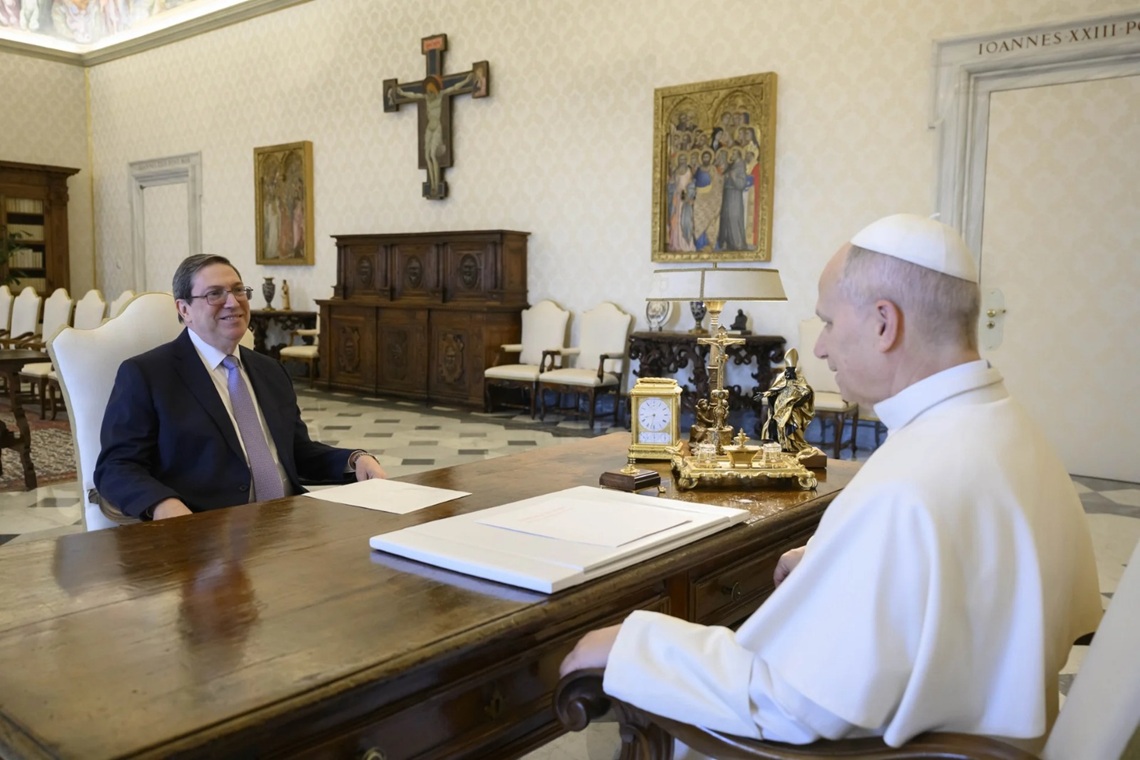
The Cuban Foreign Minister, Bruno Rodríguez, met this Saturday with the Pope Leo XIV in the Vatican, amid the current tensions between the island and the United States.
The audience between the American pontiff and the minister was confirmed in the Vatican’s daily bulletin, in which Rodríguez is mentioned as a “special envoy” of Cuban President Miguel Díaz-Canel.
Cuba’s own Foreign Minister later confirmed the meeting on his profile on the social network X, in a message with two photographs with the pope.
“I deeply thank His Holiness Leo XIV for the honor of having received me in Audience as Special Envoy of the President of the Republic of Cuba,” he wrote without providing other details.
I deeply thank His Holiness Leo XIV (@Pontifex_es) the honor of having received me at the Audiencia as Special Envoy of the President of the Republic of #Cuba, @DiazCanelB. pic.twitter.com/EU2cdnQkAU
— Bruno Rodríguez P (@BrunoRguezP) February 28, 2026
Rodríguez, who in recent weeks has led a diplomatic offensive in search of support against Washington’s oil siege, also held a meeting with the Secretary of State of the Holy See, Cardinal Pietro Parolin, according to the agency. EFE.
Tension with Washington as a backdrop
The visit of the Cuban Foreign Minister to the Vatican takes place in the midst of tensions between Havana and Washington. The American president, Donald Trump, has assured that his country could choose to “a friendly takeover of Cuba”.
A week ago the Vatican also received two American diplomats: the chargé d’affaires in Havana, Mike Hammer, and the ambassador to the Holy See, Brian Burh. Specifically, the Vatican Secretary for Relations with States, Paul Richard Gallagher, received them to talk about the situation in Cuba.
Hammer also met last Wednesday in Rome with a group of Cuban exiles and, in statements to EFEassured that in the Vatican he has held conversations to “see what can be done to try to ensure that change can be achieved peacefully” in Cuba.
Pope Leo XIV himself has asked Washington and Havana for “sincere and effective dialogue to avoid violence and any action that could increase the suffering of the Cuban people.”
These days the Supreme Pontiff has also received in audience the bishop of Guantánamo and Baracoa, Monsignor Silvano Pedroso Montalvo, while the rest of the prelates who reside on the island have not been able to travel to Rome for the traditional ‘ad limina’ visit, which they must complete every five years, due to the fuel crisis.
Condemns attacks on Iran
Also this Saturday, Bruno Rodríguez condemned the attacks by Israel and the US against Iran, and called for mobilization of the international community.
“These irresponsible actions violate international peace and security, and constitute a clear transgression of International Law and the UN Charter,” considered the Cuban Foreign Minister.
“The international community must mobilize to immediately stop the devious aggression,” he added in a message on social network.
Along the same lines, Díaz-Canel pointed out that the attacks “ruin for the second time the efforts of diplomacy in relation to the nuclear issue, and endanger regional and international peace and security.”
“The effects that are already being recorded in that turbulent region demonstrate this,” he said, while calling for immediate international action “to stop this aggression and escalation, due to its unpredictable consequences.”
They ruin for the second time the efforts of diplomacy in relation to the nuclear issue, and endanger regional and international peace and security. The effects that are already being recorded in that turbulent region demonstrate this.
23
— Miguel Díaz-Canel Bermúdez (@DiazCanelB) February 28, 2026
The attacks by Israel and the US have already provoked a response from Iran, which has attacked Israeli territory and US bases in several countries in the region.
So far the actions have already left fatalities, mainly in Iran, injuries and material damage, and threaten to escalate the conflict at the regional level amid calls from the international community for a de-escalation and a return to diplomacy.