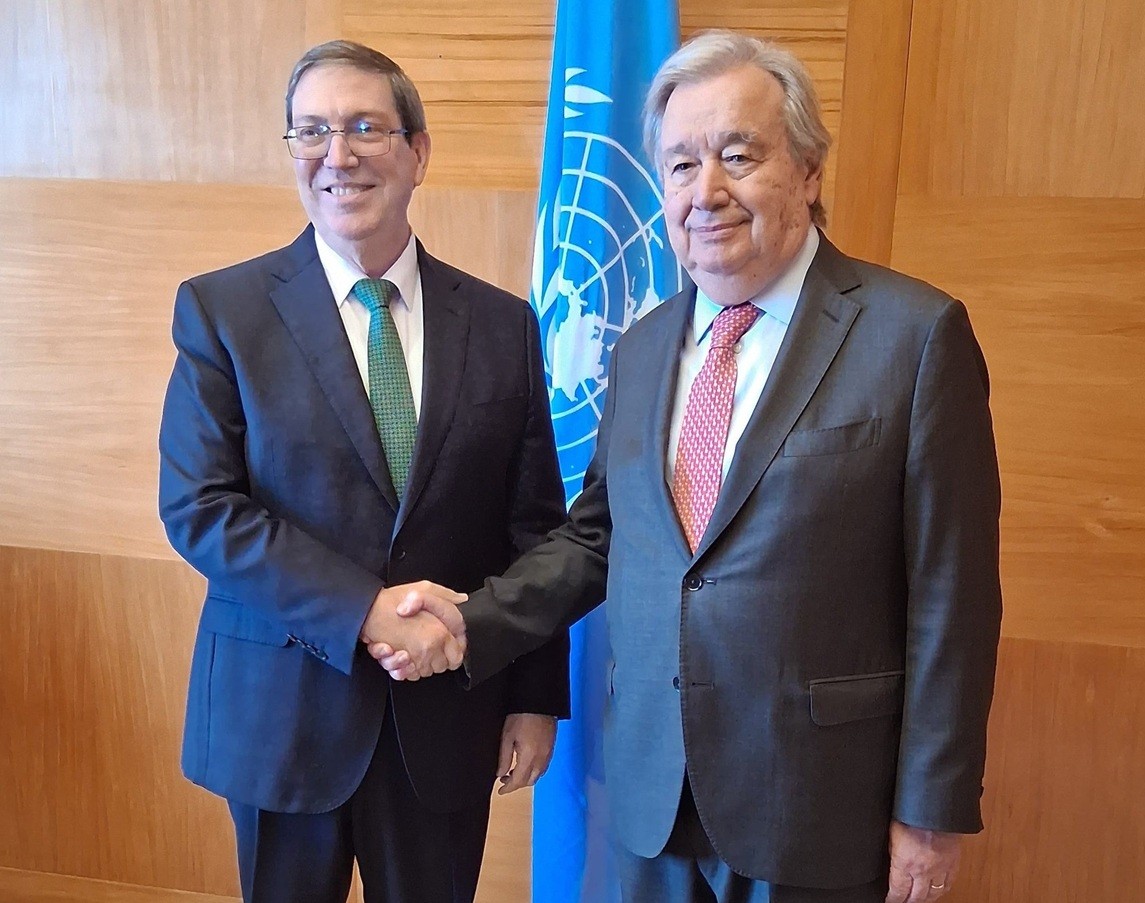
The chancellor Bruno Rodriguez met this Monday in Geneva with the Secretary General of the UN, António Guterres, and his High Commissioner for Human Rights, Volker Türk, to address the situation on the island due to the oil blockade from the USA.
“I denounced the blockade on oil imports imposed by the US Government,” the chancellor said on social media, who is completing an extensive diplomatic tour in Switzerland to discuss this matter with allies and partners.
Rodríguez also expressed to Guterres his concern about the “accelerated global geostrategic reconfiguration,” which in his opinion is based on “the American doctrine of imposing peace through force.”
He also advocated “strengthening international cooperation as a solution to present and future global challenges.”
Rodríguez reiterated Cuba’s support for “the promotion and respect for multilateralism, the role of the UN and the purposes and principles of the UN Charter.”
Cuba at the UN: “We will prevent a humanitarian crisis on the island”
Prior to his meeting with Guterres, Rodríguez spoke in the high-level segments of the Conference on Disarmament and the Human Rights Council, both of the United Nations.
In the latter, a report is required EFEalso referred to the oil siege, which the UN Human Rights Office itself has described as contrary to international law and the United Nations Charter.
Rodríguez explained on social networks that described the latest US measure against Cuba as “collective punishment” and that, in his opinion, seeks to “create a humanitarian catastrophe through an energy fence.”
“Can a great power be allowed to try to destroy a small nation, cause a humanitarian tragedy, destroy its national culture (…) All this under the crude pretext of national security?” the chancellor asked in his speech.
Great satisfaction to meet and exchange with the Secretary General of the United Nations @antonioguterres.
We reiterate the support of #Cuba to the promotion and respect for multilateralism, the role of @UN_es and to the purposes and principles of the UN Charter.
We agree on the… pic.twitter.com/ZUC9YNfBUB— Bruno Rodríguez P (@BrunoRguezP) February 23, 2026
Cuban Foreign Minister: Havana is willing to dialogue with the US
Rodríguez Parrilla also pointed out that Cuba intends to resist “even in the worst scenario” and “defend its sovereignty.”
“We will prevent a humanitarian crisis in Cuba, although we will go through deprivation and suffering,” Rodríguez assured the Council.
Finally, he highlighted that Havana has a “disposition for dialogue” with the United States, but always based on “sovereign equality and international law, mutual respect and reciprocal benefit,” in which “interference in internal affairs” is excluded.
Türk, who opened the council meeting in Geneva, referred to a dozen countries in his speech, but did not talk about the situation in Cuba under the oil siege, which his own Human Rights Office has characterized as contrary to international law and the United Nations Charter.
Great satisfaction for having a new exchange with @volker_turkUnited Nations High Commissioner for #DDHH.
We appreciate the state of relations between your Office and #Cubaas well as the existing respectful and constructive environment, which demonstrates the possibility of… pic.twitter.com/ku9CBUBY5h
— Bruno Rodríguez P (@BrunoRguezP) February 23, 2026
Rodríguez concluded in Geneva an international tour that took him to Vietnam, China, Spain, Russia and France, where his Traditional political allies reiterated their support for Havana in the face of the US blockade.
Spain, for its part, announced that it would send humanitarian aid, as Mexico, Chile and other countries have already done, mainly through multilateral agencies. Canada has announced the same.
The US and the oil siege against Cuba
In January, the United States put an end to the flow of Venezuelan oil to Cuba and, with an executive order, threatened countries that supplied crude oil to the island with tariffs.
Since then, only one oil tanker has docked in the country, according to data compiled by EFE.
He Cuban government launched a tough contingency plan to try to survive without imported oilsomething complex because the island barely produces a third of the crude oil it needs to cover its energy needs.
Cuban government reaffirms decision to resist US pressure, but remains open to “respectful” dialogue
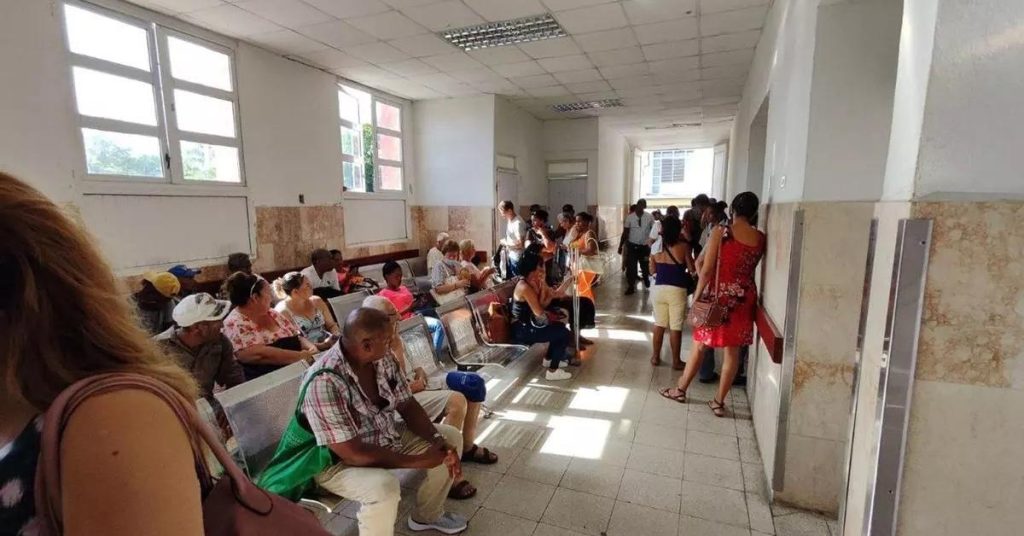
In this scenario, public hospitals work with minimal services; Non-essential operations have been postponed, universities are teaching remotely, industry has been paralyzed, state transportation has almost disappeared and fuel sales are in dribs and drabs.
Supply in the markets has not suffered markedly to date, but prices are skyrocketing due to increases in fuel prices on the black marketwhere the liter of gasoline already exceeds the minimum wage.