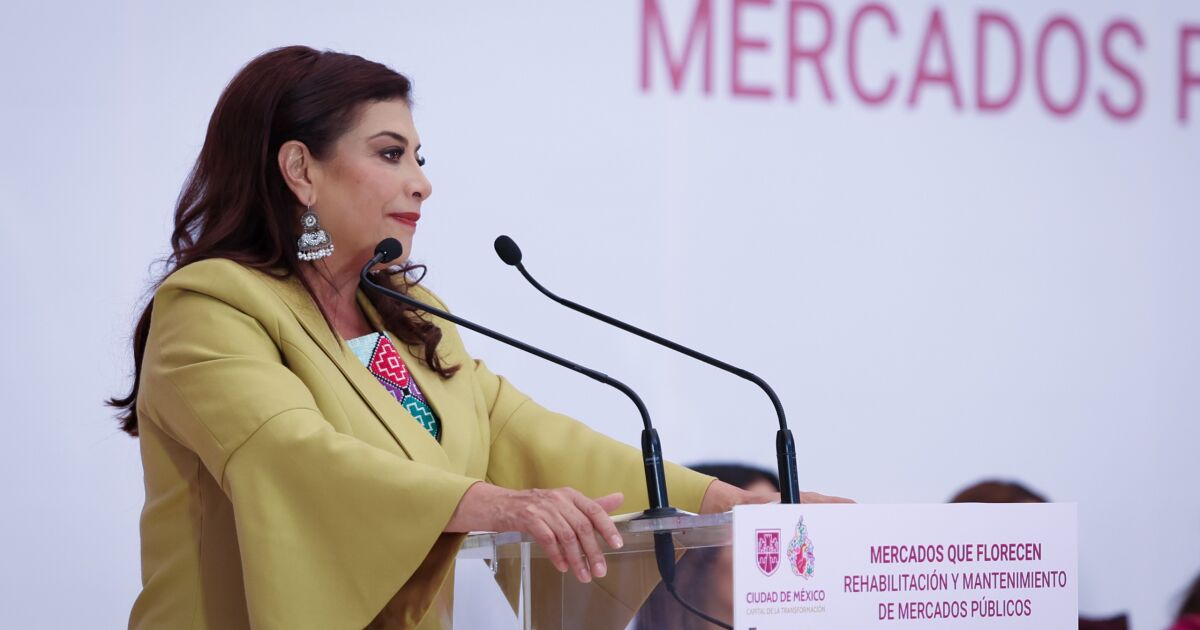
When presenting the program: “Flowering Markets: Rehabilitation and Maintenance of Public Markets”, the capital’s president explained that between the Economic Development and Works secretariats, 240 million will be allocated to the improvement of electrical, hydraulic, sanitary and gas installations in 80 public markets.
“Before making them pretty, what do we want? They are safe. Before changing the image we need the markets to be safe. The priorities for the works that we are going to undertake have to do with the risks, with addressing the risks,” the president remarked.
Brugada explained that with the works on these 80 markets in the municipalities of Mexico City, there will also be rainwater collection systems, so in addition to popular supply centers they will become sustainable units for tenants and users, whose investment will be 20 million pesos.
Additionally, the capital government will allocate 35 million pesos for the construction of four warehouses and the improvement of the Iztapalapa Supply Central, considered the largest market in Latin America, and a similar amount to the restructuring and improvement of the electrical networks of the smaller Merced warehouse.
“We are not only interested in the markets being good, in changing the image, in strengthening each of the spaces that the markets have, in being functional. We are interested in ensuring that the markets do not become points of risk for you and for the population that comes to them,” he remarked.
They go to Mercomuna on impulse
The head of government, Clara Brugada, said that in addition to the improvement program in public markets, the government of Mexico City is committed to boosting the neighborhood economy through the Mercomuna program, which are vouchers granted to residents of the capital to be exchanged in businesses in the neighborhoods.
He said that this year one billion pesos have been “injected” in vouchers granted to residents of the 16 neighborhoods, which can be exchanged in butcher shops, chicken shops, collection shops, hardware stores, haberdashery stores, grocery stores and different businesses that have joined this program.
“Before, support cards were given to the population and they were exchanged or could only be accessed in large shopping centers. With the Mercomuna vouchers it is guaranteed that the exchange that is made is of popular supply, and that it is in the markets and in corner stores, in local businesses,” he noted.
The capital’s president mentioned that public markets, in addition to boosting the economy of the colonies and popular supplies, are generators of more than 250,000 jobs.
The announcement comes after this year, market tenants reported conflicts with the Secretariat of Economic Development over the digitization of operation certificates, as well as complaints of “unfair competition” by deputies, councilors and politicians from different parties who carried out popular supply days in the vicinity of their workplaces.