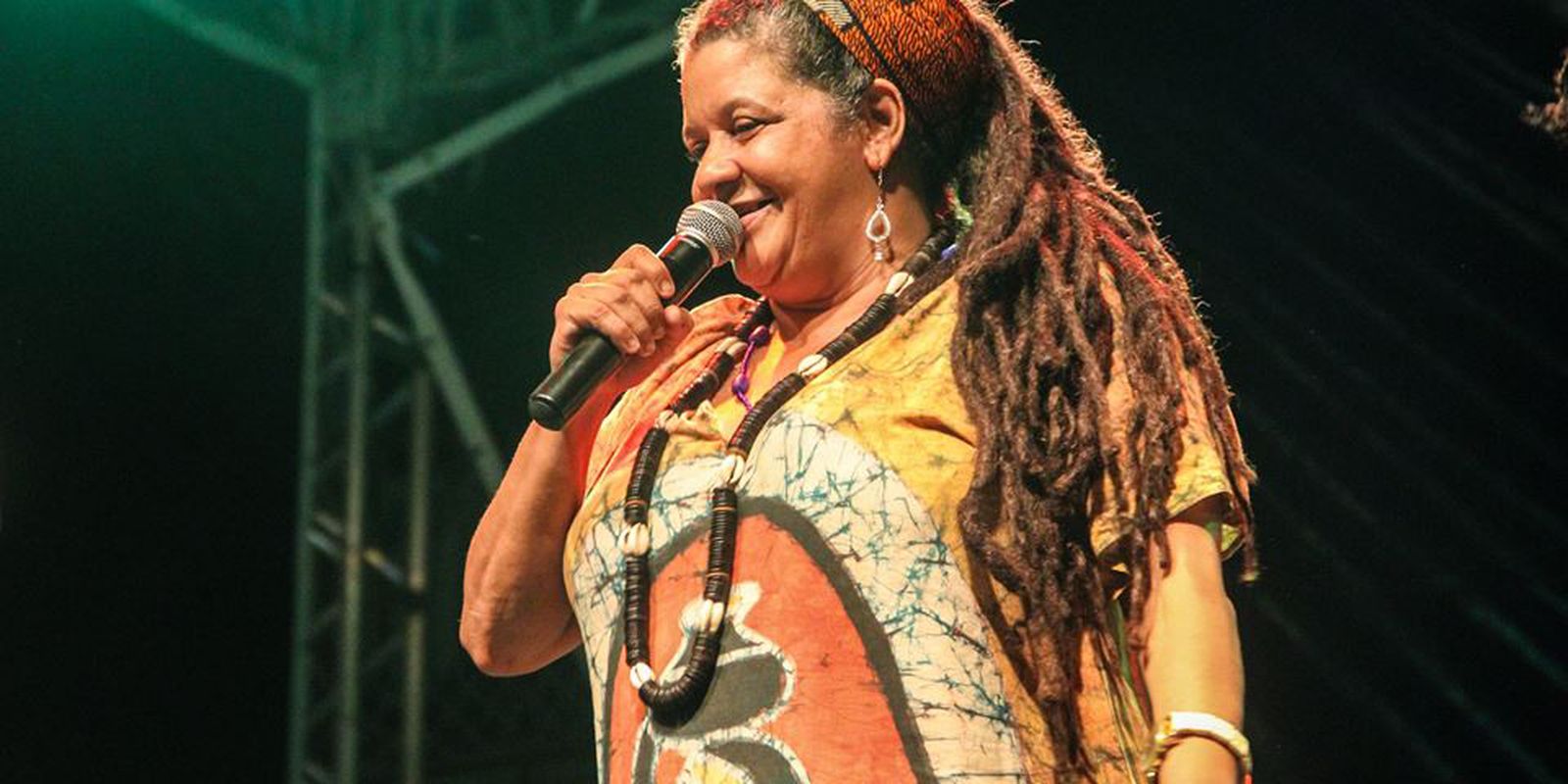
The Brazilian music festival Sonora Brasil ends its 27th edition in the city of Paraty (RJ), with free shows until Sunday (30). Recognized as a Living Heritage in Pernambuco, percussionist Mãe Beth de Oxum celebrated the country’s black ancestry and cultural diversity during a performance, last Wednesday (26), alongside lyrical singer Surama Ramos and maestro and multi-instrumentalist Henrique Albino.
Promoted by Sesc, the Sonora Brasil project travels across the country bringing a combination of artists or groups from different musical trends that represent the regional diversity of Brazilian music. In the 2024-2025 biennium, ten of these combinations of artists circulated throughout Brazil, the result of a curation by Sesc. They presented new shows, mixing references, styles and instruments, in the five regions of the country.
“The theaters were packed. People came to popular culture shows. This is a possibility for us to ‘unhide’, uncover our culture, which is a secular culture. The zabumba that I was playing yesterday is over 100 years old, it belonged to our great-grandparents. This is memory. This is ancestry. However, this music is not seen, it is not known”, said Mother Beth de Oxum, in an interview with Agência Brasil.
The show that resulted from the meeting between the duo Surama and Henrique with Mãe Beth de Oxum and her family was named Apejó, which means “meeting” in Yoruba. “It’s the meeting of the music of a lyrical singer with a maestro and the ancestral drums of my house. It’s the meeting of a black woman who comes from the church – who already recognized all her values from the university – with me, a woman who recognizes myself as black in the terreiro”, said Mother Beth.
Together with her daughter Alice Ialodê and her husband Mestre Quinho, Mother Beth brought the umbigada coconut to the festival, a manifestation of the traditional roda coconut, which gained new arrangements and the voices of Surama and Henrique. The duo, in turn, brought their own compositions, which incorporated the percussion of the umbigada coconut.
For Mãe Beth, the country needs projects like this, which can show the beauty, strength and diversity of Brazilian culture. “Mainly black culture, the culture of traditions, of African and Afro-indigenous terreiros in our country. And also bring ancestral music, the music of my family, which is the music of coco de roda, [junto a] this contemporary music, from the university, from orchestras, with the arrangements.”
“We, in fact, are sure that it is a new sound from Pernambuco, because there has never been a mix of coco de umbigada with electronic music and harmonies. So we know that it has revolutionized this time of creating our show Apejó”, celebrated Surama Ramos.
The singer, who among her works has a duo formed with Henrique Albino, said that the meeting with Mãe Beth de Oxum came about as a way of reconnecting with her ancestry.
“Everything that I wasn’t taught religiously as a child by a family that denied me everything about Afro-Brazilian culture, Mother Beth comes and gives me a gift.”
Times and Territories
One of those responsible for the festival and music analyst from the National Department of Sesc, Renata Pimenta explained that the theme of this year’s edition – Encounters, times and territories – aimed to bring together different generations of artists who shared the same state.
“The different times, which is a generational thing. But the territory, which was the most interesting, because in some meetings we have a completely different territoriality, sometimes coming from the same city”, highlighted Renata.
At the closing event, in Paraty, there was also the launch of the documentary series Sonora Brazil – Meetings, Times and Territoriesproduced by SescTV. Each episode shows one of these artist meetings that the Sonora Brasil project facilitated. They were able to tell a little about their journey in music and what led them to the festival stage. Episodes of the series are available on Sesc Digitalwith free access.
“In other years, we did a lot of backstage [bastidores]. This year we wanted to do it in a more poetic way, [questionando] ‘What guides you? What makes you want to play? What connects you with music?’ In the sense of [entender] what was the path [o artista] did to get here on this stage”, said Renata.
In the 2024-2025 biennium, the period of this 27th edition, there were more than 300 musical performances in around 70 cities across the country. She said that logistics in the northern region of the country was one of the challenging elements of the project, but overcoming this difficulty is precisely one of the festival’s objectives.
“It is difficult not to mention the North in this sense of circulation, because we see firsthand how much our transport infrastructure [no país] is complex. It’s super challenging, so there aren’t many people doing it,” said Renata, adding that, in a commercial circuit model, this project wouldn’t exist. “It exists within the logic of a company that is social and that values culture.”
For multi-instrumentalist Henrique Albino, traveling around Brazil performing is one of the best things as an artist.
“Because Brazil is such a diverse country, so gigantic and it seems like there are several Brazils that we get to know.”
“When we perform in places, we form a relationship with the audience, which was one of the most incredible things. Everyone has a foothold in Olinda. At every show, we asked: ‘Has anyone here ever been to Olinda?’ A lot of people always raised their hands,” he said.
Regarding developing other projects in partnership with Mãe Beth, he says that he has already invited the percussionist to perform and compose on his new album. Furthermore, they intend to record an album of the show created especially for Sonora Brasil, which had a good response during the performances. “Now we stick it and it doesn’t come off anymore,” he said.
The closing shows take place at Sesc Caborê, in Paraty (RJ), until Sunday (30), with free entry.
Friday (11/28)
6pm – Screening of an episode of the documentary series about Mestre Negoativo & Douglas Din (MG)
7pm – Musical performance Mestre Negoativo (MG)
Saturday (11/29)
10am – Conversation with artists Manoel Cordeiro, Felipe Cordeiro and group Mundiá Carimbó
6pm – Screening of an episode of the documentary series about Geraldo Espíndola & Marcelo Loureiro (MS)
7pm – Musical performance Geraldo Espíndola & Marcelo Loureiro (MS)
Sunday (11/30)
4pm – Screening of an episode of the documentary series about Manoel Cordeiro & Felipe Cordeiro (PA)
5pm – Musical performance by Manoel Cordeiro & Felipe Cordeiro (PA)
6:30 pm – Mundiá musical performance with the participation of Manoel Cordeiro (PA)
*The reporter traveled at the invitation of Sesc