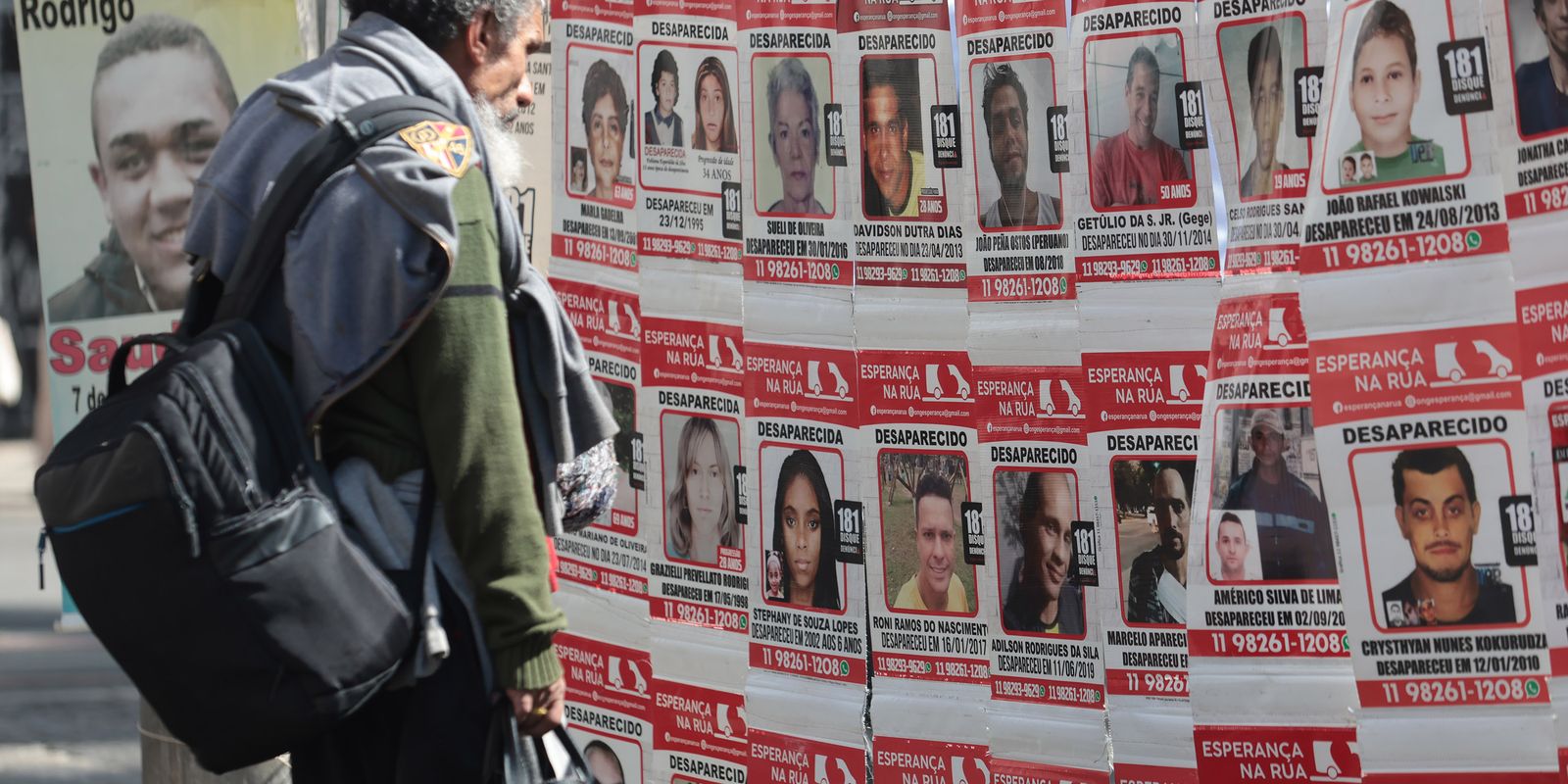
Brazil registered 84,760 cases of missing people in 2025. The number is equivalent to 232 daily disappearances and the result is 4.1% higher than in 2024, when 81,406 disappearances were registered.
Data from the National Public Security Information System (Sinesp) indicate that neither the creation of[https://www.planalto.gov.br/ccivil_03/_ato2019-2022/2019/lei/l13812.htm” target=”_blank”>Política Nacional de Busca de Pessoas Desaparecidas, em 2019, foi capaz de conter a escalada do problema. Naquele ano, foram contabilizados 81.306 ocorrências – resultado 4,2% inferior ao do ano passado. A legislação estabelece um conjunto de diretrizes e ações integradas com o objetivo de agilizar e articular a localização de pessoas desaparecidas no país, com foco na cooperação entre órgãos de segurança, saúde e assistência social.
Desde 2015 (75.916), o total de pessoas desaparecidas no Brasil só recuou em 2020 (63.151) e 2021 (67.362). Segundo especialistas, devido às restrições decorrentes da pandemia da covid-19 que, entre outras coisas, dificultaram o acesso às delegacias, ampliando a subnotificação.
“Há um consenso de que esta queda momentânea foi causada pela pandemia, pelo fato das pessoas terem que ficar em casa”, afirmou à Agência Brasil a coordenadora do Observatório de Desaparecimento de Pessoas no Brasil (ObDes), da Universidade de Brasília (UnB), Simone Rodrigues.
Pessoas localizadas
O total de pessoas localizadas também vem aumentando desde o início desta década. Em 2020, 37.561 pessoas dadas como desaparecidas reapareceram ou foram localizadas. Em 2025, este número saltou para 56.688 – alta de 51% no período e de 2% em relação a 2024, quando foram localizadas 55.530 pessoas.
De acordo com Simone, o avanço reflete tanto o crescente número de casos, quanto um aprimoramento das estratégias e ferramentas de busca.
“Tenho visto um maior empenho, principalmente nos últimos dois anos, em promover a interoperabilidade dos dados, a comunicação entre as instituições [federais, estaduais e municipais]”, said the lawyer and doctor in political science.
For Simone, official data do not account for the real complexity of the problem. Also because, according to her, many disappearances are associated with unsolved crimes. For example, the recent case of broker Daiane Alves de Souza, 43 years old, in Caldas Novas (GO).
Disappeared on December 17 last year, after being filmed in the elevator of the condominium where she lived, her body was found last Wednesday (28), abandoned in a forested area, in an advanced state of decomposition. Accused of having committed the crime together with his son, the building manager of the building where Daiana lived, Cléber Rosa de Oliveira, confessed to having murdered the broker and indicated the place where her body was.
“The dynamics of disappearance cases are complex and diverse. To understand them, it is necessary to take into account the various forms of violence that are often involved, such as feminicide, human trafficking, work similar to slavery, LGBTQphobia and the hiding of corpses”, pondered Simone. She highlights that, in many cases, relatives or acquaintances of victims avoid or are unable to file a police report.
“In contexts involving the actions of militias or other criminal groups, for example, it is common for people close to them to fail to notify the authorities. Indigenous people also do not usually register police reports in these cases. Not to mention people living on the streets. Hence, even though surprising, the numbers are not reliable, as there is underreporting”, said Simone.
National Politics
For the coordinator of ObDes/UnB, the National Policy for the Search for Missing Persons was an important initial response to the problem, but which, after almost seven years, is “still in its infancy” in the country.
“It is being implemented little by little. And it already needs adjustments. Just see that CNational missing persons directorywhich is the heart of the policy, was only created in 2025, with low support from the states”, he commented.
According to the National Public Security Secretariat (Senasp), records of occurrences of disappearances and locations of 12 of the 27 units of the federation are integrated into the national registry, created seven years after the sanction of the National Policy for the Search for Missing Persons to help cross-reference information and support investigations. Today, Acre, Alagoas, Amapá, Amazonas, Bahia, Maranhão, Piauí, Rio Grande do Norte, Rondônia, Roraima, Sergipe and Tocantins are part of the registry.
“Despite some advances, everything is still very fragmented. We don’t have a national identity card and our biometric data is separated by states, but the police stations don’t talk to each other; the Public Prosecutor’s Office doesn’t talk to another state. When a body is located, it is necessary to send a copy of its fingerprints to the 27 entities of the federation in order to know if it has an identity card [emitida por outra unidade]”, explains Simone.
According to the expert, it is still common for people who seek help from the State to locate missing relatives or acquaintances to have to face “institutional prejudice” or a lack of adequate knowledge.
“Despite campaigns to the contrary, the myth and error persist that it is necessary to wait 24 hours or 48 hours to register a disappearance. In addition to a series of stereotypes, mainly surrounding the disappearance of children and adolescents, such as that a girl or boy escaped the surveillance of their parents or guardians to date or go to a dance and will soon return. This all ends up hindering the search process.”
Minors

São Paulo (SP) 08/30/2024 – An action aimed at raising awareness among the population about missing people was organized in Praça da Sé. Photo: Paulo Pinto/Agência Brasil – Paulo Pinto/Agência Brasil
Just like the missing children in Bacabalin Maranhão, in a search that mobilizes hundreds of people and moves the country, 28% of those missing in 2025 were under 18 years of age. While the percentage of general disappearances increased by 4% between 2024 and 2025, cases involving children and adolescents jumped 8%, going from 22,092 to 23,919. Compared to occurrences in 2019 (27,730), when the national policy was instituted, last year’s result is almost 14% lower.
Another fact that draws attention is that, while men represent 64% of the total number of missing people in 2025, among children and young people, the majority (62%) of incidents involve girls.
“Many of these children and adolescents are fleeing contexts of intra-family violence and, in these cases, State agents need to be sensitive enough not to expose them to this context again. At the same time, they cannot generalize,
because not all cases are like this. It doesn’t matter the cause. The State has the obligation to search for any missing person, especially children and adolescents. Without falling into stereotypes or prejudging the person responsible who will register the disappearance”, explains the specialist.
Enhancements
Consulted by the report, the Ministry of Justice and Public Security acknowledged the underreporting of official records, but considered that, even for this reason, “the 4% increase compared to the previous year does not necessarily mean a real increase in cases”, he stated in a note.
According to the ministry, classifying the different causes of disappearances is “a statistical challenge” that depends on the “thorough investigation of each localization case and the rigorous standardization” of the information collected.
Furthermore, the ministry guarantees that, in recent years, it has been committed to, together with states and the Federal District, structuring the pillars of the National Policy for the Search for Missing Persons. This includes the launch of the National Registry of Missing Persons; training civil police professionals; campaigns to collect genetic material (DNA) from relatives of missing people and communication campaigns.
Regarding the accession of less than half of the federative units to the National Registry, the ministry expressed the “expectation of integrating the remaining entities in the first half of 2026”.