“Brazil does not like to self -praise itself.” This is how Daniel Balaban, director of the United Nations World Food Program (UN) in Brazil, begins to answer questions about the Brazilian food policy in schools.
Despite this kind of national modesty, the United Nations recognize the National School Feeding Program (PNAE) as one “of the largest and best school feeding projects in the world,” said Balaban.
Officially, the project turned 70. But for the UN representative, he gained prominence from 2009. It was when the law that defined the parameters of the type of food that should be in schools was in force, taking space from sugary cookies to place complete meals in place.
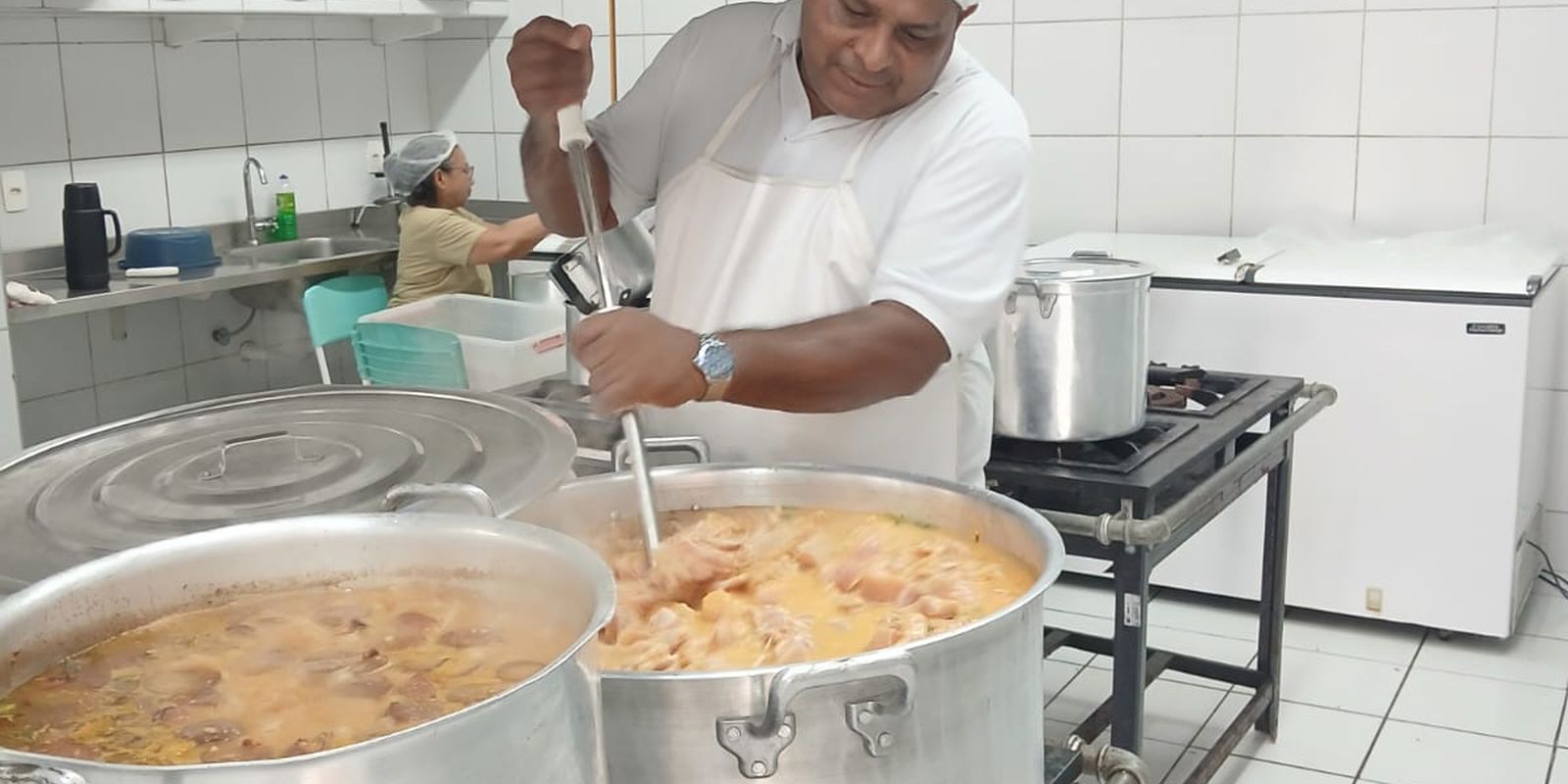
It was also in 2009 that Fernando Luiz Venâncio gave a career turn. The colleague who took care of the kitchen of the company where he worked went on vacation and Fernando, hitherto metallurgical, offered to stay in place. Never left the pans again.
Today, he heads the team responsible for the three meals served every day for the more than 400 students at Johnson School in Fortaleza, Ceará. A full -time high school.
On the menu there are dishes such as baião of two, minced meat, egg farofa and acclaimed chicken cream.
>> Follow the channel of Brazil agency on WhatsApp
Chicken breast
“The chicken cream I can’t exchange for anything,” says Fernando. Made with shredded chicken breast and vegetable broth, the dish is not close to ingredients such as sour cream. “You can’t. We don’t use it, don’t use cheese, none of that,” says Fernando.
The restriction is not random. Food has to serve all students, including those with eating restrictions. “We can’t make food for ten to 400. You have to do it for everyone, everyone should eat, have to like it and without sick,” he says.
But it is not Fernando who defines what enters the menu. “The nutritionist goes on to us and we have to work on the menu,” he emphasizes. The presence of nutritionists in the school space is one of the requirements of a 2009 law that turned merenda into a meal. Menus need to meet nutritional needs, be connected to local culture, prioritize food prepared in the school itself, restrict the presence of ultra -processed to a maximum of 15% and privilege family farming, with at least 30% foods with this origin.
From the field to the school
“From everything I produce, 30% go to school meals,” says Marli Oliveira, a family farmer. At the 6.5 hectares site in Ocara, Ceará, it creates rednecks, pigs, sheep and bees. Honey, eggs and meats that do not go to PNAE, are in the vendinhas of the municipality. But the guaranteed sale to schools “makes a difference in the life of the farmer, especially in small municipalities, since the income is practically from agriculture,” explains Marli.
A survey of the School Feeding Observatory (OAE) translated into numbers what it is to make the “difference”. The study shows that for every R $ 1 that PNAE invests in agriculture and family livestock, national gross domestic product (GDP) grows R $ 1.52 in agriculture and R $ 1.66 in livestock.
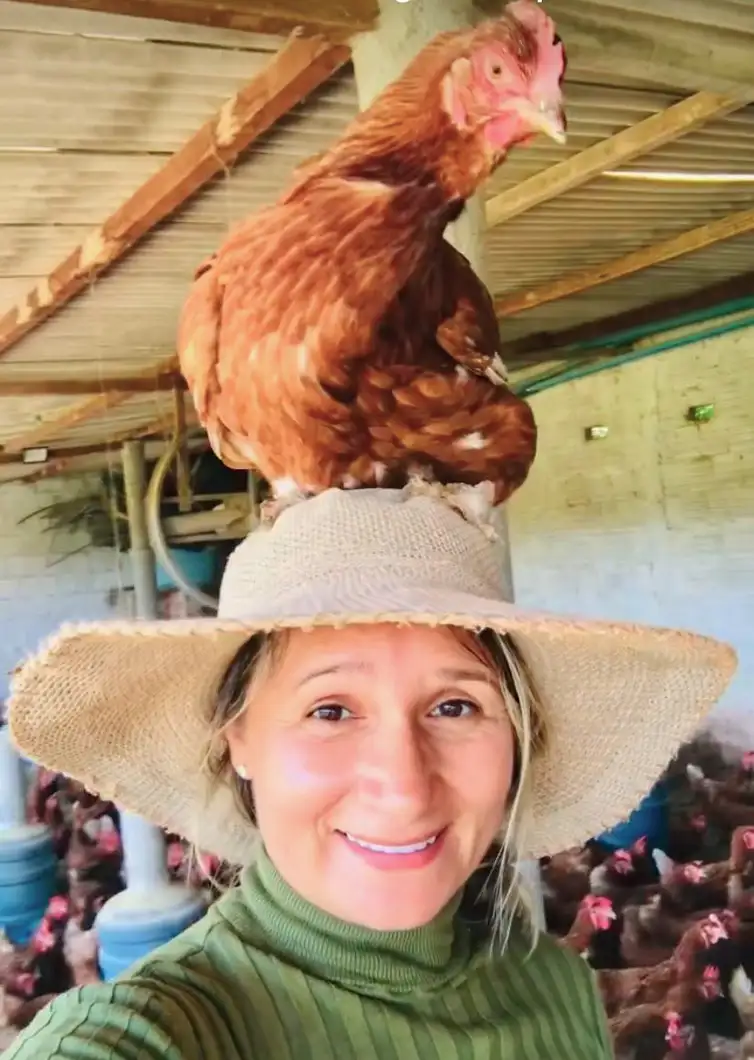
Marli Oliveira, family farmer, provides eggs, honey, chicken meats, pork and sheep for PNAE in Ceará – Photo: MARLI OLIVEIRA/PERSONAL FILE
From 2026, the participation of family farming in PNAE can reach at least 45%. Amendment approved by the National Congress can be sanctioned by President Lula. Luzia Marcia, who is based on land reform and produces cashews in Chorozinho, Ceará, celebrated the change. It still does not provide for PNAE. “We even competed recently. Unfortunately, for the issue of score, we have not been,” he says.
With increasing demand, she expects to be able to open the door: “PNAE is very important because production flow is one of the greatest bottlenecks of the farmer today. It’s not just producing, but is this where I will put my production?”.
Export type
Between September 18 and 19, Brazil hosted the 2nd Global Coalization Summit for School Feeding, which brought together representatives from over 90 countries that pledged to ensure quality food for over 700 million students by 2030.
It was there that the Minister of Education of Sao Tome and Principe, Isabel Abreu, spoke of cooperation with Brazil. “Our nutritionists were formed online With nutritionists from Brazil and we had the support of a Brazilian nutritionist who was with us three years guiding how to make the meal, ”says Isabel. Sao Tome has also been followed at the principle of placing local foods inside the school.
Today, in Brazil, PNAE serves 40 million students every day, from day care to EJA (Youth and Adult Education.
“The program helped Brazil out of the UN hunger map,” says Daniel Balaban. “If you have no food at school, you would leave food insecurity most of these 40 million students. For many, the main meal of the day is at school,” he emphasizes.
Challenges
However, despite the compliments, playing PNAE in everyday life is a task surrounded by challenges. In 2025, the program budget was R $ 5.5 billion. The transfer per day per student ranged from R $ 0.41 for EJA students up to R $ 1.37 for day care centers and students. But before the last readjustment, in 2023, the values were frozen for five years.
In addition to the federal transfer, states and municipalities need to complement the value with their own resources. But, this does not always happen. According to the School Feeding Observatory, more than 30% of the municipalities of the North and Northeast of Brazil do not do this.
In another survey, OAE listened to Brazil’s nutritionists to find out if they can meet the program’s nutritional requirements.
Practically half (47%) said no and pointed out the problems. Among the most frequent are the lack of structure for the preparation of food, the resistance of families and education professionals, the inflation of food, the short budget and the lack of nutrition professionals and cooks and cooks.
School food
For Albaneide Peixinho, president of the Brazilian Nutrition Association, these problems are a reflection of how public managers continue to understand school feeding.
“Unfortunately, the view that most managers still have is that the program is called ‘lunch’. It is just a quick snack from the point of view of the concept of nutrition. [Eles] They understand how a welfare program and think it’s a great favor they are doing, ”he emphasizes.
Albaneide coordinated PNAE for 13 years and was part of the team that has prepared the 2009 law that is trying to bury this idea of the lunch. Contrary to this ancient notion, she remembers another ingredient that differentiates PNAE: “This is a pedagogical health promotion program. The formation of healthy habits is as important as the offer of meals that contribute to the improvement of teaching-learning”.. He concludes: “Despite understanding that PNAE is a world reference, because it is in the Constitution, something many countries do not have, there is still much to move forward.”
* The reporter traveled at the invitation of MEC