At Carnival, many spaces have barriers that limit the movement and permanence of people with disabilities (PWD) at events, such as the lack of ramps, sidewalks and tactile flooring, limited availability of public transport and reserved spaces with elevated views for those using wheelchairs or the scarce number of Brazilian Sign Language (Libras) interpreters.
Understanding that accessibility is not a favor, but a right, 14 years ago, historian Lurdinha Danezy Piantino founded, together with parents and representatives of entities focused on people with disabilities, the carnival block Disabled is the motheras a way to combat ableism, which is the discrimination and oppression of people with disabilities, as a way of underestimating their capabilities and treating them as inferior.
“People with disabilities have to occupy all spaces: social and cultural. And the most important cultural moment of the year is Carnival. So, people with disabilities have to be together.”
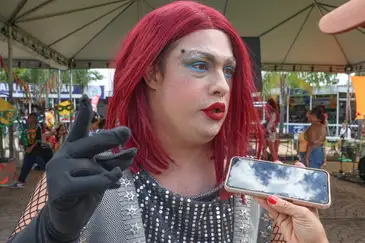
Drag Queen Ursula Up at the Carnival Block Handicapped is the mother, on the TV tower. Photo: Valter Campanato/Agência Brasil
Lurdinha is the mother of Lúcio Piantino, 30 years old — the multifaceted artist who gives life to Úrsula Up, the first Drag Queen with Down syndrome in Brazil and an active voice in the LGBTQIA+ cause. Off stage and without the production, Lúcio expands his talent as an actor, visual artist, dancer and clown.
Gay and passionate about carnival since childhood, he believes that the blocks are essential tools to include and bring everyone to the party. “I feel great. It’s life, which is very good.”
Block on the street
In this fight against prejudice, another founder of Disabled is the mother is the retired public servant, Luiz Maurício Santos, aged 60. A wheelchair user for 28 years, due to a motorcycle accident, he reports that despite the difficulties of placing the block on the street, due to resources and bureaucracy, the result is worth it.
However, he advocates that more people with disabilities understand that carnival is their space too.
“We still have difficulty mobilizing the segment. People are still a little afraid of participating, of suffering some discrimination. So, we always try to mobilize this group so that they show up.”
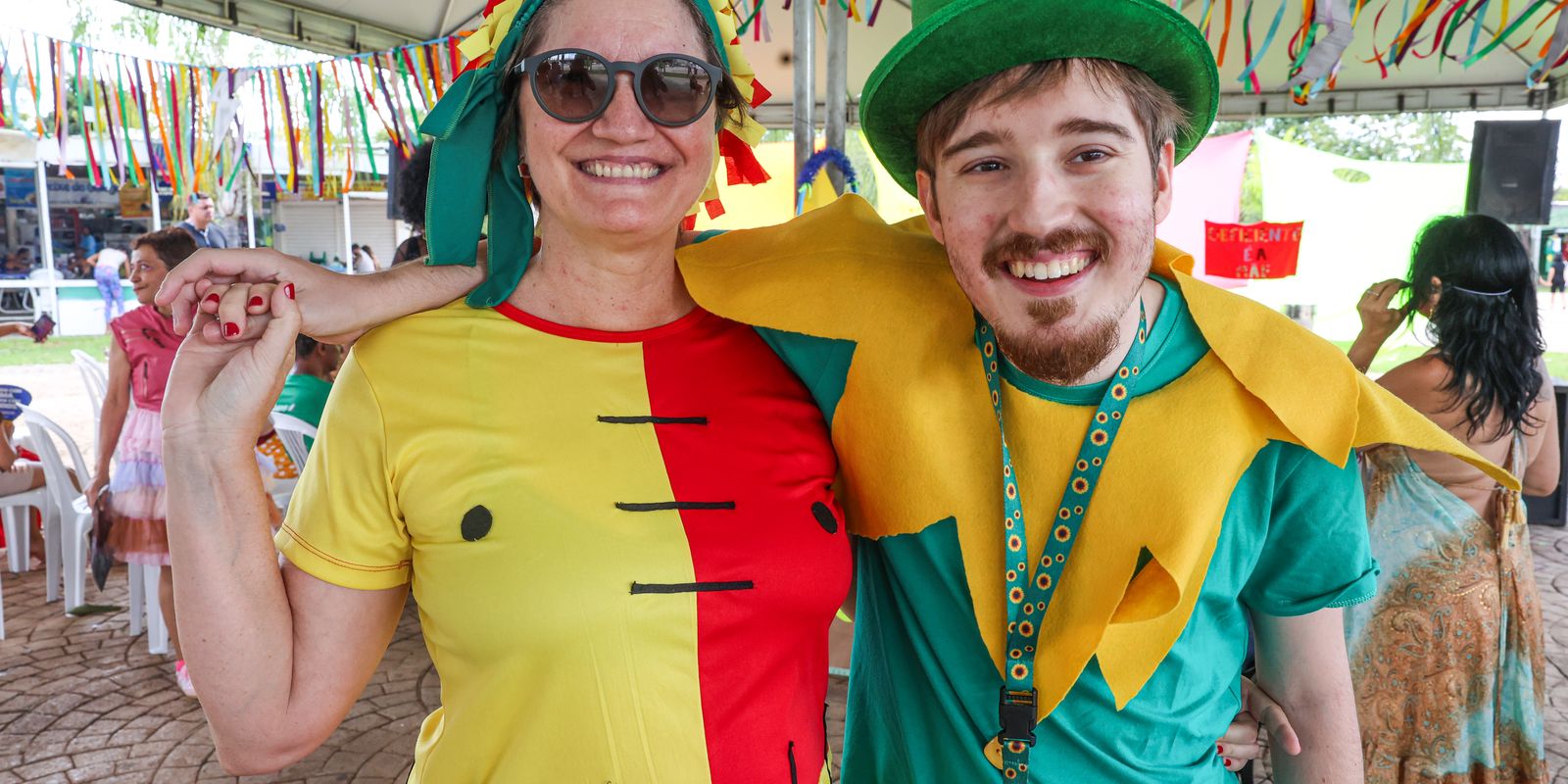
One person who does not miss the block’s annual meetings is young Francisco Boing Marinucci, 22 years old, who has Autism Spectrum Disorder (ASD). Teacher Raquel Boing Marinucci takes her son to the block because he likes music and knows carnival marches and different sambas.
In 2026, the two’s carnival costumes pay homage to the protagonists of Sítio do Picapau Amarelo, by writer Monteiro Lobato. Literature and television series that marked Francisco’s childhood. He says he enjoys her company during the four days of the Momesca festivities. “Mother adores me, loves me with passion. Mother is my company.”
For Raquel, the block for PWDs is inclusive and safer for both.
“When people with intellectual disabilities are young, there is more understanding, because, in general, children are not prejudiced. But for a young person or adult with an intellectual disability there is no real inclusion. Therefore, it is not possible to let them go out alone in an environment without a hired caregiver or someone from the family.”
More conscious society
According to IBGE, Brazil has 18.6 million people with disabilities aged 2 years or over, which represents 8.9% of the population in this age group. Visual impairment is the most common, affecting around 3.1% of the population.
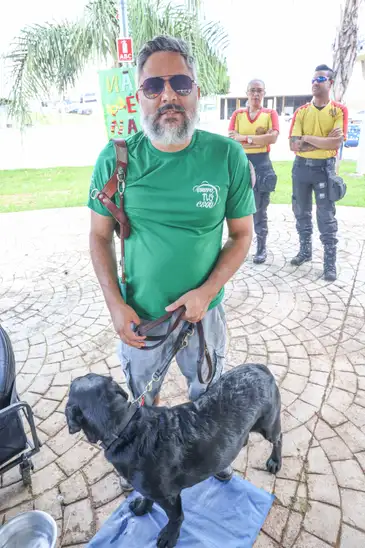
The visually impaired Thiago Vieira took his guide dog Nina. Photo: Valter Campanato/Agência Brasil
People like library assistant Thiago Vieira, who has had low vision since birth. This carnival, his companion is his guide dog Nina. Thiago classifies himself as a carnival lover and considers it important to have inclusive events.
“All year round, we are quite forgotten. This block is a start, I feel safe here. Who knows, maybe society will become more aware and open up more accessible places for us?”, he wishes.
Joy and optimism
Another regular visitor to the block created by and for people with disabilities is school secretary Carlos Augusto Lopes de Sousa, who works at an education center in the city of Recanto das Emas, in the Federal District. He arrived at the carnival block, in the center of Brasília, in a wheelchair with the intention of enjoying Carnival Monday.
“This is called inclusion and respect.” Carlos’ paralysis was caused by a spinal fracture following a collapse 37 years ago.
Carlos is still optimistic about the results of the research carried out by Tatiana Coelho de Sampaio, a professor at the Federal University of Rio de Janeiro (UFRJ), who developed a medicine (polylaminin compound). The first experiments showed promising results in the regeneration of spinal cord injuries.
“She’s incredible! National hero”, celebrates Carlos Augusto between one carnival hit and another. The research awaits authorization from the National Health Surveillance Agency (Anvisa) to advance into broader clinical studies.