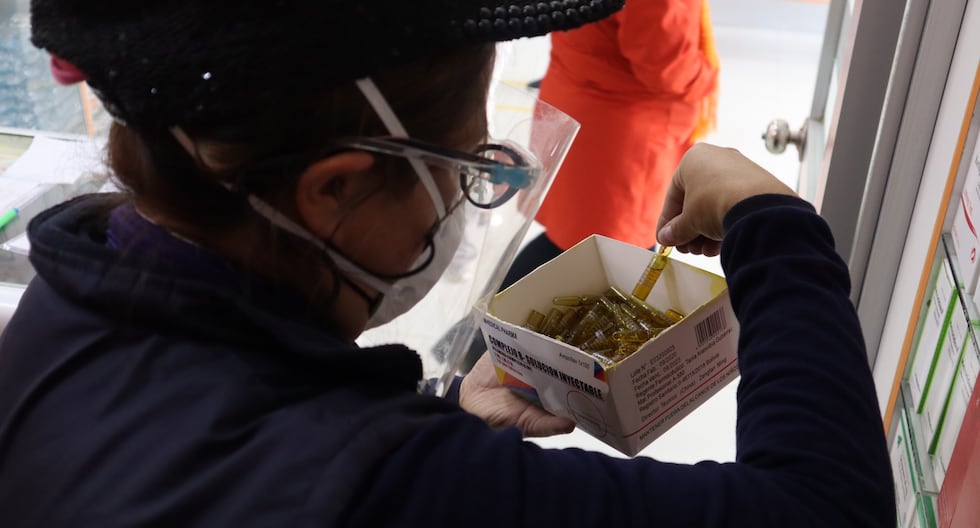
So far from 2025, the Diresa Junín Medicines Department seized 56 thousand 972 units of pharmaceutical products medical devices and health products in different formal and informal pharmaceutical establishments and commercial establishments, said director Katy Gordillo Hinostroza.
He explained that until July of the year 2025, 585 establishments between formal and informal were inspected.
Among the deficiencies found to these premises, it was found that they do not have a permanent pharmaceutical chemist during the operating time. In addition, it was found that some store products with health observations and others do not meet good storage practices.
They sell without a recipe. It is an obligation that antibiotics and anxiolytics are sold upon presentation of the medical recipe. But, it would not be fulfilled.
“The use of antimicrobials is a risk when consumed without the indications of a doctor or with past recipes a resistance will be generated,” said the pharmaceutical chemist, Katya Gordillo Hinostroza.
According to the range of observations found, formal and informal establishments that breach with health standards, are given a temporary closure and the products are also seized.
Operations were carried out in Huancayo, Chilca, Concepción, Sapallanga, El Tambo, Jauja and La Oroya.
In the operations they found over expiration expiration, poor condition, sale of medical samples, poorly fractionated, of unknown origin, medications of ESSALUD, MINSA and the Police.
Pharmacovigilance. The dean of the Junín Pharmaceutical Chemical College, Sonia Bonilla said that a medicine can “heal or kill.” That is why it is necessary to establish pharmacovigilance, first so that patients do not self -medicate and secondly, so that health professionals apply a medication, such as an injectable and know how to adequately administer it.
He mentioned that there are cases, where sensitivity tests are even performed and still the patient can suffer an allergic reaction, even with other medications that enhanced pharmacological action. At El Carmen hospital, they will carry out the evaluation of the clinical case.
Claim. There is a commission called Contrafalme, where the Junín Medical College asked to participate in the supervisions of pharmaceutical establishments, to know which pharmaceutical chemical professional is erring and assuming actions in this regard.
In addition, he regretted that in the Junín Diresa, he lacks personal for the control of formal and informal establishments, since they barely have 6 to 7 inspectors.
“The problem in Junín is the existence of informal apothecies, as we can sanction the pharmacist that allows these products to be sold in poor condition in the apothecary that runs, but what we do with the informal ones where there is no regent pharmacist,” said the dean of the pharmaceutical chemical school in Junín, Sonia Bonilla.
These informal stores are not necessarily apothecates, since in many cases they are presented as well as stores and bazaars, before which he also demanded the intervention of the municipalities that grant them the licenses, without really knowing the type of businesses they are.
The dean Sonia Bonillam reported that throughout the Junín region, there are 1800 pharmaceutical chemists, which should be running apothecies and pharmacies.
“The owners of Botics, who are mostly technical, cannot say there are no chemical-pharmaceuticals, which should be in these establishments controlling what is sold to users,” he said.
In addition, they have found cases where the pharmaceutical chemist lives in another region such as Huánuco or Huancavelica and is as regent in Huancayo, which would be impossible, which is why it seeks to establish greater control.
Another problem, whereby the apothecies do not have a permanent pharmaceutical chemist is the contracting modality, since there have been cases where 200 soles are paid a month, without any formality.