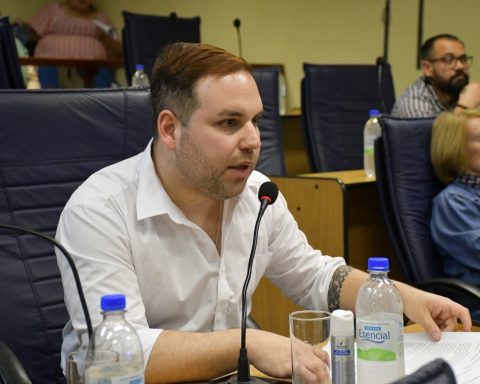
Representative Yisela Araujo said that last year in the same period more procedures were carried out than now
He clarified yes, that the amounts were smaller. Likewise, he maintained a direct dialogue with the National Director of Customs and announced a face-to-face meeting for November 6.
“There is no work and people subsist on that,” expressed the Broad Front legislator when referring to border controls.
He said that he conveyed these concerns to his government authorities and said that “We will continue doing it, because behind every checkpoint, behind every truck or every seized merchandise, there is a family that depends on it to live.”
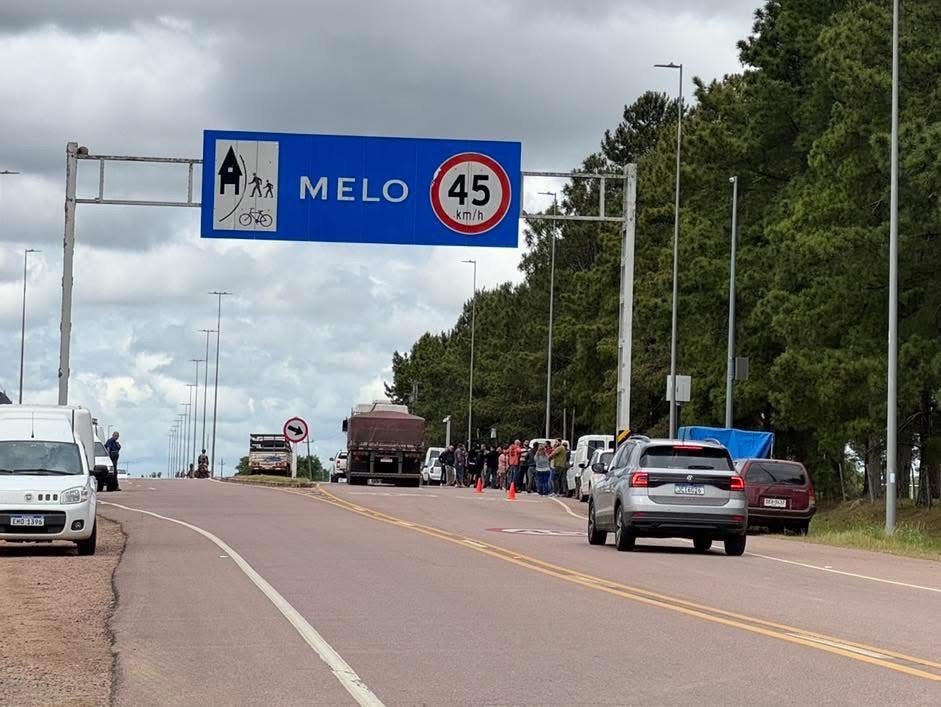
Until the early hours of Thursday morning, the Representative for Cerro Largo Yisela Araujo had a prolonged telephone exchange with the national director of Customs, Joaquín Serra, as a result of the tense situation registered in the city of Melo, where dozens of border workers demonstrated peacefully demanding to be able to continue their activity as a means of subsistence.
As the parliamentarian explained, the conversations with the leader began shortly after midnight and lasted until almost two in the morning. “I arrived at my house at 12 at night yesterday. I read everything, I received everything and there I contacted the director of customs, who until 1:54 in the morning you communicated with the director of customs. It is not the first time. He answered you by phone, he responded to all my messages,” the deputy said, confirming that she maintained direct and fluid contact with the national authority.
The Broad Front legislator reported that on November 6 she will hold a face-to-face meeting with Serra, in order to institutionally convey the concerns raised by workers and border communities.
A “SPECIAL REALITY” DEEP INSIDE
Araujo recalled that this situation had already been raised more than two months ago before the Ministry of Economy and Finance, when Undersecretary Vallcorba visited the area. “When Vallcorba was there, which was more than a month or so ago, two months ago, we asked colleagues, in fact, I asked veteran colleagues, like Gustavo, who was a deputy, that everyone else, there were others, a bunch of experienced colleagues, to go and propose that our reality is a special reality,” he detailed.
The parliamentarian explained that the particularities of the dry border with Brazil make many families directly dependent on the circulation of merchandise and commercial exchange. “We convey these concerns. Being able to distinguish the social impact in what you harm a family from those who go and bring back to resell.
“THE BORDER MEASURES BE APPLIED AT ONCE”
The legislator expressed her expectation for the effective application of the so-called border measures, which the national government has been announcing for months and that allow prices to be equated and activities currently in the informal sector formalized.
“I’m looking forward to the famous border measures being applied once and for all to see the impact. You saw that supposedly, they told us it was the middle of November.
According to Araujo, the lack of concrete implementation of these measures leaves hundreds of workers in the air, who are torn between the need to survive and the risk of sanctions.
“THIS GOVERNMENT IS NOT AGAINST THE WORKER”
In another passage of her testimony, the deputy referred to versions that circulated on social networks about an alleged extreme tightening of inspections, which compared the situation with the policy of the “zero kilo” from previous years.
“On the other hand, I want to make it clear, because the run-run (rumors) were already ringing, this government is not against the worker, this government does not apply the zero kilo, this government does not put a tank or rifle in anyone’s face and this government neither puts Miguelito nor does it put, as happened in the pandemic, to stand guard every day,” he expressed firmly.
However, he recognized that institutional communication has been deficient and that this contributes to generating confusion and unrest among the population. “There is also a communication problem. I asked the national director of Customs, with greater respect, one of the things I said, I am a legislator, we are representatives, we are the political forces, I am the executive branch, please, what I ask of you is to communicate well.
“BORDER LIFE MUST BE UNDERSTOOD”
Araujo reiterated that the main problem is the lack of employment in the area. As he explained, for many families in the deep interior, the possibility of moving small quantities of merchandise to re-sell is not an illicit activity, but a survival strategy.
“What many of these workers express is concern about a reality because there is no work and they subsist on that,” the legislator repeated, emphasizing that administrative decisions must consider the social and human impact in small communities, where opportunities are scarce.
He also highlighted that the geographical context of Melo and Aceguá, unlike other border points, aggravates the problem: “Because we are 60 kilometers from the border. Because Chuy does not have that problem, nor does Livramento, nor does Quaraí have it.”
DIALOGUE, LISTENING AND SOLUTIONS
Finally, the deputy reaffirmed that her meeting on November 6 with Director Serra will have as its central objective “look for real solutions” and not just protocol responses. According to him, he will insist that the border measures come into force “immediately”, and that clear communication and coordination mechanisms are established between State institutions.
The parliamentarian also valued the attitude of Director Serra, who, she said, responded with openness and willingness to dialogue. “He responded to all my messages. I informed him, I passed the link to him as we also passed to Frati, of the demonstration, of the publications on the portal, of other media outlets that were reaching us, with the audios of colleagues who were informing us,” he explained.
Direct contact between the departmental representative and the national authorities will be maintained, he said, as long as the situation at the border continues to generate uncertainty.
A DEMAND THAT CROSSES BORDERS AND PARTIES
Beyond political differences, Araujo recognized that the claim of border workers is transversal, and that all forces must act responsibly. “We are representatives, we are the political forces, he said, and we have to accompany and convey the concerns of our people, without generating fear or misinformation.”
The representative closed her speech by reaffirming that her priority is to defend the right to work of border residents and guarantee that national policies are applied with social sensitivity and common sense.