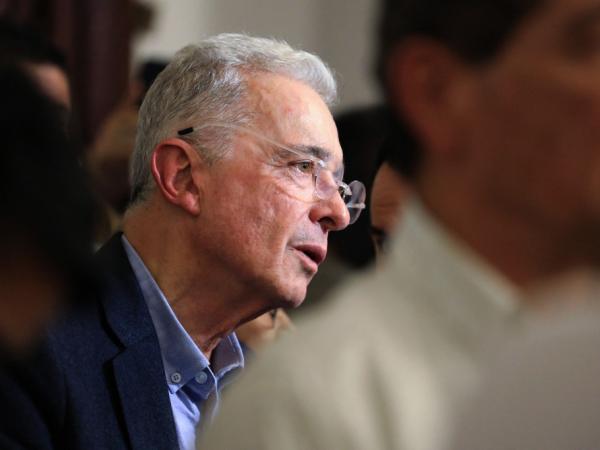
Colombia will know on Tuesday the ruling that will define whether the influential former president Álvaro Uribe must pay or not pay 12 years of house arrest for manipulating paramilitaries into denying their relationship with these bloody anti-guerrilla squads.
(Read more: Petro, to apologize for comments about female journalists, after the Court’s ruling)
A judge sentenced the former president (2002-2010) in August to the maximum possible sentence for bribery and procedural fraud, in the final stretch of a case that made him the first former president in the history of the country to be criminally convicted and deprived of liberty.
According to the first instance ruling, the 73-year-old leader of the Colombian right-wing put pressure on imprisoned paramilitaries so that they would separate him from his organization, responsible for massacres, disappearances and other atrocities in the midst of the armed conflict.
After spending twenty days in house arrest, the former president defends himself in freedom protected by a decision from a Bogotá court. Uribe’s defense appealed the sentence and Now that same court must decide whether to ratify it, with or without modifications, or whether to annul the conviction.
The most high-profile judicial process of the century in the country began in 2018, when the Supreme Court began to investigate Uribe for his links with paramilitaries after complaints from the left-wing senator and now presidential candidate Iván Cepeda. The imprisoned former paramilitary Juan Guillermo Monsalve became a star witness after recounting how a lawyer for Uribe tried to bribe him.
Courts of Bogotá and Cundinamarca
(Read more: Public investment in the country continues to lag behind: it does not reach 50%)
The lawyer Diego Cadena offered Monsalve benefits to change his testimony, but he recorded it with a camera hidden in his watch. The Colombian justice system sentenced Cadena to seven years in prison house arrest for bribery in the same network.
Uribe has always denied links with paramilitaries and maintains that his judicialization is the result of persecution by the left, in power under the leadership of President Gustavo Petro. But His name appears in at least three more investigations for the founding and financing of a paramilitary group, several massacres and the murder of a human rights defender. They are all in the hands of the Colombian Prosecutor’s Office.
If the conviction is ratified, Uribe and his legal team will be able to escalate the case with an appeal to the Supreme Court. The court will first study if it is valid and in such case the resolution could take months or years. Uribe is very popular for his fierce hunt against the guerrillas during two consecutive terms.
However, authorities recorded serious human rights violations at that time, such as the murder of thousands of civilians at the hands of the Army, presented as guerrillas killed in exchange for benefits.
(Read more: Recovery without foundations: economic activity shows signs of life, but not recovery)
AFP