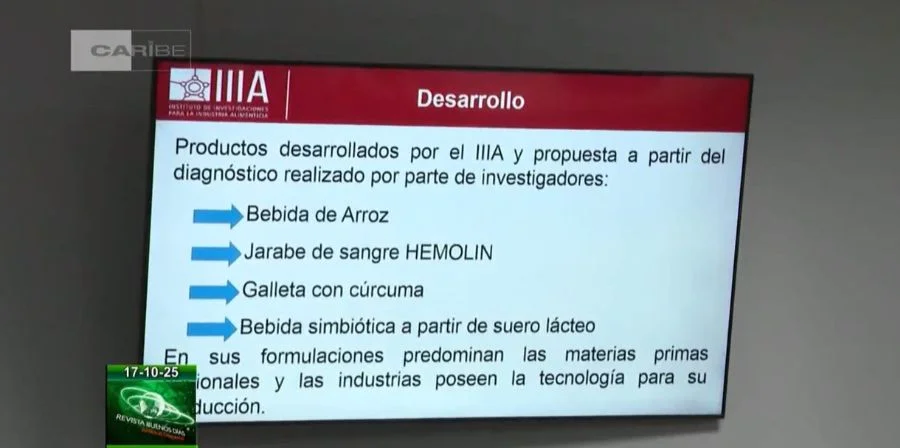
“Rice drink”, “cookie with turmeric” and “symbiotic drink from whey” complete the new menu devised by the Cuban regime.
MIAMI, United States. – Officials of the Cuban regime presented this Thursday “new proposals for nutritional supplements” for nursing homes and grandparents’ homes, during a session of the Government Commission for Attention to Demographic Dynamics headed by the Prime Minister, Manuel Marrero Cruz.
Among the “new proposals” developed by the Research Institute for the Food Industry (IIIA) – as could be seen in the images of a report broadcast this Friday in the informative magazine Good morning―, “rice drink”, “HEMOLIN blood syrup”, “cookie with turmeric” and “symbiotic drink from whey” appear.
The announcement drew immediate criticism. Cuban journalist José Raúl Gallego noted on Facebook that, “surely, grandparents Raúl Castro and [José Ramón] Machado Ventura are not fed rice drink or blood syrup. Those do eat meat, fruits, milk. But for our old people, what there is is this,” he lamented.
The report of Good morning specifies that “several proposals for nutritional supplements and foods were presented, mainly for the elderly, whose introduction (…) will have nursing homes and grandparents’ homes as priority.”
The food situation of “vulnerable people”—including older adults—has been documented by independent media. In September 2025, Cuban Diary reported that in soup kitchens in Santiago de Cuba the typical menu was “rice and soup or soft drink,” with insufficient portions and an expensive system for pensioners.
Although this Friday’s television report did not publicly detail the formulations of each “supplement”, it does fit into a trajectory of “substitute” or low-cost products that the Cuban State has promoted or developed in recent years:
In Cuba, for example, there is research and pilot production of probiotic drinks made with whey, with reports on an industrial scale in Granma and physical-chemical and microbiological evaluations published in the Cuban Food and Nutrition Magazine.
Regarding the “rice drink”, Cuban researchers reported in 2023 the development of a “chocolate drink” based on rice flour, “aimed at feeding the elderly”, work disseminated by a Cuban academic magazine (CITECAL).
Furthermore, the official Cuban press has reviewed Since 2022, the use of formulations that combine wheat flour with cassava, pumpkin and rice to expand offers of bread, cookies and pastries in Sancti Spíritus in the face of the wheat shortage.
In 2023, the newspaper Granmaofficial organ of the Communist Party of Cuba (PCC), reported that the “first comprehensive moringa powder plant” on the Island was ready to produce, intended—among others—to meet nutritional and industry needs.
The combination of accelerated aging, inflation and shortages has pushed authorities to “substitute imports” with alternative or low-cost products, several of them of low protein value or unusual in the Cuban diet.
Until now, Cubans have had to hear about food proposals based on moringa, ostrich and jutía meat, curieles, cassava flour, potato and melon peels, “decrepit chickens” and “white bone croquettes”.
Therefore, it is not surprising that in March 2022, when the Radio Guamá station published an article highlighting the “nutritional value” of cockroach milk, Cubans’ alarm bells will go off.
From moringa to “white bone croquette”
One of the solutions that would supposedly put an end to food insecurity on the Island is due to the late Fidel Castro, who proposed moringa as a panacea for all ills. However, the population never fully accepted moringa, and farmers who tried to grow it lost time, effort and investment, without achieving the results promised by the authorities. Even in 2018, the Cuban regime believe the Science, Technology and Innovation Entity “Sierra Maestra” to materialize Castro’s ideas on food security.
Another controversial initiative was the promotion in 2019 of the consumption of ostrich and jutía meat by Commander Guillermo García Frías, who assured publicly that the ostrich produced “more meat than a cow,” which immediately generated ridicule and memes on social networks. In the midst of the serious food crisis that the country was going through – and still going through – Cuban Internet users described the proposal as “offensive.”
In 2020, the Minister of the Food Industry, Santiago Sobrino Martínez, defended the use of “decrepit chickens” and the reuse of two million meters of beef and pork intestines for the production of croquettes. Nephew assured in the official program Round Table that this practice was not typical of poor countries, but rather reflected a typical use of “developed countries.” However, this generated strong rejection from the population, who considered the proposal “humiliating.”
More recently, in July of this year, participants in the III Provincial Workshop “Recycling to avoid contaminating”, held in Camagüeypresented the initiative to produce “dough for croquettes with white bone (canilla)”. The event focused on the so-called “circular economy”, a model promoted by the Cuban authorities to address the shortage of food and raw materials through recycling and reusing waste.
Likewise, other similar initiatives were highlighted: the “Raúl Cepero Bonilla” Packing Plant, from Camagüey, reported on the use of intestines, fats and blood in the production of sausages.