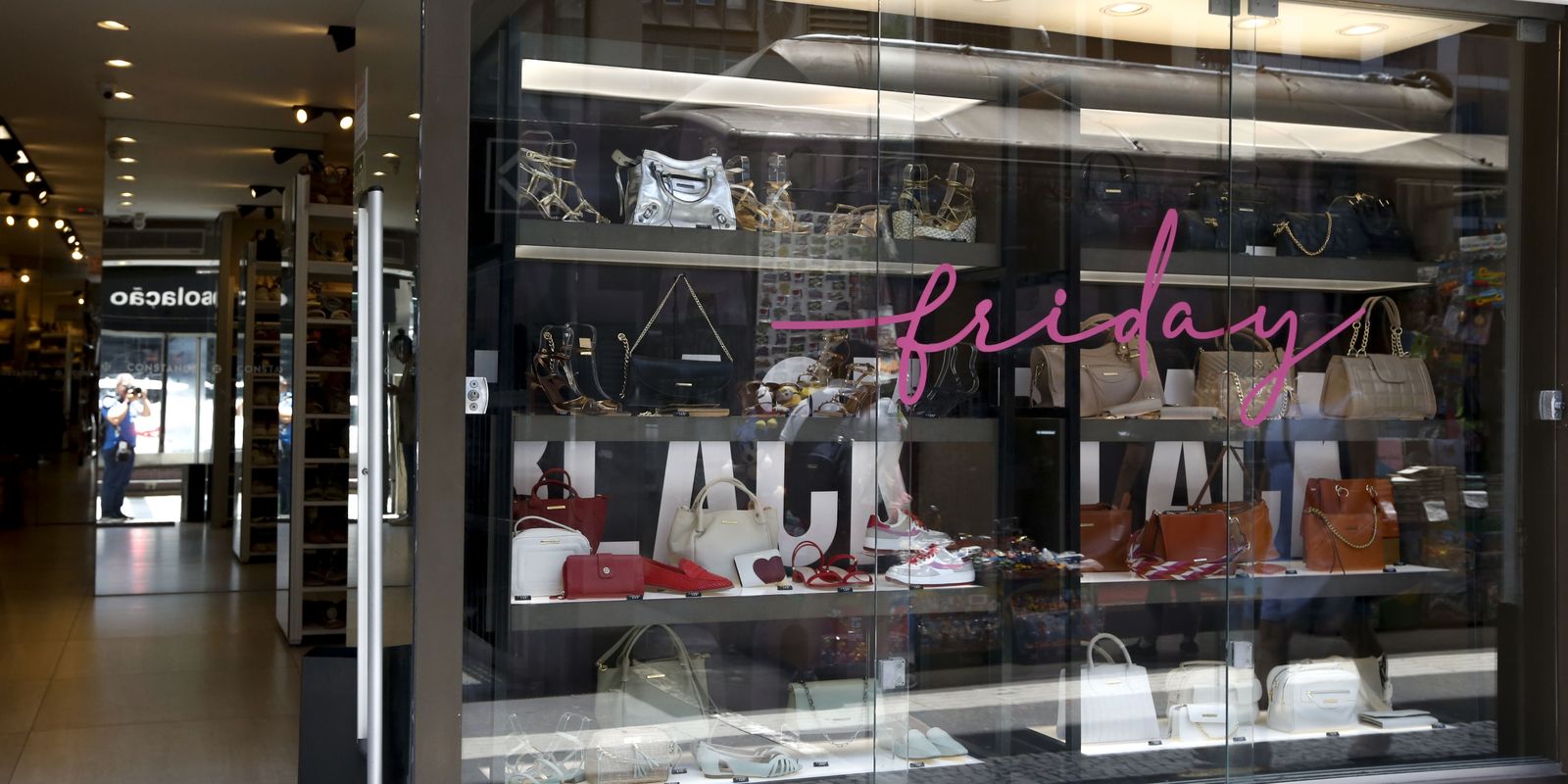
Commerce is expected to receive a record volume of R$5.4 billion with this year’s Black Friday, a shopping season that will be marked by Friday next week (28). The estimate is from the National Confederation of Commerce in Goods, Services and Tourism (CNC).
THE CNC projection represents growth of 2.4% compared to last year (R$5.27 billion), already discounting inflation for the period.
The CNC’s chief economist, Fabio Bentes, explained to Brazil Agency that the research does not refer to a specific day, but to the impact throughout the month of November. “This is a characteristic of Brazilian Black Friday”, he says.
Follow EBC’s complete coverage at COP30
Black Friday is already the fifth most important date for commerce, behind Christmas, Mother’s Day, Children’s Day and Father’s Day.
The sectors that may have higher sales are:
- hyper and supermarkets: R$ 1.32 billion
- electronics and household utilities: R$ 1.24 billion
- furniture and household appliances: R$1.15 billion
- clothing, footwear and accessories: R$950 million
- pharmacies, perfumeries and cosmetics: R$380 million
- bookstores, stationery, IT and communication stores: R$360 million
Influences
When pointing out reasons for the record volume, CNC remembers that the Brazilian economy has experienced devaluation of the dollar (which makes imported products cheaper), loss of strength in inflation and growth in employment and average worker income.
The unemployment rate in the country reached 5.6% in the quarter ended in September, the lowest level ever recorded in the historical series of the Brazilian Institute of Geography and Statistics (IBGE)started in 2002.
On the other hand, the CNC points out factors that prevent even greater growth in sales: the high level of interest and the level of indebted families.
The study cites a survey by the Central Bank that indicates the average interest rate for free credit operations aimed at individuals at 58.3% per year, the highest level for this time of year since 2017.
In relation to debt, the trade representative entity cites its own research that shows 30.5% of families are in arrears.
Another factor that weighs against it is competition with the external sector, through imports. In other words, people who prefer to buy from foreign stores.
Discounts
CNC monitored 150 prices of items from 30 categories daily to measure average discounts. The survey points out that 70% of them revealed “high potential for reduction”, when the price was already showing a downward trend of more than 5%.
The biggest discounts were in the following categories:
- Stationery: 10.14%
- Books: 9.02%
- Jewelry and costume jewelry: 9.01%
- Perfumery: 8.20%
- Household Utilities: 8.18%
- Personal Hygiene: 8.11%
- Fashion: 7.82%
- History
Brazilian Black Friday is inspired by the traditional stock burning carried out by United States merchants after the celebration of Thanksgiving Dayan American holiday always celebrated on the last Thursday of November.
In 2010, according to the CNC, the turnover was R$1.52 billion. At the time, only the furniture and household appliances segments, bookstores and stationery stores and housewares and electronics stores were involved in the event.
Care
The season of promotions and sales appeal is accompanied by traps from scammers and fraudsters, which demands attention from consumers.
The National Consumer Secretariat (Senacon), linked to the Ministry of Justice and Public Security, provides a guide to reduce the chance of being scammed.
Check out some guidelines:
- Be wary of unrealistic discounts: promotions can hide previously inflated prices. It is possible to track and compare the values of desired products over time, using online tools
- Check the store’s reputation: especially on unknown platforms, search complaint sites
- Pay attention to delivery and refunds: check deadlines and policies before completing your purchase
- Prefer secure websites: see if the address starts with “https” and if there is a padlock next to the URL (virtual address)
- Right to regret: online purchases have up to seven days to regret with a full refund
- If you suspect false advertising or feel harmed by a purchase, report it to portal consumer.gov.br or Procon in your state
AI scam
A recent survey published by website Complain Here pointed out that 63% of consumers cannot identify scams with artificial intelligence (AI).
Baptista Luz Advogados, a partner on the website, pointed out some ways to help identify possible scams created by AI:
- Videos and artificial voices, off-beat speech, out-of-rhythm blinks or voices with robotic intonation
- Ads featuring celebrities or influencers in unusual contexts: when a famous person’s face or voice appears promoting something they have never officially announced, e.g.
- Very formal messages, with repetitive phrases or subtle errors in agreement and punctuation
- Professional-looking fake profiles, newly created social media accounts, no posting history or automated comments
- Distorted images or logos: AI still misses small details, slightly different logos, incoherent shadows, oddly proportioned hands or objects in promotional images are clues to digital manipulation
- Communications that simulate human service: chats, emails or messages with agents who appear real but respond in a generic way