In the middle of Avenida Presidente Vargas, one of the main ones in the center of Rio de Janeiro, the monument in honor of the black leader Zumbi dos Palmares dawned this Thursday (20) surrounded by popular demonstrations, such as music and dance. The place is one of the most traditional points of celebration of Black Awareness Day.
Amidst the attractions and speeches of activists and figures from the black movement, a huge buffet sold Afro-Brazilian cuisine. The point of sale was an expression of what entrepreneur Carol Paixão calls the “black economy”.
The concept, also known as black money (in English, black money), consists of a socioeconomic movement of making capital rotate within the black community.
“It’s an economy that drinks from Africanity”, says the entrepreneur to Brazil Agency.
“We are talking about an economy that targets the black population, which aims to employ more black people”, she adds, amidst dishes from South Africa and Mozambique, as well as Brazilian feijoada.
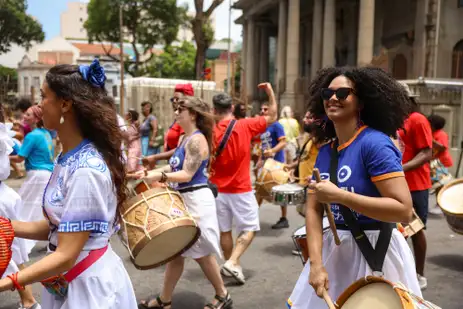
Popular demonstrations in the center of Rio de Janeiro on Black Consciousness Day. In the photo, Tia Ciata’s Procession – Photo: Tomaz Silva/Agência Brasil
Carol is responsible for Kush Empireestablishment in the center of Rio. The name is a reference to an ancient African empire. She explains that the concept of black money it also extends to relationships with other enterprises.
“When we enter into a service provision partnership, we also aim for them to be all black”, he emphasizes.
According to the Brazilian Institute of Geography and Statistics (IBGE), black and brown people experience more unemployment than white women, in addition to receiving lower wages and working more informally.
See the photo gallery:
Repair
In front of the giant bust of Zumbi, the president of the State Council for Black Rights (Cedine), Luiz Eduardo Oliveira, known as Negrogun, points out that the presence, year after year, at the monument on the day of the holiday is a persistence sign.
“We have to have reparations now”, he declared to Brazil Agencyin reference to the damage caused by more than 300 years of black slavery in the country.
Cedine is an instance that brings together state government representatives and activists, like Negrogun.
Quilombolas
Zumbi led the resistance against slavery in a group of quilombos that existed for around a century – where today is the Alagoas city of União dos Palmares. He was killed in 1695.
>> November 20th: find out the origin of the date and who Zumbi dos Palmares was
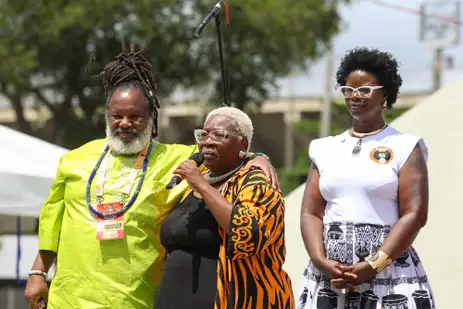
Negrogun, Bia Nunes and Rose Cipriano participate in an event on Black Awareness Day at the Zumbi monument – Photo: Tomaz Silva/Agência Brasil
The need for reparation is a vocabulary present in quilombola communities. According to the IBGE Census, in 2022, there were 1.3 million quilombolas in Brazil, corresponding to 0.65% of the population. Eight out of ten live with precarious basic sanitation.
The president of the State Association of Quilombola Communities of the State of Rio de Janeiro (Acquilerj), Bia Nunes, emphasized the pressure exerted by descendants of quilombo inhabitants.
“Quilombola communities are a reference of resistance within this country. They are men and women who, from their generation, from their ancestry, resist within their territories, dying for the territory, but sustaining and protecting them”, Bia Nunes told Brazil Agency.
“If it weren’t for the original population and the quilombola population, we wouldn’t have the biodiversity we have in this country. That’s what the quilombola territories represent in Brazil”, added the leader who represents 54 quilombola communities in Rio de Janeiro.
Favelism
Writer, philosopher and activist Gê Coelho sees similarities between the resistance of quilombos, during the time of slavery, and current favelas.
“Favelas, in fact, are a fight against State oppression of the poorest, most humble, most peripheral people,” he said, who released the book this year Favelism: The revolution that comes from the favelas.
He contextualizes that the Zumbi monument is about 600 meters from Morro da Providência, considered the first favela in Brazilcreated at the end of the 19th century, to house soldiers who fought in the War of Canudos (1896-1897), in Bahia.

Writer Geraldo Coelho, author of the book Favelismo, the revolution that comes from the favelas – Photo: Tomaz Silva/Agência Brasil
Gê Coelho considers that resistance currently occurs through “disputes in the field of ideas”. He defends the creation of universities within Brazilian favelas.
“Most people who will talk about us will tell a story that is not our story, that is not our reality”, he criticizes.
“We need to have a university, not telling the story from them, but from us, from our knowledge”, he adds.
According to the IBGE, black and brown people make up 55.5% of the country’s population, however they make up 72.9% of favela residents.
Everyone’s fight
At the event, which also included social action such as a vaccination campaign, federal deputy Reimont (PT-MG), president of the Commission on Human Rights, Minorities and Racial Equality of the Chamber of Deputies, argued that “the struggle of black people is not just black people”.
“Of course, black people have the space to talk about the racism they suffer, but we, white people, who understand that this land belongs to everyone, have to be supportive in the fight and make ourselves available to carry out this fight, so that humanity can happen”, he told Brazil Agency.
Invitation to the march
The day of celebration and collection also served for the coordinator of the State Committee of the Second National March of Black Women, Rose Cipriano, to extend an invitation to the popular demonstration which will be held in Brasília, next Tuesday (25).
“We know that to this day the black population suffers the impacts of racism, women in particular. We know about the rates of violence, the lack of representation and that today, in the 21st century, we are still arriving in some places for the first time”, said the coordinator.
“Angela Davis [ativista negra americana] It says, ‘black women move the structure of society’, that’s why we’re going to march for reparation and good living”, she encourages.
The first edition of the movement took place in 2015, also in the federal capital. 1 million people are expected next week.
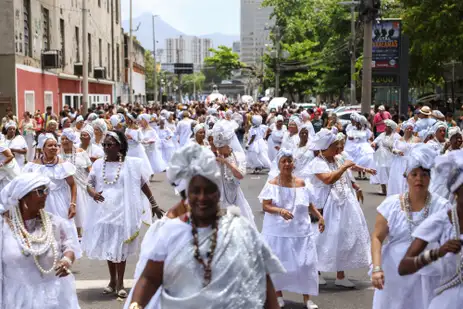
Tia Ciata’s procession runs through the streets of downtown Rio de Janeiro – Photo: Tomaz Silva/Agência Brasil
Aunt Ciata Procession
The streets surrounding the Zumbi monument were a presentation space for the procession of Tia Ciata (1854-1924), a black Bahian woman considered the matriarch of samba.
Thousands of people – from Bahian carnival participants to children from samba schools – formed the cultural manifestation full of references to Afro-descendant culture and a mix of batuques, such as samba, maracatu, afoxé and samba school drums. The mayor of Rio, Eduardo Paes, attended the celebration.
Brazil – Angola
The consul general of Angola in Rio de Janeiro, Mateus de Sá Miranda Neto, gave an international tone to the celebration, remembering that the month of November is also representative for Angola, the African nation of origin of enslaved black people who came to Brazil.
“November for us is a very important month. It is the month that resulted in the great fight we had to wage against colonialism, a fight that led us to November 11, 1975, our independence.”
Like Brazil, Angola was colonized by Portugal.