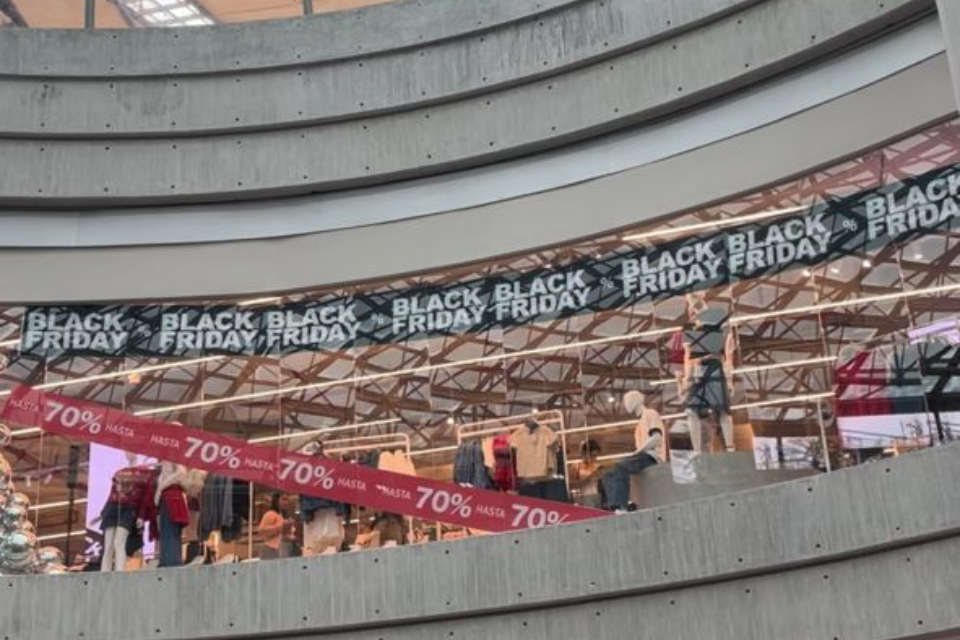
Venezuela is experiencing a Black Friday marked by long lines, aggressive offers and deep social contrasts. Multimax leads the day with discounts of up to 70%, while thousands of people woke up early to take advantage of the promotions
Since the night of Thursday, November 27, thousands of Venezuelans gathered in front of appliance stores and shopping centers in cities such as Caracas, Lechería, Valencia, Maracaibo and Barquisimeto in search of the long-awaited Black Friday offers, promised by several companies through their social networks. The day, traditional in the United States, has become a national phenomenon that marks the symbolic beginning of the holiday season.
“It seems to me that there are stores that still offer genuine and good offers, that people can still take advantage of, unlike those that take advantage of the innocence of customers and increase prices simply to offer a false offer, but you can still buy some things,” said one of the buyers at the Sambil in Chacao.
Richard Ujueta, president of the Venezuelan Chamber of Electronic Commerce (Cavecom-e), reported that current sales are between 30% and 50%, with several stores applying liquidations to their inventory.
Shopping centers announced days with extended hours to encourage purchases, while digital platforms strengthened their logistics due to the increase in orders. Likewise, different brands plan to extend the promotions during the weekend, before the expected ‘Cyber Monday’, an online shopping event that is traditionally the Monday after Thanksgiving in the United States, and will be celebrated on Monday, December 1.
The reality of Black Friday
«The truth is that nothing out of this world. I expected a little more because everything says it has a 40% discount, but everything costs $80. I expected to spend 50, but on things that were worth it,” commented a woman in Caracas.
In the Sambil shopping center in Chacao, there were hardly any queues in some stores, despite the announcements of offers, such as some dedicated to the sale of clothing. The attendance was similar to that of a weekend.
On the Sabana Grande boulevard, where stores must compete with the price set by peddlers, “it was similar to any other day of the week,” said Patricia Lara, who took advantage of some offers in a well-known chain of stores: two shorts for seven dollars each, a belt for $10 and a printed flannel for $15.
Some of those interviewed stated that they had paid with financing applications such as Cashea, while others made their full payments in bolivars at the BCV rate.
On the other hand, a buyer from the Balú store said that “all the discounts are great, because they had a 50, 70 and 30% discount, so I was able to buy with Cashea. The budget was already planned, like 200 dollars.
Contrast with economic reality
While some celebrate the sales, others judge the day as a “commercial bubble,” which does not reflect the country’s economic crisis. Venezuela faces projected inflation of over 500%, accelerated devaluation and geopolitical tensions in the Caribbean. The phenomenon sparked an intense public debate. On social networks, several users criticized that the attendance in certain stores was presented as a reflection of the country’s economic situation, and questioned that images of crowds shopping are used as a symbol of recovery, when many are barely able to cover basic needs.
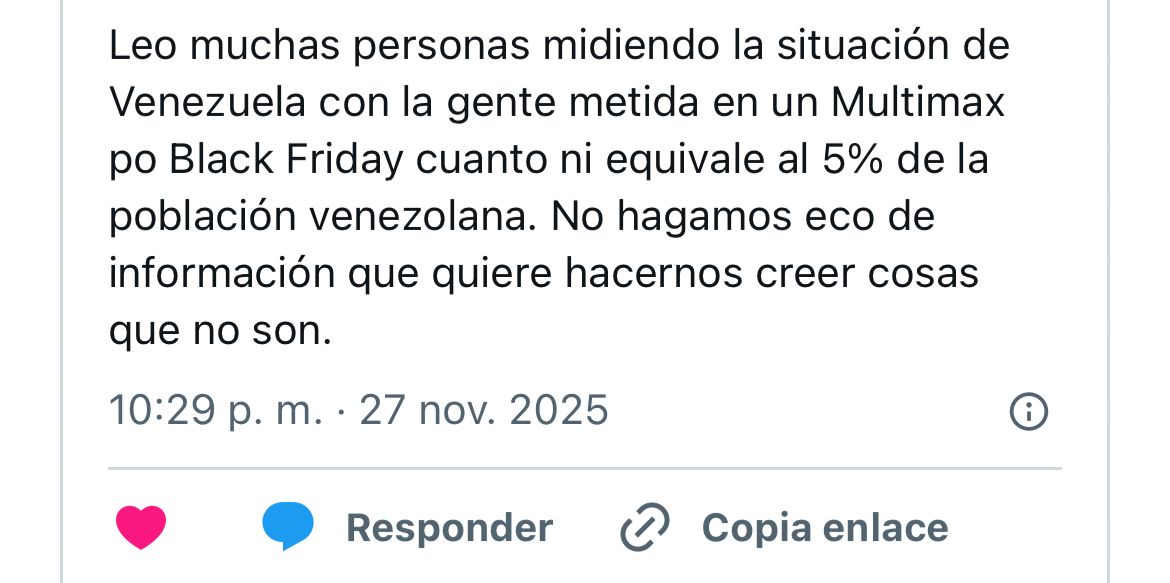
“That does not even represent 5% of the population,” wrote one of them, alluding to the fact that the virality of Black Friday does not hide the loss of purchasing power. Others highlighted the paradox between the images of crowds buying and the inflationary crisis.
“People buying appliances while salaries fade with inflation,” reads another post. There were also messages that stressed that official bonuses, such as the so-called Economic War Bonus, and pensions, are barely enough for food, much less to participate in the offers.

Even so, the commercial sector considers Black Friday an occasion to reactivate sales, but in Venezuela, it not only reveals commercial ingenuity and the desire to celebrate, but also the deep social gaps that cross the country. A day of lights and shadows, where consumption is mixed with hope and contradiction.
*Journalism in Venezuela is carried out in a hostile environment for the press with dozens of legal instruments in place to punish the word, especially the laws “against hate”, “against fascism” and “against the blockade.” This content was written taking into consideration the threats and limits that, consequently, have been imposed on the dissemination of information from within the country.
Post Views: 147