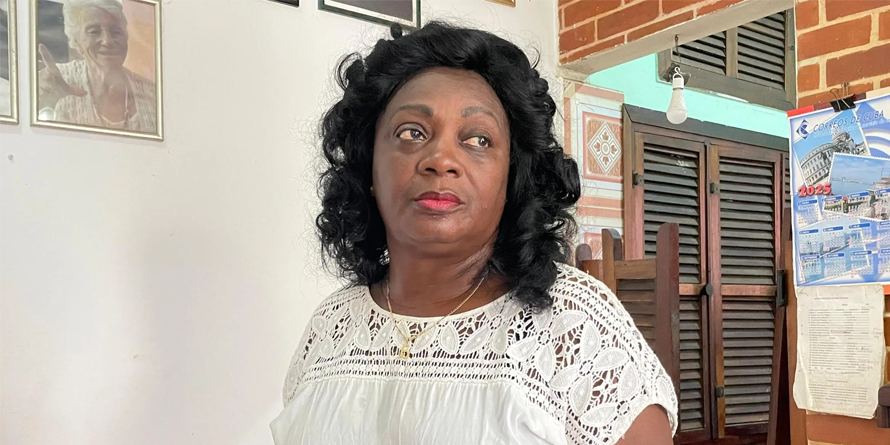
Despite the danger of detention, Cubanet moved to the place and was able to talk with the activist
Havana.- “It is a recognition of 22 years of struggle of the ladies of Blanco, but also 66 years of resistance against the communist dictatorship in Cuba,” the leader of the Ladies in Blanco, told Cubanet exclusively, Berta Soler, After receiving the Solidaridad Lech Wałęsa Awardon the part of Poland.
Soler could not attend the delivery ceremony, which was held at the Biltmore Hotel in Miami and was chaired by Poland’s Foreign Minister, Radosław Sikorski. During the event, the US Secretary of the American State Marco Rubio was also present.
Shortly after the announcement, the organization’s headquarters in Lawton, Havana, was besieged by the repressive organs of state security. The house remains guarded, even with security cameras.
Despite the danger of detention, Cubanet moved to the place and was able to talk with the activist.
Berta, why couldn’t you attend the award ceremony?
I could not be there because the Cuban regime imposes a way out without return, which I do not accept. I stay in Cuba.
We decided then to represent the Cuban-American Foundation, because the organization has been with the ladies in Blanco, leaning on the good and bad. For me it has been an honor that Irma Mas Canosa, a widow of Jorge Mas Canosa, collected that prize. I am very grateful to both Sikorski and all attendees.
Marco Rubio was also present. One of the issues he mentioned was that what I most admired of you was that, despite repression, you had decided to stay inside the island. Why have you decided to stay in Cuba despite the harassment of state security?
I have decided to stay in Cuba, next to my husband, because for me the fight is directly in Cuba. Many men and women are dying in prison and need our persistence and resistance to fight against the oppressor: the Cuban regime.
We would have been out of Cuba since 2010, when the agreement between the Cuban regime and the Government of Spain, with the mediation of the Catholic Church, occurred for the release of the prisoners of the 75 group of the 75 of Black spring. My husband, Ángel Moya, was one of them. But we decided to stay in Cuba.
My only two children live outside Cuba, in the United States. I have grandchildren that I do not know, because the regime, before imposing the exit without return, regulated me, that is, it prevented me from traveling abroad.
It is very difficult to separate my children, but I have to thank them for understanding and for being patients. The love for the country is what makes me stay here.
Cuban Chancellor Bruno Rodríguez Parrilla made a post in his X profile talking about this award, although he did not mention it directly. He talked about the alleged use of the American taxpayer money to finance subversion in Cuba, in reference to the metallic award they received. What would you answer?
Yes. I could not see it because they have me without connection, but they told me.
We do not form any public disturbance, we take to the streets because we have the right to defend the rights of Cubans already demand, in a peaceful way, respect for human rights and freedom of political prisoners and the people of Cuba.
Nor is it an award that comes from the American taxpayer. It is an award that were awarded from Poland; What was done was to deliver it in Miami, but the United States government has nothing to do. There you realize, once again, that these people (who hold power in Cuba) live from the lie.
What do the white ladies that worry the Cuban regime so much?
We are human rights defenders. We only go out on Sundays to assist Mass to pray for political prisoners and for the freedom of Cuba, although they have been preventing it for several years.
Before they allowed us to reach Mass; Then we marched through the streets, dressed in white, some with photos of political prisoners, flowers in the hands, sometimes we distributed brochures with the Universal Declaration of Human Rights. But after the visit of the then president of the United States, Barack Obama (2016), they no longer allowed us to attend Mass, they do not even let us leave our homes, because we are immediately detained.
The regime has used more than twenty repressive methods to dismember, discredit and end the white ladies. Right now we have few women, we are around 38 in the country. Many are sick, others agreed with the regime, others were blackmailed, others decided not to follow health problems, others died, but those that we have felt we feel raised in this fight, which is hard but necessary to obtain the freedom of the people of Cuba.
We also have two white ladies to go out peacefully on July 11, 2021: Sissi Abascal and Saily Navarro. Sissi was sentenced to six years and Saily to eight years in prison. Both have remained firm in prison, despite all the repression, the denial of prison benefits, the lack of medical assistance and the fact that they even locate them with dangerous common prisoners. They have not been able to bend them. Both are very strong, very brave, you have to take off your hat before these two white ladies.

He talked about the repressive methods used by state security with you. Could you exemplify them, Berta?
They stop us for more than 72 hours; Some have been put within hermetically closed patrol cars to have asphyxiation sensation; They also take young children, manufacture crimes and take them to prison; They have brought many white ladies to prison to give up their activism. They pay them to their passages to leave Cuba; The minor children are trying to put hinders in schools to suspend; In social networks they create false testimonies to discredit us.
Some may reach Mass on Sundays, but they are arrested at the exit. They also constantly monitor us, wherever we go, they even film us to get those situations with the objective of discrediting us.
They have hit me. On one occasion they made me a laceration in one eye. They have dragged me, and that has happened to many white ladies. Aymara Nieto was beating while within the police patrol (2018) and was then sentenced to prison. When he almost had to be released, they manufactured a cause again and condemned it again. After more than seven years imprisoned, they gave him the option of leaving the country or being prey, and could not endure anymore. He went out with his family for the Dominican Republic.
And the arrests every Sunday are violent: several women dressed in civilian, strong and higher than me, grab me by the neck, almost suffocating me, and they take me to trail or on the point of feet for the patrol.
But those that we are still firm, fighting and resisting. That is why the Cuban regime attacks us.
After the 11J protests there were many more prisoners than in Cuba’s black spring (2003). However, mothers and wives have not achieved an articulation similar to that of the white ladies. Why do you think it has been so? What would you recommend to the relatives of political prisoners?
The doors of the headquarters of the white ladies are open for all who want to fight against the Cuban regime in a peaceful way. Here are some 11J prisoners, residents in Havana. But they have come only once because state security has threatened them and they have taken fear.
It is a pity that, except for some exceptions, relatives do not protest or go to demand their rights in state entities. It is a pity that in social networks do not denounce what is happening with their loved ones.
The greatest fear is that they told you that he died, who murdered or hit a family member of yours in prison. Some do, denounce, but if they did it in a group it would be much better. That was what the Blanco ladies did; Most of us did not even know each other when they imprisoned our husbands or children in 2003. Very few militated in some human rights group or party. We coincided on trips to prisons, for example, and we decided to leave, unite for pain and love to our families.
I am not saying that those of now do not have love for their families, but that fear has to overcome it because their relatives are unjustly imprisoned and can kill them. There are many who have died, there are many who have been killed.
We have contact with some relatives, but the Cuban regime goes on them and threatens them. The family is the main strength of the political prisoner, so they must go out to defend them. The white ladies come out for all, but it is not the same: that a relative is present has a greater connotation.
We achieve it in 2010, also with the support of the international community, to release our relatives after seven years after bars. Many of them had sentences of more than 20 years in prison. Some had to leave into exile, but others stayed and we have continued with the struggle for all political prisoners.
That is why I call on the relatives of the political prisoners to join, not to shut up, to leave, to disclose what is happening with their relative, that they go to the entities of the regime to deliver complaints, which are raised in front of the prisons, even before the Supreme Court, the Ministry of Justice or the State Council. But do not do it alone, because they will not pay attention to them or it will be easier to repress them.
They do not have to integrate into us, but they can achieve it if they join. We, with our persistence and resistance, we manage to release our loved ones before complying with the sentences imposed by the Cuban regime. They can also do it.