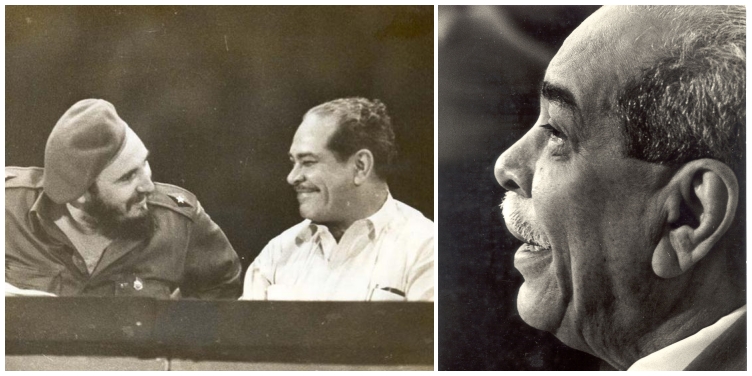
The complaint about the exhibition in Cuba of “defeatist, confusing and immoral” films began a resounding controversy within the communist intelligentsia during the 1960s.
HAVANA, Cuba – In the 1960s and 1970s there was no shortage, also among actors and actresses, of apapipios who unconditionally served Castroism, not only to the detriment of their colleagues, but of society in general, by contributing to it being more closed, intolerant and repressive.
The most extreme cases were Carlos Monctezuma, the comic actor who became a G2 agent infiltrated in an anti-Castro group, or Ana Lasalle, an actress who, more than the talented actress she was, is remembered as a snitch and persecutor, scissors in hand, of long-haired people who were ideologically deviant.
But there were also measles sufferers who, with their extremist statements, serving as reviewers of a supposed ideological and moral correctness, contributed fuel to the bonfire of censorship and prohibitions. This was the case of Severino Puente, that actor who, after being a malt announcer on TV, popularized the character of the Niño de Pijirigua in the 1950s, many years later the pirate Jano Momo and who finally – who would have thought it with that pro-Castro devotion and zeal that he once showed! – emigrated and went to live in New York.
Severino Puente, at the beginning of December 1963, sent a letter to the Clarifications section of the newspaper Todayorgan of the United Party of the Socialist Revolution (PURS), where it complained that “defeatist, confusing and immoral” films were shown in Cuba, such as The sweet life, Accatone, Alias Gardelito and The exterminating angel. Because of that letter we were on the verge of not only being banned in Cuba from North American films, as was already the case, but also much of the best that was being made in world cinema at that time, and we were limited to watching only Soviet films, from the communist countries of Eastern Europe or Chinese war dramas in the style of the one where a terrified North American soldier exclaimed “let’s flee like rats, the glorious Red Army is coming.”
Severino Puente’s complaint was enthusiastically received and responded to on December 12, 1963 by Blas Roca, the veteran communist leader who, in addition to presiding over the PURS, directed the newspaper Today. Roca, despite admitting that he had not seen those films, advocated that they not be shown in Cuba and ruled that “the Accatones nor the Gardelitos could not be the models for our youth.”
The moral and the ideological itches with the Stalinist reek of Blas Roca, they were fired by the dissolute life that Federico Fellini’s film showed The sweet lifethe pimp of Accatone of his compatriot Pier Paolo Pasolini and the tango thief of the film Alias Gardelito by the Argentine Lautaro Murúa. And not only that: he was also concerned and disgusted by the individualism of Michel Angelo Antonioni’s characters in The screamand that many could not understand what Luis Buñuel meant in The exterminating angel.
That motivated an unusual and heated controversy between Blas Roca and the director of the ICAIC, Alfredo Guevara, to which Segundo Cazalis joined, in the newspaper Revolutionon Guevara’s side, and Vicentina Antuña, the Stalinist director of the National Council of Culture, who, on behalf of Roca, wielded the resolution of the First Congress of Education and Culture that had been held in 1961.
In his responses to Blas Roca, Alfredo Guevara, who due to his old friendship with Fidel Castro felt authorized to maintain critical positions regarding the so-called “cultural policies of the revolution”, showed his repugnance for “the Marxism of fears for domestic animals”, accused Roca of “fear of thought” and of feeling “a perhaps deep contempt for intellectuals”, he spoke out against “the abstract archetypes of socialist realism that could compete in unreality and falsehood with the characters of Corín Tellado”, and warned that “art is not propaganda and not even in the name of the revolution is it legal to conceal its meanings.”
The controversy, which became increasingly heated and full of recriminations and missteps, lasted fifteen days, until Fidel Castro asked it to stop. On December 27, 1963 he appeared in Today Blas Roca’s last letter to Alfredo Guevara. Guevara’s response was not made public and remained stored until 2006, when it was collected by Graziela Pogolotti in the book “Cultural Controversies of the 60s.”
The only positive thing about that dispute between communists was that Blas Roca did not get his way of depriving us of the “decadent and deforming bourgeois cinema” and that we could, if not of Hollywood cinema – that would not be possible until 1972 when terrible black and white copies of films like The human pack, The legend of the indomitable and The godfather– enjoy the films of Antonioni, Fellini, Trufaut, Godard, Visconti, Lelouch and Pasolini (despite the resentment of the Castro commissioners for the comings and goings of the Italian Communist Party of the controversial director and writer).
In light of the years that have passed, that brawl to show who was more communist and attached to Fidel Castro’s ordinances may seem ridiculous and boring. But there is no choice but to agree with the experienced television program director Yin Pedraza Ginori when he wrote on his blog regarding that controversy:
“It is illustrative to contemplate that today, in the first line of command, there are no personalities of the intellectual stature of Blas Roca and Alfredo Guevara, with whose approaches one could agree or not, but they revealed a level of knowledge and acuity and an ability to present their reasoning that we do not even remotely see in today’s mediocre leaders.”