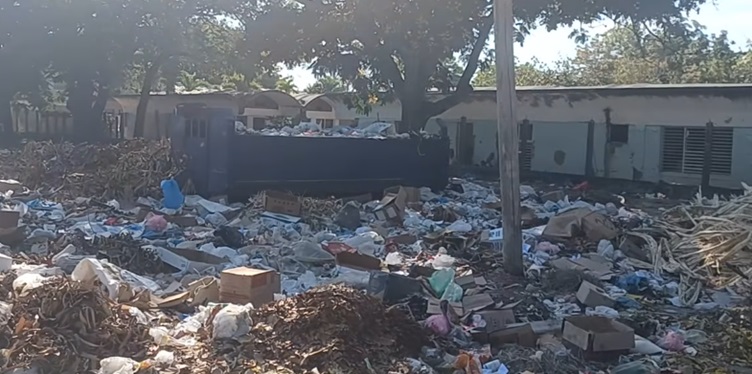
Madrid, Spain.- A few meters from the Mario Pozo Children’s Circle, located on Victoria Street and Captain Urbino Avenue, in the Freedom Distribution of the city of Holguín, an improvised landfill generates concern between neighbors and workers of the educational center. This shows A video recently published on social networks.
The images are eloquent: a strip of about 15 meters long by 5 of width full of waste makes a “natural” barrier between the street and the fence of the area destined for early childhood. Behind the containers overwhelmed with garbage, children play in a focus of pollution and fetidity.
“Where are we going to stop?” It is heard to say to a worker from the educational center, while another points out that there is an invasion of flies that fly from the landfill to the game of the nursery. Despite the multiple complaints made, the authorities do not just implement a sustainable solution.
The garbage accumulation In urban areas it is not an isolated phenomenon. In 2020 and 2021, there were complaints of fires in the landfill that generated toxic smoke clouds. They affected the minors and neighbors of the environment. Also the state weekly Now! He warned about problems in the collection of solid waste in the midst of an “epidemiological situation very complicated by the arbovirosis and the COVID-19”, and mentioned the specific case of the landfill of Victoria Street.
In 2022, the independent medium CIBERCUBA He made a mape of dumps without collecting that extended throughout the city of Holguin. The visual reports showed waste clusters in various parts of the city and the cast of the cast Libertad came out once again.
The situation, far from improving, has aggravated. It has become a direct threat to public health in a city that generates more than 1,620 tons of waste daily and lacks ampirols or vehicles designed for garbage collection.

In addition to the visual and environmental impact, the deterioration in the management of solid waste has led to the proliferation of vectors such as mosquitoes and rodents. In particular, the Aedes Aegypti mosquito, dengue transmitter, represents a high epidemiological risk for the territory. According to Reports More recent, the poor sanitation of common areas, the lack of resources and social indisciplines, are some of its aggravating ones.
In January of this year, the official press Local acknowledged that the streets of Holguín have become “authentic landfills”, which represents a risk to public health. The lack of concrete actions by the authorities reflects a pattern of environmental and social neglect that is still waiting for an answer.