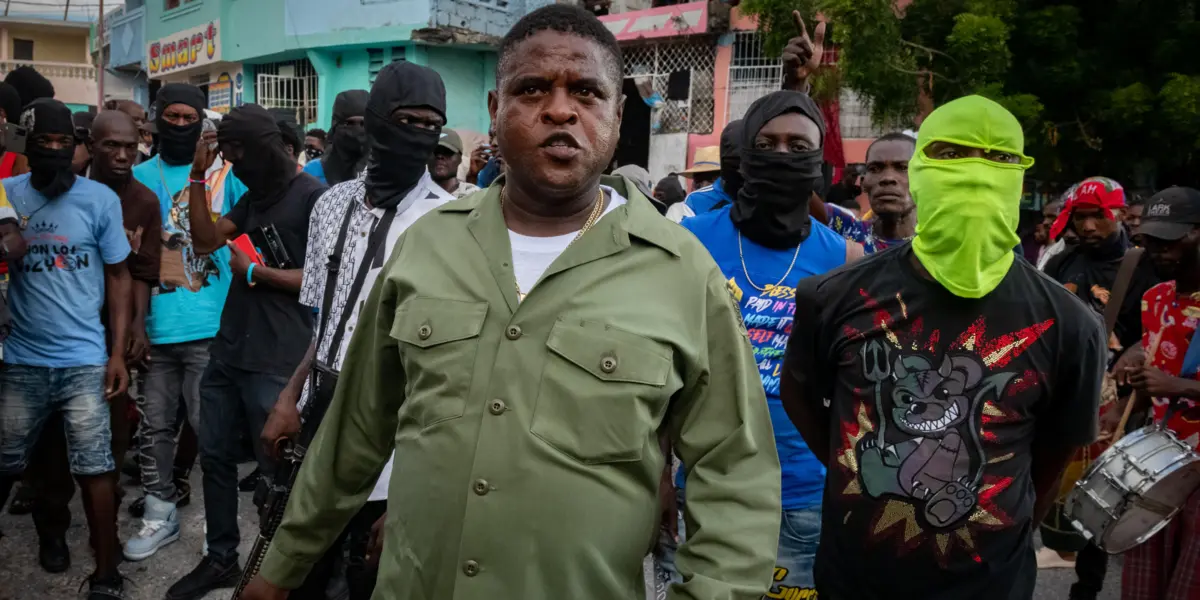
Santo Domingo.- The public absence of Jimmy Chérizier, alias Barbecue, head of the Viv Ansanm criminal coalition, keeps Haiti in suspense.
For just over seven days, the gang leader has not left a trace on social networks, a channel that he used systematically to send messages, justify violent actions or try to wash his image before the population.
Silence occurs after a series of attacks carried out by the National Police Haitian using drones, which destroyed at least three homes in the Delmas 6 sector, identified by local media as part of the Chérizier operational center.
According to the Haitian newspaper Gazette Haïti, the houses were pulverized in broad daylight, in what they describe as a symbolic blow to the territorial power of the gangs in Port-au-Prince led by Barbecue.
Attacks on barbecue celebrated
Sociologist and researcher Danny Shaw, who is in Haiti and reports for the radio program This No Has a Name from Cap Haitien, explained that the media disappearance of Barbecue has been received with a mixture of celebration and prudence by the population.
“People celebrate, but with caution. There is fear that the gang members will reappear with greater force,” he said.
Shaw maintains that, although the operation left an estimated death toll of at least one hundred people, mostly civilians, so far the death of any gang leader has not been confirmed.
“Barbecue is presumed to be alive,” he stressed, while warning that the use of drones and bombs has increased the number of innocent victims without being able to dismantle the criminal leadership.
According to the researcher, Haiti is experiencing an “almost silent war for the hemisphere,” marked by the territorial control of gangs, the trafficking of cocaine, weapons and alleged trafficking of human organs, in addition to kidnappings, rapes and forced disappearances.
In that context, he denounced that such high volumes of drugs could not be moved without the complicity of state or international agencies.
Cap-Haïtien, Shaw explained, has become a de facto “second capital,” while Port-au-Prince remains fragmented by areas under armed rule.
“The gang members represent a dictatorship. No leader can speak openly against them because they may disappear,” he warned.
Shaw also questioned the political motivations behind the operations. In his opinion, the attacks would have a proselytizing nature on the part of the members of the Transitional Council, at a time when the possibility of holding elections on January 7 is being considered.
“There are no conditions for elections. A large part of the population lives in displaced persons camps, many girls are victims of rape, and insecurity is total,” he said.
The sociologist also denounced that members of the Transition Council continue to travel to the United States and manage international resources, while using armed operations to project an image of control and commitment to Washington and other external actors.
In parallel, Shaw warned about a double occupation in Haiti: one foreign and the other paramilitary. He compared the current gang suppression force with the one deployed in 2004, noting the arrival of troops and mercenaries from Caricom countries, Jamaica, Guyana, Kenya and even the presence of US marines.
Finally, he said that social networks have been one of the main weapons of gang leaders. “After massacres and kidnappings, they return to the networks to justify themselves and wash their image. That is why it is so striking that in the last ten days nothing has been heard from Barbecue,” he concluded.