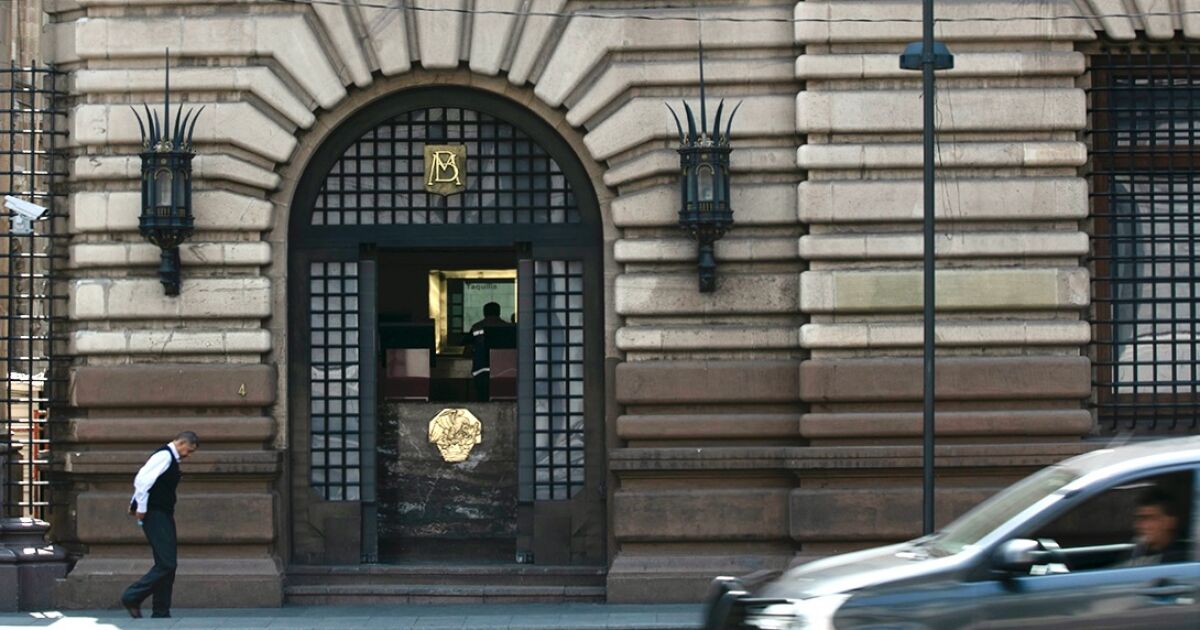
Background, Mexican banking before Banxico
Actually, the idea of creating a Mexican central bank is more than 200 years ago. In 1822, during the Empire of Augustine of Iturbide, the plan of the “Great Bank of the Mexican Empire” was presented, which would have the power to issue tickets. However, the project did not progress.
At the end of the century, by 1884, Mexico maintained a system of “free concurrence”, similar to that of Europe, in which different commercial banks issued its tickets, which caused the lack of uniformity and control in the money supply.
During the Porfiriato, there was a growth and modernization thanks to foreign financial capital, as well as the expansion of private issuance banks, but still lacked a comprehensive system.
This way of carrying the bank was disintegrated due to the development of the Mexican revolution in 1910. In addition to violence and political instability, it referred to monetary collapse and a distrust of the population towards the paper money.
At that time, the need to unify and control the issuance of money was more urgent. The Political Constitution of 1917 laid the foundations for the creation of a central bank. Article 28 established that the only one that could issue the currency would be the government.
Although it was established as a constitutional decree, the creation of the Central Bank was delayed several years. Finally, on September 1, 1925, the Bank of Mexico was inaugurated during the presidency of Plutarco Elías Calles and its Secretary of the Treasury, Alberto J. Pani.
From the Foundation to the establishment of the Bank of Mexico
From its foundation, he was granted the exclusive power to create the currency, mediate the coin of metal parts and tickets. He also had the task of regulating circulation, interest rates and exchange rate. With that weight, it also became a relevant body, financial advisor and banker of the federal government.
However, it was released that commercial banks could be associated or not with the Central Bank.
In this period, one of the most difficult missions was to reconcile the population with the use of paper money, after inflationary events during the revolution.
“The chronicles tell that at that time the scarcity of currency was so great, that a national movement began in favor of the acceptance of the Bank of Mexico, a fact that substantially increased the demand by said means of payment,” says Banxico in its history section.
The subsequent years also faced different changes such as the monetary law of 1931, in which gold was demonized in Mexico and the subsequent obligation of association with banks.
Once the acceptance of the ticket was achieved, it also took care of the service of the Federal Government Treasury and centralized the bank reserves, and subsequently from 1938 credit limits were established.
As of 1935, tickets known as “shrimp” began to circulate, and pieces with less silver, following the crisis of this metal due to its price increase.
In 1941 a new Organic Law was promulgated, which gave the Bank of Mexico monetary regulation and containment mechanisms, during the context of World War II.
Other important events in the history of Banxico are:
1954-1970: Economic growth period with price stability, due to the prudent policy of Banxico.
1974: Creation of the average percentage cost of collection (CPP), a reference rate for bank loans.
1976: Impulse to the creation of “multiple banking” for greater competitiveness to the financial system.
1978: Creation of Treasury Certificates (CETES) for the development of the bond market in Mexico.
1976 and 1982: Banxico had to financial fiscal deficits, which caused two severe crises of payments.
1985: issuance of a new organic law that limits the financing that the Bank can grant to the Government.
The path to autonomy and modernity
The modernization of Banxico began with its autonomy as of April 1994. This faculty granted provides protection to any authority to demand the granting of credit, and the control over the mony of money (bills and coins) in circulation.
According to Banxico himself, autonomy is based on three pillars: its constitutional mandate, a Governing Board with members designated in alternate periods and its administrative independence.
The Governing Board is a collegiate body made up of a governed and four subgovernors, public officials appointed by the Executive, with alternate periods of six years and eight years respectively.
Shortly after the granting of its autonomy, the Bank of Mexico had to face the 1995 payment balance crisis, and together with the Ministry of Finance, they implemented a stabilization program to eradicate inflation gradually.
As a product of the strategy, a scheme called “Inflation objectives (OI)” arose to give myor efficiency to monetary policy and minimize the costs of the fight against inflation. As of 1996, annual inflation goals were established.
Other shares that began to exercise was the purchase of dollars and obtaining credit lines with the United States Federal Reserve and the International Monetary Fund.
What is Banxico’s role in your pocket?
One of the main functions of Banxico since its foundation has been to regulate the national currency, but it is not its only action on the Mexican economy and that directly impacts personal finances:
Control inflation and give price stability. Banxico has the main mission of maintaining low and stable inflation, that is, the value of money and, therefore, of goods and services. It also impacts the cost of credit in the economy, encouraging consumption or investment to maintain prices under control.
Emission and circulation of money. Since 1969 Banxico has its own bills and coins, which are authorized to function the economy. It also removes deteriorated or old pieces from the market, as well as fighting with the falsification of money.
Manage international reservations in Mexico as the dollar. The reserves function as a “safe” in the face of external imbalances such as capital escape or weight depreciation.
Promote a healthy financial system by supervising financial institutions and ensuring their proper functioning. This implies the regulation of credit products, bank commissions and investment options, to protect the interests of the population.
Guarantee the operation of payment systems such as electronic transfers (SPEI), credit and debit cards.
Government banker and lender. As a Federal Financial Agent, he performs treasury operations and acts as a last instance lender for commercial banks with liquidity problems, and thus avoid systemic crises.
Transparency and informationsince it publishes economic and financial statistics, as well as the details of its monetary policy decisions.