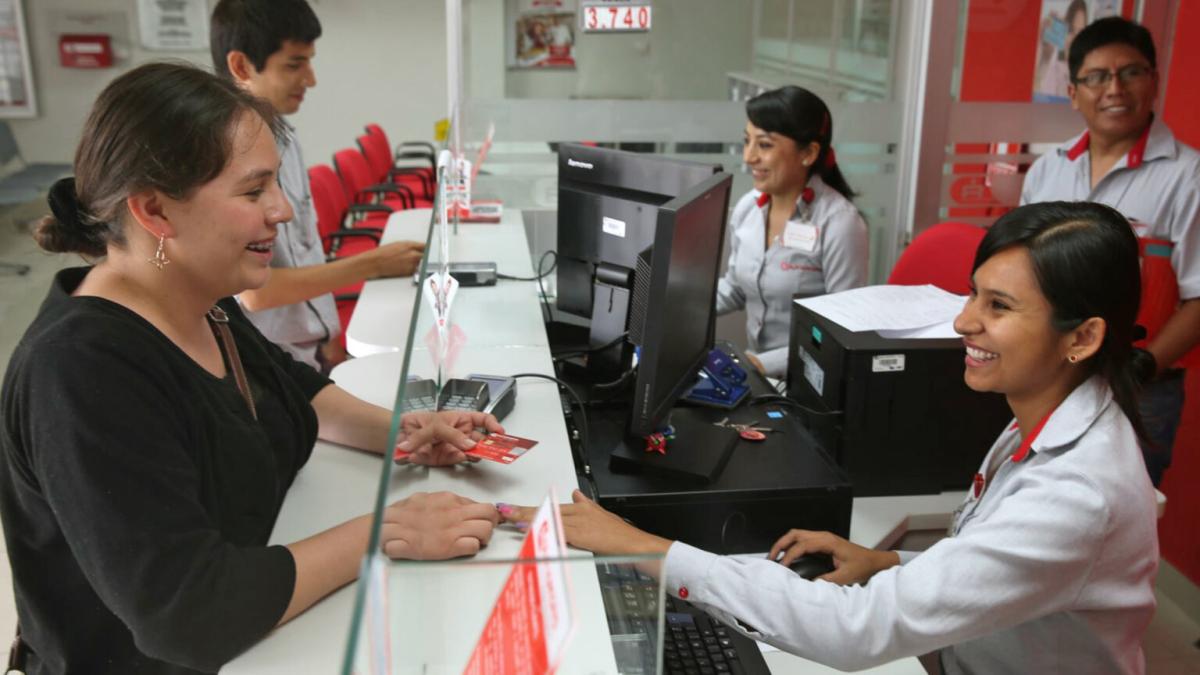
In the last year, the banks and the boxes They have increased their level of capital and profits, have improved the quality of their loan portfolios, and have become more profitable. According to the Central Reserve Bank (BCR)this strengthening achieved by the entities allows them to guarantee depositors that their savings will be safe; have a greater capacity to absorb unexpected losses, and ensure that credit will continue to flow to households and businesses.
“The entities of the financial system show a solid equity position as the reduction of credit risk and the recovery of profitability are consolidated. The comfortable levels of solvency and liquidity remain their main strengths,” indicated the BCR.
“This would allow the system to face adverse macroeconomic scenarios, maintaining its intermediation functions towards the real sector of the economy,” he added in his latest Financial Stability Report.
The monetary authority highlighted that the Peruvian financial sector shows “greater solidity”, associated among other factors with the growth of its profits. As of September, the entities reported profits of S/11,502 million, which represented a growth of 47.6% compared to the same period of the previous year.
Although there are 19 banks, not all of them necessarily surpassed the rest of the entities in profits. For example, among the 19 most useful, in addition to banks, four municipal savings banks and two financial companies participated.
Likewise, as of September, which is the last period in which information is available for banks, the profits of these companies grew 43%. While, as of October, profits in financial companies grew 60.8%, in municipal savings banks 135.7% and in credit companies 88.1%. Rural savings banks stopped reporting losses. This improvement in results is reflected in its equity profitability (profit generated by each sole invested in the equity) as shown in the graph.
Portfolio quality
The BCR added as another cause of the strengthening of the entities the reduction experienced in the risk of non-payment, due to the improvement in the punctuality of debtors, as well as the implementation of more conservative credit policies. He noted that, as a result of the above, the participation of overdue loans, in judicial collection, refinanced and restructured in the total portfolio of the entities, was at its lowest level since the pandemic.
This situation, he indicated, led entities to reduce their provision expenses, mainly on problem consumer loans.
All of this would not have been possible without the favorable macroeconomic environment, the improvement in business confidence, the positive evolution of employment and the low levels of inflation, which had a positive impact on the payment capacity of debtors.
The BCR indicated that this internal context also led to a recovery in loans in all segments, with the most dynamic being especially loans to larger companies. As of September, credit to corporations and large companies grew 10.2%; Financing to medium, small and microenterprises (MSMEs) fell 0.6%; consumer loans increased 7.3%, and mortgages rose 6.8%.
Another notable factor was the large capital surpluses recorded by the entities. According to the BCR, as of September, capital contributions of S/420 million were made and some banks issued subordinated bonds for the same purpose.
Financial inclusion for mypes at risk
A problem that should not be overlooked is the fact that, while the adoption of digital wallets works in favor of financial inclusion, crime is working against it.
According to the BCR, so far this year, loans to small and microenterprises (mypes) have been registering lower growth compared to the corporate and large company segment. One of the factors that would be behind this lower dynamism is extortion.
The Federation of Municipal Savings and Credit Banks (Fepcmac) has been denouncing this fact. The president of Caja Piura, Javier Bereche, has pointed out that crime has generated the dilemma in the savings banks between financially including or protecting their analysts from extortionists.
According to the IPE, as of August 2025, in the districts of Lima and Callao, with an annual increase of more than 100% in complaints for this crime, credits to MSEs have contracted 12%.
Receive your Perú21 by email or WhatsApp. Subscribe to our enriched digital newspaper. Take advantage of the discounts here.
RECOMMENDED VIDEO