Havana/Almost a week after the announcement by the Central Bank of Cuba of the entry into force of a floating rate for the foreign exchange market, in addition to other official quotes, the measure still has not materialized for the majority of Cubans. In Havana, banks do not sell dollars to the population, despite the fact that the rule was presented as a step to “order” the exchange market and bring the official rate closer to the economic reality of the country.
In practice, the only thing that has begun to work is the purchase of foreign currency, and even that operation is surrounded by improvisation, administrative silences and confusion among the bank employees themselves, as he was able to verify. 14ymedio on a visit to several bank branches in the Cuban capital.
“So far I have no news that dollars are being sold to the population under the new rate; what is being done is buying,” an employee of a Banco Metropolitano branch in El Vedado, who prefers anonymity, explained to this newspaper this Monday. According to details, the US currency was being received that day at 401 pesos.
“If the client delivers a large amount of dollars and the bank does not have enough cash in national currency, part of the payment is made by electronic transfer. If the disbursement is made completely in cash, a 3% discount is applied as a tax concept,” says the state worker.
The new rate It was announced by the monetary authorities as a flexible mechanism, subject to adjustments according to supply and demand. The stated objective was to compete with the informal market and capture dollars that today circulate outside the state financial system. However, what happens in the branches is very different from the official story: there are no clear protocols and staff works without instructions precise information on how to proceed.
There are no clear protocols and staff work without instructions
This scheme, far from transmitting confidence, feeds the perception of improvisation. “This entire process of the new floating exchange rate of the dollar has been implemented without notice or prior preparation for banking staff,” summarizes the worker. “We have not received any guidance on how we are going to do it if we sell dollars, if we are going to give them in cash or by electronic transfer. We even had a meeting yesterday at our bank and the issue of selling dollars was not even touched on.”
The uncertainty is repeated in other branches of the capital. In the bank located on the ground floor of the Focsa building, also in El Vedado, an employee confirms that the order, for now, is only to buy foreign currency. “We ourselves have doubts. Now what all the banks are doing is collecting. That is, buying the dollar,” he explains. Although he assures that the sale will come “at some point,” he acknowledges that there is still no official instruction that allows dollars to be offered to the public.
The worker also confirms that the rate of 401 pesos is already being used in other financial operations. “Those who have an MLC card, now when they make an operation from Transfermóvil to the national currency, the exchange rate used is that. And you earn there in cash.” If this is confirmed, then it would be a sign that the BCC is trying to consolidate the freely convertible currency again, as the rapid rise of this virtual financial instrument on the informal market quotes board published every day by the site ‘El Toque’ seems to indicate: at the end of October it was worth barely 200 pesos per dollar and is now at 350.
The design of the sales mechanism, when it is finally activated, also raises questions. According to banking sources, MSMEs will receive dollars exclusively through electronic transfers, not in cash, a decision in line with the chronic shortage of banknotes in state coffers. For individual clients, a combination of cash and transfers is planned, although “that is when they approve it,” clarifies the Focsa employee. For now, the panorama is an asymmetric scheme: the bank buys dollars from the population, but does not sell them.
The BCC reported a new banking channel so that the non-state sector can buy foreign currency in the official market. “Requests will be made from commercial banks and through the fiscal account, without handling cash,” the brief information note clarifies. “The limit will be up to 50% of the average gross income of the fiscal account in the last quarter,” the text adds.
/ 14ymedio
As for individuals, this note clarifies that the limit of $100 per person will continue and that the cumbersome and ineffective Ticket shift system will be maintained in the 41 sales offices.
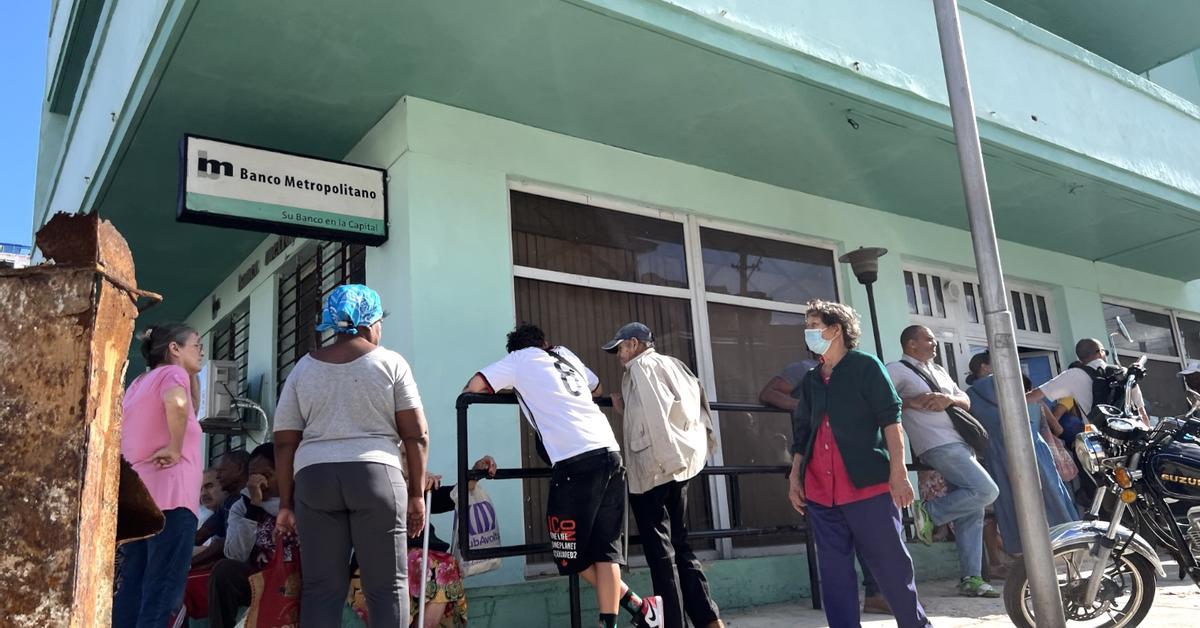
Outside the Focsa bank branch, the emergencies this Monday, however, were different. The long queue to collect the pension or try to withdraw cash from ATMs monopolized the customers’ anguish. Every time an employee stuck his nose in the front door, a barrage of questions rained down on him. The doubts ranged from the store’s operating hours on the upcoming holidays to the question of when they will start selling dollars.
Informal money changers, for their part, seem to be beginning to react after days of paralysis and uncertainty following the official announcement. “He who buys dollars in my neighborhood I hadn’t accepted them for about a week but it has already started again and has set them at 420 pesos,” a young resident of the municipality of Guanabacoa explains to this newspaper. In private businesses it is common for employees to accept the US currency at the informal exchange rate and even buy it.
The Touch reports that the dollar is exchanged this Tuesday at 440 pesos in the informal market, where the fula It continues to circulate with greater agility and without taxes or cumbersome procedures. For many Cubans, handing over their foreign currency to the bank—with registration of personal data and without certainty of being able to buy it back—does not seem like an attractive option at the moment.
“I had 100 dollars saved for Christmas and I preferred to exchange them with an individual who has a cafeteria on my block,” says a neighbor from Cotorro. “They priced me at 425 and that worked out better than with the bank and without even having to show my ID card,” he adds. However, he will avoid selling the remaining US currency “until the waters level out.”