By Lourdes Moreno Cazalla, Nebrija University
“What I feel goes beyond myself. It’s for those who came before me and went countless yards so I could come in and score a touchdown…”
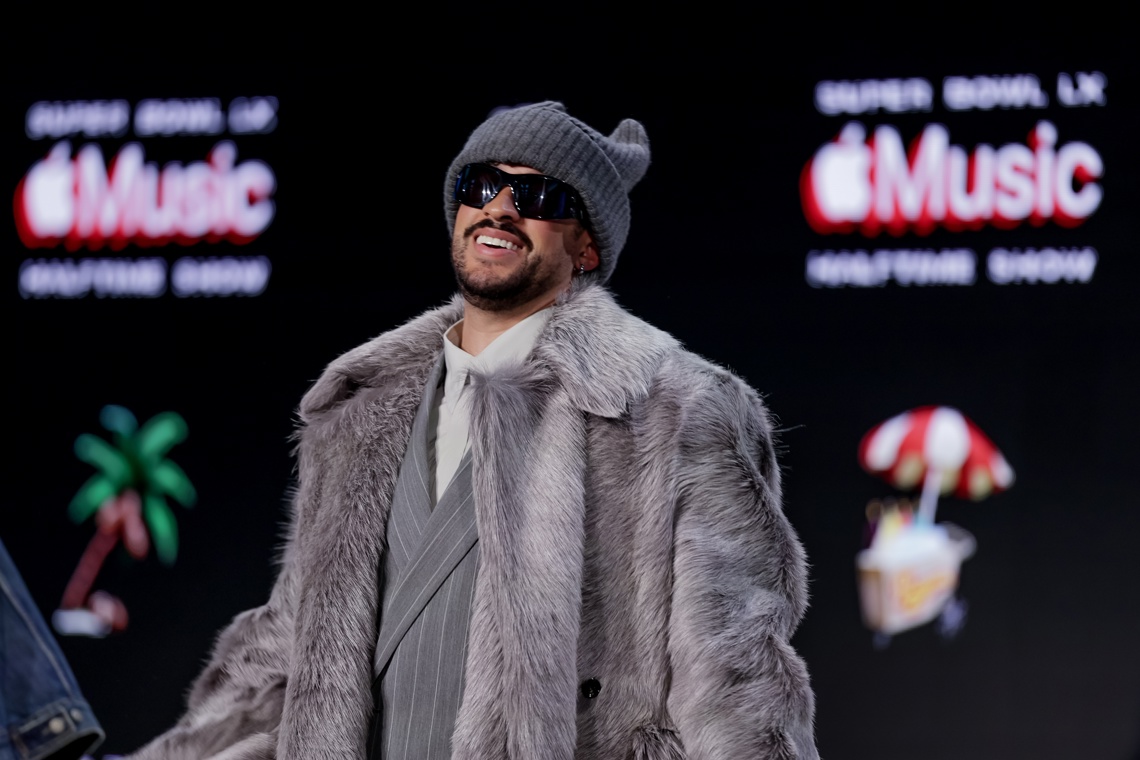
With these words, Bad Bunny confirmed in September 2025 that he would be the artist in charge of the Super Bowl halftime show. The reference to “those who came before” does not point to an individual career, but to a shared history. To accumulated trajectories, to previous presences that made that moment possible.
And, above all, to a language like Spanish, which for decades has occupied a paradoxical place in the United States.
United States is the fifth country with the highest number of Spanish speakers of the world. However, it is the only one of those five where this language is a minority compared to the dominance of English. That is, although Spanish has been omnipresent in broad American contexts, such as in work, music or the daily lives of many people (more than 43 million, according to the 2023 census), it has also has been a language carefully depoliticized in spaces of national representation.
In the United States, one in five people is of Hispanic origin, but, for example, only 6 of its 100 senators share that origin. The Spanish is audible, but it is contained.
A hidden language
Bad Bunny, Puerto Rican and, therefore, Americanhas already announced that his concert will be entirely in Spanish. That this year’s Super Bowl sounds in that language is not just any cultural fact. This event is one of the most relevant national rituals in the United States, a stage where a certain idea of the country is represented and normalized. In this context, the emergence of a language other than English cannot be read as a neutral gesture.
What meaning does this have then?
The answer is not simple, but the fact is powerful and symbolic. 78% of Americans ages 5 and older speak only English at home, according to an analysis by the American Community Survey (ACS) Data Center of 2023 from the Census Bureau. The remaining percentage is divided between those who speak English very well, but do not practice it at home (14%) and those who do not speak English well.
Also, Spanish in the US. It is a so-called “heritage” language.which is spoken mostly in homes and is subject to the dominant language. Thus, in Spanish-speaking homes, as they are being born more generations, the heritage language is becoming diluted in favor of English.
In this context, it must also be taken into account that, since March 2025, following an executive order from Trump, English has been declared the official language from the United States, something that had not been determined in the almost 250 years of the country’s existence.
This “officialization” is accompanied by a deliberate reduction of public services, which progressively eliminates most information that is not in English and seeks to reinvest that money in programs to learn to speak it. The effects they are already being visiblesuch as the closure of the version of the White House website in Spanish or the portal LEP.gov.
Spanish before the world
While official state channels restrict the use of Spanish, sports and music They now give it a visibility that goes beyond the US borders.
The Super Bowl halftime performances have become a cultural event with great international projection. So they were for superstars like Michael Jackson, Madonna, Lady Gaga, Katy Perry and Usher. This format has established itself as a space for celebrating diverse identities, characterized by productions of high technical standards and strategic collaborations between musical artists beyond pop.
In the 2025 edition, Kendrick Lamar reached the record of 131.2 million viewerseven surpassing the audience of the sporting event itself.
For Bad Bunny it will not be an individual conquest nor an unprecedented experience, since he already participated as a guest artist in 2020 during the performance of Jennifer Lopez and Shakira in Miami. Precisely, it was the most viewed performance in history before Kendrick Lamar, and, according to YouTube data, the official video of that show is he halftime show most viewed on the platform.
What impact can Bad Bunny have?
Bad Bunny has acquired leadership in the global music industry that cannot be considered temporary.
He just won the Grammy for Best Album of the Year by I SHOULD TAKE MORE PHOTOS and on Spotify has managed to be on four occasions Top Global Artistwith more than 27 million recurring listeners. The figures have made him the artist who has obtained this recognition the most times, ahead of figures like Drake or Taylor Swift.
The entire catalog has already exceeded 19.8 billion global views, which represents an average of more than 60 million views. streams diaries. Translated in terms of time scale, listening consecutively to all the reproductions generated by the Puerto Rican in 12 months would require more than 124 thousand years, a magnitude that illustrates the distance between this type of phenomena and the conventional cycles of musical success.
The National Football League (NFL) does not ignore these numbers and, despite the rejection that the singer provokes in the US Government, seeks to appeal to the Latino audience thanks to his participation in this year’s Super Bowl. But the question is not what Bad Bunny can do for the NFL, but what the artist’s exposure in this global event can do for the Spanish language.
According to data from online language learning platform Preplywithin 24 hours of announcing that he would head the show After the Super Bowl halftime, searches for “Spanish classes” from the United States increased 178%. Searches for “Bad Bunny lyrics in English” also increased by 366%.
These figures function as an indicator of a phenomenon that is reconfiguring Latin culture and the Spanish language and that does not seek to please political or institutional desires. And here the Super Bowl offers itself as an intermediary, acting as a mirror.
Lourdes Moreno CazallaDoctor in Communication. Author of the study for the Nebrija Spanish Observatory “The boom of Latin urban music and the expansion of Spanish on a global level”, Nebrija University
This article was originally published in The Conversation. Read the original.