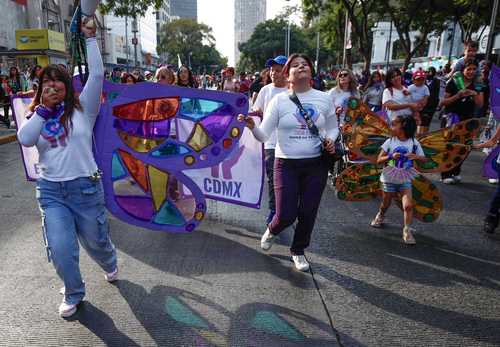
▲ The 25N march, as it passes through the Glorieta de las Mujeres que Luchan, on Paseo de la Reforma.Photo Cristina Rodríguez
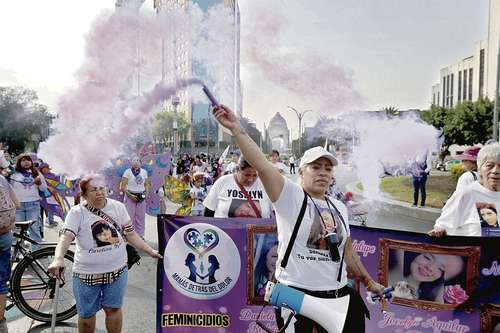
▲ Searching mothers joined the march of the Angel of Independence to the Zócalo.Photo Cristina Rodríguez
Blanche Petrich
La Jornada Newspaper
Wednesday, November 26, 2025, p. 5
In the 11 months that have passed since 2025, in the region of La Montaña de Guerrero, the Tlachinollan Human Rights Center received reports of 15 femicides, six of them occurring in the municipalities of Cochoapa, Copanatoyac and Alcozauca, in a context of a lot of interfamily violence and with aggressors under the influence of drugs, said the organization’s lawyer Neil Arias Vitinio. The agents of the Public Ministry of the region opened investigation folders for homicides or, worse still, as acts that do not constitute crimes.
Therefore, for Neil and her colleagues in the women’s defense area of the Tlachias the advocacy center is known, rooted in La Montaña for more than 30 years, this November 25, International Day for the Elimination of Violence against Women, there is nothing to celebrate. “Because here, where we are and where we work, to access justice you have to have money.”
Yesterday, at the presentation of his report The Women of the Mountain, reborn among the edges of obliviona young woman gave her testimony.
She was given away by her father in a forced marriage several years ago. With two children in tow, the couple emigrated to the agricultural fields to work. Between them they managed to build a house in their place of origin, Juanacatlán, municipality of Metlatónoc. He violated her. When she became pregnant again she returned to town. He followed her, harassed her, beat her and raped her. He stripped her of the common property, alleging that she has a debt with her spouse’s family for the amount they paid for her when “they bought her.”
When the couple appeared before the MP, the agent did not allow her to speak because she was a woman. She only listened to the aggressor husband. The regional prosecutor determined that she must pay the debt and does not have the right to possession of her house. And because she is a woman, she cannot represent herself before the authorities. This happened just a few weeks ago, in 2025, 21st century.
In the 20 municipalities of the region – with a female population of about 215 thousand women, 93 percent from one of the four indigenous or Afro peoples and 63 percent illiterate – there is only one agency for the investigation of sexual crimes and domestic violence. The report reports that, for the entire La Montaña region, with so many remote places and many of them in a context of acute violence, there are only nine agencies of the Public Ministry of the common jurisdiction, six of these concentrated in Tlapa, one in Malinaltepec, another in Huamuxtitlán and another in Olinalá.
There is only one agency specialized in sexual crimes and domestic violence. And no federal Public Ministry.
The report highlights, with statistics, the official under-reporting of violence against girls and women. While Tlachinollan documents 83 cases of femicides perpetrated in the region between 2020 and 2025, the different official reports only account for 16.
Killed for reporting
The report includes 22 microstories that give a name and face to the violence described. Eight are femicides. Two have set precedent in the state’s jurisdiction with sentences for femicides against the perpetrators. One is that of Flor, me’phaa, 23 years old, mother of two girls. Her husband killed her for reporting domestic violence and demanding, as required by law, child support. Thanks to his mother’s tenacity, three years later a 36-year sentence was achieved against Enrique, the first case of sentencing for femicide under the traditional system.
This report includes seven cases of forced disappearances, all of which have gone unpunished. The stories are known because the families went to Tlachinollan to report them. In all cases there are criminal lawsuits. However, strikingly and very regrettably, the annals of the National Registry of Missing and Unreported Persons do not include any of these.
Aurelia, missing
One of these stories is that of Aurelia, a native woman from Cochoapa el Grande, a place that for decades has appeared in statistics as the poorest municipality in Mexico. The story begins with Aurelia, a young woman married to a violent man and mother of three children – the youngest just a few months old – sleeping on the floor of her home with her three children. It is the early morning of April 29, 2020. Suddenly, unknown people burst in and shoot the husband to death. When she, terrified, seeks help at her in-laws’ house, she is accused of the murder. She is beaten by the spouse’s entire family. The father-in-law, who is an authority in the town, ties her hands, tied to a post in the open. They take away your children. When she goes to the Public Ministry in the municipal seat, Tlapa, they ignore her. And when he dares to return to his town to look for the children, his trail is lost. Disappears.
Crime eradicated?
More disturbing is the difference between official figures and those reported by the Tlachinollan report in cases of forced marriages, which has already been classified as a crime in the state. The human rights center has documented 267 girls and women sold to families for the supposed purpose of marriage. Official sources report zero cases. And they maintain that they have declared the crime eradicated.
Seven more stories are told of what is called “forced marriages”, but which is nothing more than a sale of girls and women. The tragedies of Estela, Patricia and Anahí, aged 14, 15 and 16, are similar. Through deception, their parents sold them to two families from another indigenous community. The girls arrived in Tlapa between October and November 2008. They were sent to work as domestic workers, without pay, in two different houses. In one, the boss abused one of the girls. The other was given to a 15-year-old boy for sexual services. The third was found in Tlapa, captive of a man named Braulio, who exploited her sexually and professionally, putting her to work in street trading. In order to return to their families, the parents had to repay the 40 thousand pesos they had received for them years before.