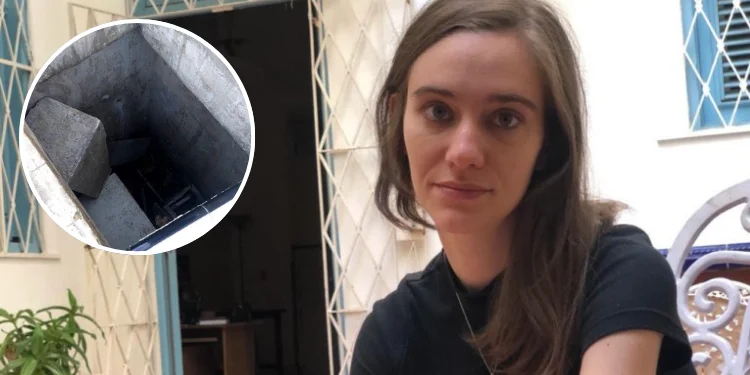
“My family went to bury their last dead in the city’s General Cemetery and to their surprise, the ossuaries or urns of any of our deceased were not there,” denounced Camila Lobón.
MIAMI, United States. – The Cuban plastic artist Camila Lobón reported this Friday on Facebook that his family’s family pantheon in the General Cemetery of Camagüey appeared empty, without ossuaries or urns of any of their deceased, in a cemetery that in recent years has accumulated reports of desecration, looting and abandonment documented by neighbors and independent media.
According to Lobón, his family went to the city’s General Cemetery to bury a new deceased and found that the pantheon was completely unoccupied. “Today my family’s super humble little pantheon in Camagüey appeared empty. My family went to bury their last dead in the city’s General Cemetery and to their surprise, the ossuaries or urns of any of our deceased were not there,” he wrote.
The artist states that she has no explanation for what happened: “I can’t even speculate on the reasons behind this. It doesn’t make sense in the most delirious bureaucratic logic, nor in the most miserable act of looting. They simply grabbed the remains of my family, my grandfather, my great-uncle who was a political prisoner, my great-grandmother Rosa and my great-great-aunt Mercedes, the ones who raised us all, the most important and sacred people for the family, and they threw them away.”
Lobón emphasizes that even she, who does not consider herself religious, maintains an intimate bond with those dead: “I, who have no particular religiosity, nor a fetish with the remains of the deceased, the one I pray to in my hours of despair is that great-grandmother.” He related that for his grandmother and the elders of the family, who do go to the cemetery every year to commemorate their dead, the blow has been devastating.
In her complaint, the artist connected the disappearance of the remains with the daily experience of the Cuban diaspora, marked by distance and the country’s crisis: “And one day you wake up and in the country to which you cannot return, they have grabbed and thrown away as garbage the only deep part of you that remained, your dead. One more symptom of how everything has gone to shit.”
Bones in the air, looted niches and unburied coffins
Lobón’s complaint comes after repeated complaints about the state of the General Cemetery of Camagüey, the oldest operating cemetery in Cuba, founded in 1814 and considered a necropolis of high historical and heritage value.
In December 2024, the independent media CyberCuba collected the testimony of José Morell Rodríguez, who denounced the looting of the family niche in the city’s main cemetery. According to that report, Morell assured that when he arrived at the place he found the lock on the gate forced, the ossuaries open, and missing human remains, including skulls. “What I saw was horror. I have proper documents that prove 10 boxes in the niche, all searched and looted, leaving the remains exposed to the elements,” he declared.
The complainant stated that he went to the cemetery administration and received no response, and that these events were not isolated but part of a pattern of looting that “goes unnoticed” by workers and custodians.
The images and videos released since then by neighbors, journalists and independent organizations have shown a systematic deterioration of the cemetery. The Camagüeyan environment Cuba Time published the report “Death without eternal rest: graves desecrated in Camagüey”accompanied by photos showing open graves and exposed human remains.
The Cuban Institute for Freedom of Expression and Press (ICLEP) has also disseminated cemetery images in which fragments of bones and bags with human remains are seen “exposed, without any protection.”
Only after these images circulated massively, the Provincial Company of Communal Services of Camagüey published a note on social networks ensuring that it was working “with total receptivity” in the “organization and transformation” of the cemetery.
The General Cemetery of Camagüey, located in the west of the city, is considered by specialized sources and by the official local press itself to be the oldest cemetery in operation in Cuba. Historical figures of the region rest there, including Ignacio Agramonte and other protagonists of the wars of independence.