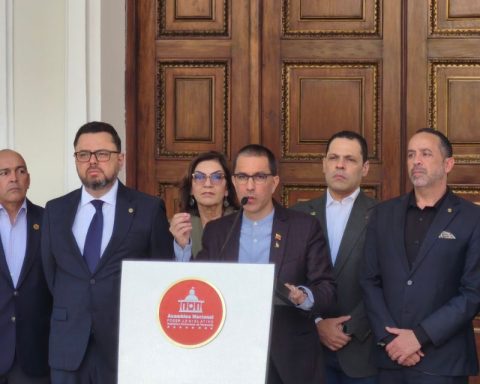
The deputy of the National Assembly Jorge Arreaza recognized that the irregular use of the Law Against Hate led to arrests lacking legal basis. He admitted that there are cases of people who lost their freedom due exclusively to messages found on their mobile devices during random and illegal searches.
Deputy Jorge Arreaza, current president of the Commission for Coexistence and Peace of the National Assembly, publicly acknowledged that the Coexistence Against Hate Law has been the subject of “irregular” applications.
During a radio interview this Tuesday, February 24, the leader of the United Socialist Party of Venezuela (PSUV) admitted that the justice system and security forces have used this legal instrument erratically, which led to deprivations of liberty lacking solid legal support.
“Here the Law against Hate has been applied sometimes very well and sometimes very poorly,” said Arreaza during an interview with Circuito Exitos.
*Read also: Provea: 10 years of Arco Minero leave ecocide, slavery and violence in the south
The parliamentarian placed special emphasis on one of the practices most denounced by citizens and non-governmental organizations: the inspection of cell phones at police and military checkpoints. On this point, the spokesperson declared, after several years of denunciation of this practice by citizens, that “there is no right” to search citizens’ personal devices at road checkpoints, since the action constitutes a transgression of the private sphere if there is no prior judicial order.
According to Arreaza’s explanation, the search of a phone is only justified if the citizen is under a formal investigation or a specific accusation. The deputy admitted that there are cases of people who lost their freedom due exclusively to messages found on their mobile devices during random and illegal searches.
This admission validates the alerts that organizations such as Foro Penal and Provea have systematically issued about the use of technology as a tool of political persecution.
Despite the recognition of these excesses, Arreaza defended the usefulness of the law under the argument of the protection of life. He assured that the State has managed to prevent physical attacks and lynchings motivated by political hatred through preventive charges. The deputy cited examples of messages on social networks inciting attacks on the homes of Chavismo militants, and maintained that in these scenarios state action is necessary to avoid major tragedies.
For its part, the National Union of Press Workers (SNTP) reacted to these statements and reiterated that the review of mobile phones not only violates privacy, but also puts the practice of journalism at risk. For the union, these actions by the security forces violate the right to secrecy of the source, a fundamental principle for freedom of information. The debate on the Law against Hate thus resurfaces in a context where the ruling party itself begins to point out the seams of a system that, in practice, has served to criminalize dissident opinion.
Post Views: 30