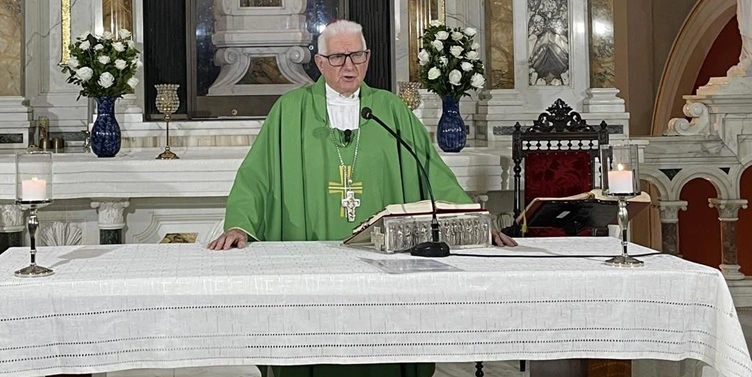
In the Eucharist this Sunday Dionisio García recalled that in Cuba “everything is needed” and asked for a society where the people do not depend on “being given.”
MADRID, Spain.- The Archbishop of Santiago de Cuba, Dionisio García Ibáñez, offered this Sunday one of his most direct interventions on the critical social and economic situation that the east of the country is going through, aggravated by the severe damage from Hurricane Melissa. During the homily and at the end of the Eucharist held in the Basilica of Caridad del Cobre, the prelate spoke of “very difficult times of poverty, scarcity and in many cases of misery,” and stressed that on the Island “everything is needed,” from medicines to food.
In his speech after the mass, the archbishop thanked the gestures of support received after the disaster, but insisted that the material needs of the population are incalculable: “What we need is so much that it cannot be counted.” He added that much aid, although valuable, “is always very limited,” in a context where “everyone is in need.”
Hurricane Melissa devastated areas of the province, especially coastal and mountain communities, and left thousands of families with destroyed or severely damaged homes. García acknowledged that the Church has tried to assist those affected “to the extent of its possibilities,” recalling that Christian communities, despite suffering “so many difficulties,” have gone out to help their neighbors.
In his homily, the archbishop linked the destruction caused by Melissa to structural problems that the country has been dragging on for decades. He pointed out that, in addition to natural phenomena, the people face “difficult situations” that do not come from the climate, but from “an element imposed by us men, who have not known how to create a just society, a society in which we can all […] work for good.”
García criticized the conditions that force Cubans to depend on external aid to survive. In his most explicit call, he stated that society should be organized so that each person can “find all those things necessary” through his or her own work and without becoming “dependent on anyone to give me.” He also insisted that communities must be able to “rise up with their efforts” when facing difficult situations like the current one.
The archbishop warned that many families in the region are “crushed” by the situation, and urged Cubans to support each other: “Today our brothers here in this area are crushed because they see a difficult situation. And we have to help ourselves.” […] to stand up and help each other.”
During the celebration, he recalled that the devastation of the hurricane adds to years of social and economic crisis in Cuba. He stressed that phenomena such as cyclones, scarcity or precariousness should not be interpreted as divine punishments, but as realities that demand human responsibility: “Far from God punishing us with a cyclone […] The important thing is that we know how to recover and build something new.” The prelate concluded by urging us to build a society that does not condemn the population to permanent dependence or extreme vulnerability: “Let us not build falsely. Let us always seek the word of God and his justice […] What remains is the grace of God, God present in our lives.”
A critical stance sustained over time
García Ibáñez’s interventions in recent years have followed a line of open concern for the life of the country. Last September, on the occasion of the feast of the Virgin of Charity of Cobre, he sent a message in which he called on the faithful of Latin America and the Caribbean “to unite in prayer for peace, justice and fraternity in the country.”
In May 2024, he called for seeking harmony and accepting diversity of thought as a path to peace. That same year, during Palm Sunday, he asked the Virgin for “flow, food and freedom,” reflecting the most urgent demands of the Cuban population. But his calls on behalf of the people come from much earlier.
Already in 2017, after Pope Francis welcomed Cuban bishops in the Vatican, the archbishop declared to Vatican Radio that “Cuba was waiting for changes,” and noted that “Cubans […] “We realize that the people can live in better spiritual and material conditions, and that things must change.”
Almost 20 days after the hurricane, the emergency continues
Almost twenty days after Hurricane Melissa passed through the east of the Island—which left more than 90,000 homes damaged and around 100,000 hectares of crops affected— The Santiago de Cuba Electric Company reported that it is still 45% of residents in the province remain without electricity service.
Despite the magnitude of the emergency, recovery is progressing slowly. The international community has announced multiple supports: the UN presented an assistance plan valued at 74.2 million dollars, while its Central Emergency Response Fund released 4 million dollars before the impact of the hurricane as an anticipatory action, although so far there is no public information on the use of that money. The United States offered $3 million and Norway announced a contribution of $400,000.
However, hundreds of testimonies from residents in eastern Cuba denounce that this million-dollar aid is not arriving. They talk about minimum rations, food in poor condition, deliveries conditioned or converted into sales, and entire communities that continue without electricity or drinking water.
The Cuban Government has a historical pattern of opacity in the management of funds and donations, which feeds the citizen perception that a good part of the humanitarian aid is lost within state structures without actually reaching the victims.