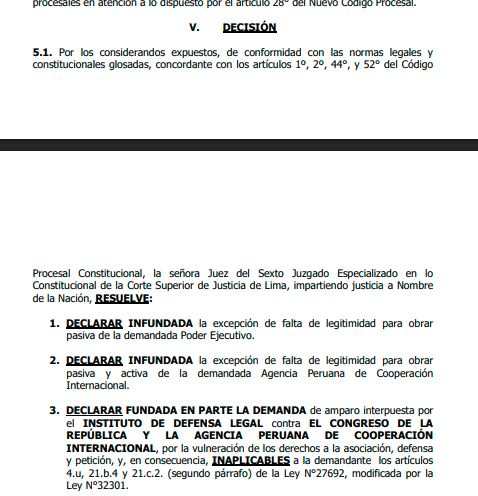
He Sixth Constitutional Court of Lima declared the claim of amparo action presented by the Defense Legal Institute (IDL) against Congressthe Peruvian Agency for International Cooperation and the Executive by the application of the APCI Law (Law 32301). This rule subjects Non-Governmental Organizations (NGOs) to the inspection and sanctions of the APCI of up to 500 UIT for NGOs that provide legal support to people who denounce the State.
In accordance with the resolution in the first instance, Judge Rocío Rabines Briceño accepted the request for IDL to declare articles 4.u, 21.b.4 and 21.c.2 of the aforementioned law inapplicable. With this decision, the IDL You will not have to ask the APCI for permission to execute your projects and you will be able to defend people without resources who denounce the State.
Those paragraphs mentioned indicated that the APCI Its main function is to give prior approval to the execution of plans, programs, projects or activities that the NGO with the budget granted by International Cooperation. Likewise, it was established as a minor infraction to execute said resources without authorization.
As if that were not enough, it was also established as a serious infraction that, if legal advice was given to a person who denounces the State, but does not have resources, the NGO could be fined up to 500 UIT.
YOU CAN SEE: Fuerza Popular, Perú Libre and 8 other parties must be held accountable for the use of S/7 million from the State
According to the IDL, the APCI Law It threatens the right to freedom of association, constitutes an interference in the autonomy of the will of NGOs and promotes prior censorship, whenever it must inform the APCI about the projects to be carried out.
Likewise, the IDL maintains, the norm violates the principle of legality and proportionality with its fines, equality and the right to petition and is incompatible with the State’s duty to protect human rights defenders.
The foundations of the Constitutional Court
The Sixth Constitutional Court of Lima indicated that the mere issuance of the law generates an impact on the fundamental rights invoked by IDL. Regarding articles 4.u and 21.b.4, the judicial body indicated that any prior authorization that determines the development of NGO activities “violates the right of association, even when it does not appear to prevent its constitution.”
Regarding article 21.c.2 – on prohibiting giving legal support to people without resources – the Court highlighted that this would affect the right of defense, as well as the right to petition of the people who support them. NGO they defend.
Executive tried to distance himself from the APCI Law
In June of last year, the Executive – then led by former president Dina Boluarte – tried to distance itself from the APCI Law. In its response to the request for protection, the Presidency of the Council of Ministers indicated that “the questioned norm was issued and prepared by Congress, with only the president proceeding to sign it; therefore, there is no valid procedural legal relationship with its client.”
Despite this, it was requested that IDL’s request be declared inadmissible.
In this regard, the Court highlighted that “it cannot be taken as a simple signature or act of formality” when the Constitution itself establishes the power of the president to present observations on a law.
“The exception of lack of legitimacy to act passively on the part of the defendant Executive Branch must be declared unfounded,” the resolution reads.
On the other hand, International Cooperation said that this rule “does not violate fundamental rights, nor does it configure an arbitrary control system over the IDL.” In addition, he mentioned, according to them, that the “possible sanctions are exercised based on the principle of legality, they are proportional to the legitimate purposes of the State.”
In fact, they also alleged that “the acts do not originate from an autonomous or regulatory action attributable to the APCI” because it was Congress that issued that law. However, the Court indicated that the APCI itself is in charge of executing said rule and that part of the demand consists of ordering them not to apply the questioned rules.
Meanwhile, Congress indicated that, regarding the sanctions established by law, “there is no threat.”