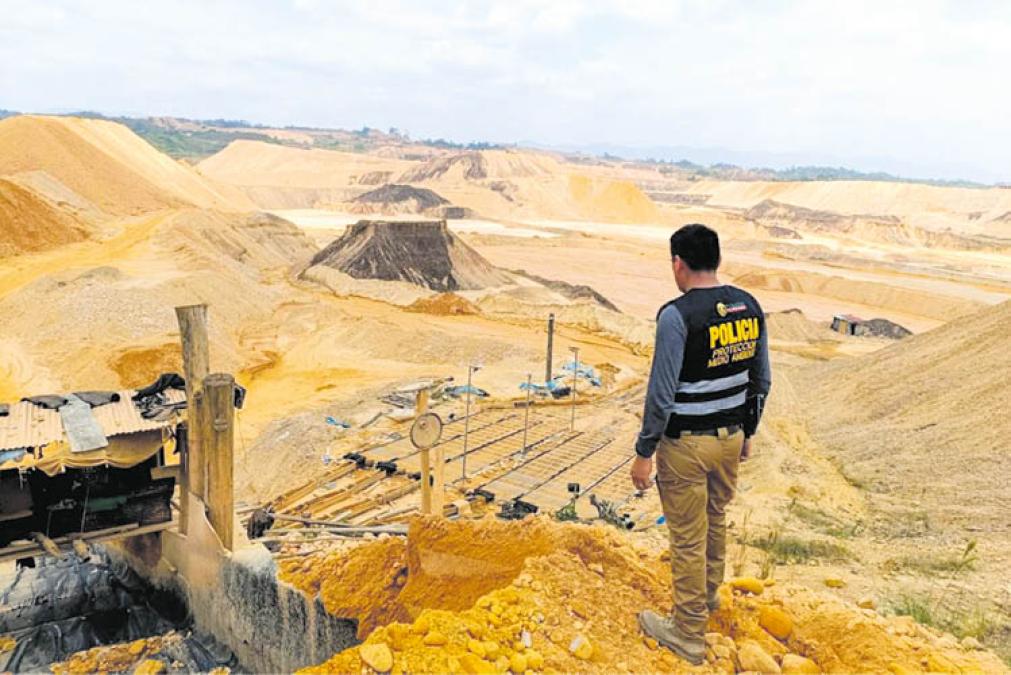
The Government has toughened sanctions against illegal mining. The officialization of Legislative Decree 1695 introduces changes to the Penal Code, which includes an increase in the minimum prison sentence. The norm redefines the criminal framework applicable to illegal mining by modifying articles 307-A, 307-E and 307-F, as well as the incorporation of a new article, 307-G, to the Penal Code, Legislative Decree 635.
Among the main changes, the decree expands the scope of the crime of illegal mining, incorporating into it people who obtain benefits or develop activities linked to this practice outside the law, in accordance with the regulations that regulate mining activity.
Thus, the carrying out of exploration, extraction, exploitation or benefit activities of metallic or non-metallic mineral resources without authorization from the competent authority or outside the formalization process, which causes or may cause harm, alteration or damage to the environment and its components, environmental quality or environmental health, is considered an illegal mining crime. The established penalty is five to eight years in prison, in addition to fines ranging from 100 to 600 fine days.
Those who commit the crime of illicit trafficking of chemical inputs and machinery intended for illegal mining – acquiring, selling, distributing, marketing, transporting, importing, possessing or storing chemical inputs – will be sentenced to prison of no less than six years and no more than nine years and a fine of 100 to 600 days.
The same penalty will apply to anyone who acquires, sells, leases, transfers or assigns use under any title, distributes, markets, transports, imports, owns or stores machinery, knowing that they will be used for the commission of illegal mining crimes.
The rule specifies that this last crime occurs when the mineral resources originate from mining operations outside the comprehensive mining formalization process or when they do not have the administrative authorizations required by law.
Meanwhile, the new article 307-G incorporates the penalty of disqualification from obtaining mining concessions for those found responsible for any of the crimes contemplated in the law, for a period equivalent to the custodial sentence imposed.
Congresswoman Diana Gonzales, one of the most relevant figures in the fight against illegal mining in Parliament, described it as “significant progress” in the fight against this criminal activity.
He also welcomed the imposition of prison for those who acquire or possess minerals from illegal mining and who knew or should have known their illicit origin.
“In this last case, it will be very important for legal operators, such as the Public Prosecutor’s Office and the Judicial Branch, through their jurisprudence, to determine what are the reasonable elements or characteristics that constitute the duty to presume the illicit origin of the mineral,” indicated the legislator and candidate for deputy for Avanza País.
Subscribe for free to the most prestigious Gastronomic Guide in the country. SUMMUM, the weekly newsletter. http://bit.ly/4imAPEI
RECOMMENDED VIDEO