A group of 120 nurses from Ghana will arrive next week on the Caribbean islands of Antigua and Barbuda to reinforce the health system, although the Government assured that it has not yet formally ended the program through which it recruited health professionals from Cuba.
In recent months, the United States has intensified its pressure on Caribbean countries that had Cuban doctors and nurses to conclude these programs.
Members of the Caribbean Community (Caricom), including Antigua and Barbuda, defended Cuban medical missions, vital to their health systems, but were forced to somewhat capitulate to pressure from Washington.
The nurses from Ghana are expected to arrive in Antigua and Barbuda on January 23, the Director General of Communications of the Prime Minister’s Office, Maurice Merchant, told local press on Thursday.
The official specified that most of the health workers will carry out their work at the Celeste Bird Medical Centre, the territory’s main hospital, and others will be in various clinics and schools.
“These Ghanaian nurses are highly qualified,” said Merchant, adding that their arrival will have “a positive impact on the health system in Antigua and Barbuda.”
Merchant indicated that African nurses will help alleviate the burden of their Caribbean colleagues in the absence of more health workers, as professionals from Antigua and Barbuda emigrate to North America and Europe in search of better salaries.
Antigua and Barbuda would have suspended medical collaboration with Cuba, according to local sources
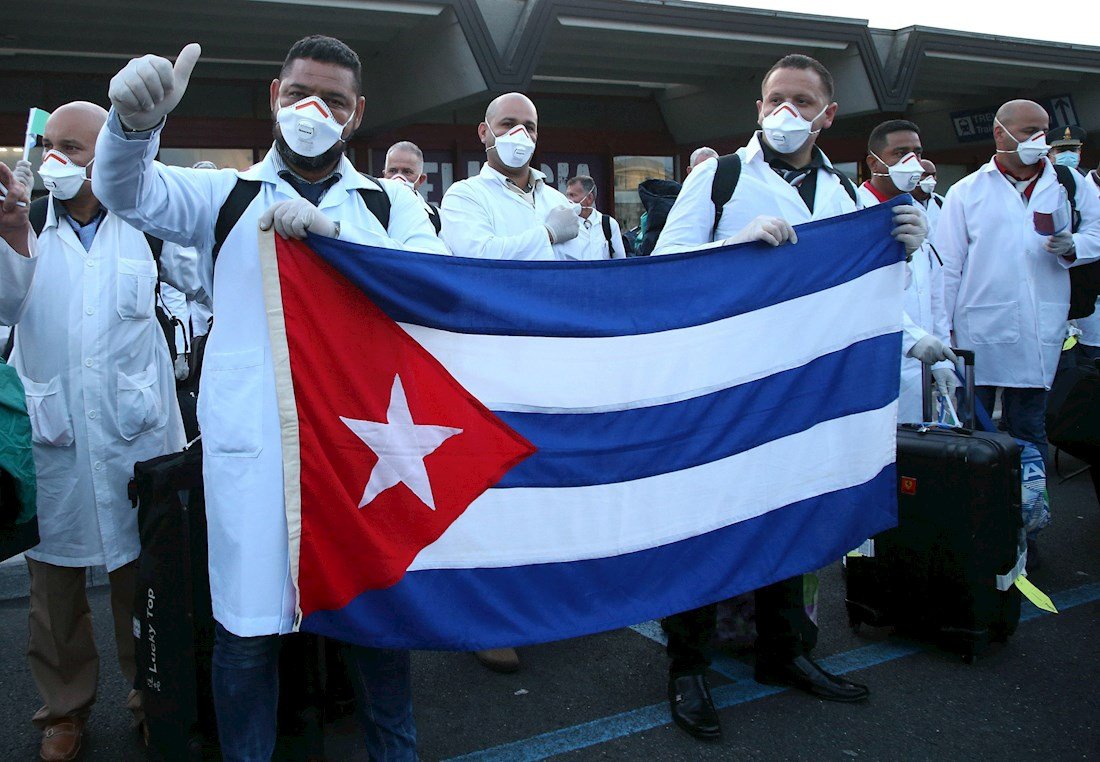
Cuban doctors
Regarding Cuban professionals, Merchant stated that they have been a pillar of the local health system for many years and that the agreement is subject to change but has not been finalized.
“The Government values the contributions that the Cuban Government has made and is making in relation to our health sector and, as in everything, there is a transition period,” he declared without offering further details.
Cuban medical missions have become one of the main sources of tension between the United States and several Caribbean countries, following the measures promoted by Washington against this system through which Havana sends teams of medical personnel to dozens of countries.
According to research by NGOs, the Cuban State retains on average close to 85% of the salaries of these professionals.
The 2024 report on human trafficking from the United States Department of State placed Cuba’s income from the export of professional services between $6 billion and $8 billion, making these missions one of the island’s main sources of foreign currency.
According to the National Office of Statistics and Information (ONEI) of Cuba, between 2018 and 2020 this type of exports represented more than 40% of the country’s total external sales.
In this context, US Senator Marco Rubio attacked these missions, which he described as “forced labor schemes”, and promoted visa restrictions on officials from Latin America, the Caribbean and Africa who hire Cuban medical brigades, as well as diplomats from the island involved in the negotiation of these agreements.